
Your Stories Don’t Define You
How You Tell Them Will
A podcast to unlock your stories and uncover meaningful insights.
Stories of Outdoor Adventures Color Our Lives with Gratitude
Returning From an Adventure with No Toilet Paper Makes You Grateful for the Little Things

Kevin Strauss wasn't born into a family that was outdoorsy. He didn't grow up in a place where it was common to hike for miles, or to go camping in the wilderness over the summer. But at some point in his life, he realized he wanted to reconnect with nature, to explore his adventurous nature and stretch out of his comfort zone. He did something he never thought he'd do, and that experience set him up for a future full of extreme outdoor adventures.

When we think about our lives and how we live each day, we have three concentric circles of our activities and behaviors. The innermost, smallest circle is our comfort zone, and most of us stay in there in the majority of our daily activities. The next circle is about double the size of the comfort zone, and that's our stretch zone. The majority of us spend about 5 percent of our time there on a daily basis. And then there's the huge, outermost circle - our "oh shit" zone. That's the place we avoid as much as possible, totally out of our control and beyond our imagination of our own capacity and drive.
When we take a leap like Kevin did, we stretch that comfort zone out a bit, but more importantly, we stretch our stretch zone out dramatically. What we thought we'd never do, suddenly becomes an option, a possibility.
Being in nature, really out there, beyond easy access to an escape route, we realize a) how little control we really have, and b) how little, in terms of "stuff" we need to survive. Being out there with no toilet, no toilet paper, and no access to prepared food leaves us with a complete understanding of exactly what is a necessity, and what is simply luxury.

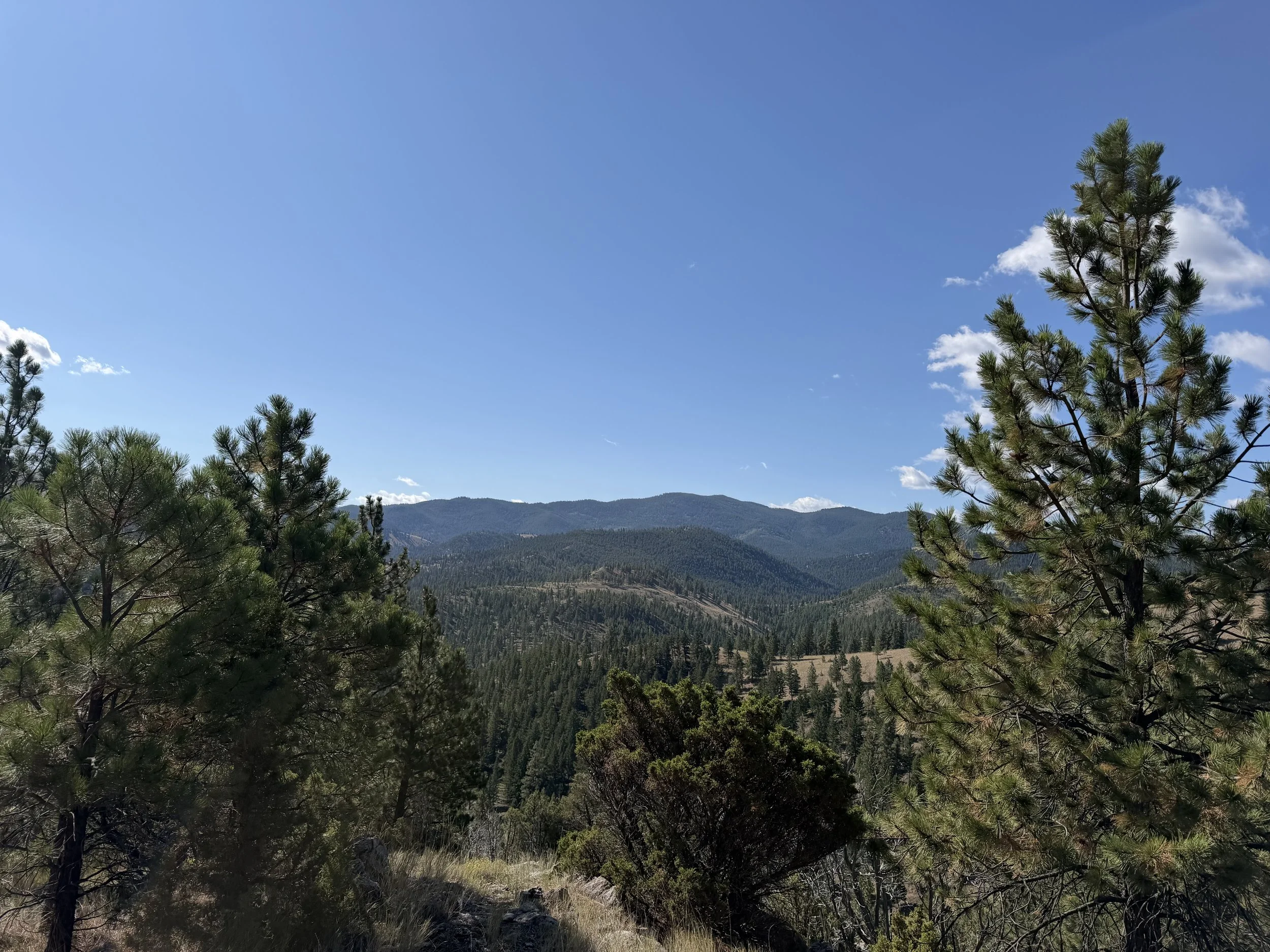
Mount Helena City Park, Helena, Montana
That's when we can connect deeply with ourselves and the world around us. The best part of this kind of adventure is the return to "real" life, when we get to apply the lessons we learn on our adventures. We realize that gratitude changes our lives, improves our relationship with ourselves and others, and helps push us to try new things and set our priorities.
As promised in the podcast, here are a few resources for you, just in case you are inspired to step out of your comfort zone in an outdoor adventure:
Local REI and MeetUps often have trips for beginners, as well as classes
Backpacker.com is a great magazine to get you started and thinking about trips and gear
Backpackinglight.com has a plethora of articles, webinars, podcasts, etc.
Cottage shops for gear often have great articles and resources on their websites, as well as “real life” experiences. Gossamer Gear, Six Moon Designs, ULA, Mountain Laurel Designs, Zpacks. You won’t find this gear at REI or other major sporting goods stores, but you’ll learn about real gear that works.
And here's the other promised link to Kevin's blog post about toilet paper.
---
Kevin Strauss is a 17-year, injury-free Ironman Triathlete and Coach. If you have any question or need help with your endurance events, including backpacking, or if you want to get started and run your first 5K and do it right, visit his website. Learn more about Kevin and his products, Family eJournal and Corporate eJournal, and connect with him on LinkedIn.
Stories Shared Create Safe Space
Nicole Herbig and her partner at REBORN are acutely aware of the different world they're experiencing as a result of growing up not only as digital natives, but at the cusp of another industrial revolution.
Demonstrate Caring Online, Make a Difference Offline
Nicole Herbig and her partner, Maggie Rose, at RE|BORN are acutely aware of the different world they're experiencing as a result of growing up not only as digital natives, but at the cusp of another industrial revolution.
Her story isn't unique in that many young people have experience with mental health issues in their families. But her story is unique in that she sees this online social world for the impacts it's having on her peers, and she's doing something about it.
In this episode, Nicole and I share stories of our experiences with that disconnection our community members are feeling as a result of trying to replace face-to-face relationships with online relationships. In our discussion, we come to the conclusion that when we are intentional and caring in our activities on social media, we can translate that creation of safe space into an in-person safe space.
Toward the end of our conversation, we shared stories about the role music plays in how we connect with our own feelings, and to others around us. I mentioned a song our older son shared with me in his early teen years, and if I hadn't had the realization I needed to be fully present when he shared it, I might have missed an important opportunity to better understand him at that time in his life:
As is usually the case, the story I shared triggered a memory for Nicole, one about how music helped her look past her own discomfort with her mother's mental illness, to reach out to her and work toward improving their relationship:
Nicole's story is one we're going to hear more and more in the coming decades, and it makes me hopeful that younger generations are seeing the digital disconnect and finding ways to leverage these powerful tools to address big issues in mental health.
I write a lot about the disconnect between us and our human nature, particularly related to our dependence on our virtual connections. To read one of these articles, click here.
If you write on topics related to suicide, there are great resources available to make sure you are doing more good than harm. As a relatively uninformed professional on this topic, I use this website, ReportingSuicide.Org as a resource.
National Suicide Prevention Lifeline - Call 1–800–273–8255
Available 24 hours everyday
Nicole Herbig is days away from completing her bachelor degree in counseling psychology at Pillar College in New Jersey - with a 4.0 GPA. She's also full of creative energy and ambition, working to help address mental health issues in a way only a digital native can - using the constantly adaptive tools of technology at her fingertips. Learn more about Nicole and connect with her on LinkedIn, and visit the RE|BORN in its infancy, as she and her partner, Maggie Rose, continue to develop the mission and vision of this innovative project.

It's Hard Work to Decompress
Why couldn't I clear my head? I closed my eyes, trying hard to think of nothingness, to listen intently to the sounds around me, to smell the air and nearby wild flowers.
Even in the most beautiful environment, decompressing doesn't always come quickly or easily.
We took our time getting out of town, knowing it would be light well into the evening and not wanting to get started on our hike while it was still over 80 degrees outside. I had never backpacked into the wilderness for overnight camping, though I had spent plenty of time hiking through the mountains. Gear is important for trekking into bear country, so we made sure we had a can of bear spray and a loud whistle for each of us, good shoes for hiking and crossing streams, a water pump so we wouldn't have to carry too much water, and the right food to sustain us.
It was about 5:30 in the evening when we left the car with our packs on our backs and started hiking into the Scapegoat Wilderness Area in Montana. It was a well-worn trail, lots of horses and hikers have explored the area, and many take the three mile hike in for a day trip to visit the famously beautiful Devil's Glen section of the Dearborn River. It was not too rigorous a hike for our first trip in with heavy packs, and though my pack looked almost as big as I am, it was only around 30 pounds.
It didn't seem like very long before we hit the three mile mark and saw a handful of tents and campers around fires in the meadow above the Devil's Glen. We decided to keep hiking and see if we could find a more secluded spot near the river. Another 3/4 of a mile and we headed down a less-worn path toward the river. Bob spotted a perfect campsite on the other side, so we crossed carefully, found a place to pitch the tent, and settled in for two nights.
The river was loud and full of life; as we watched the sunset, we saw a trout splashing in a large pool on the opposite side of the river, heard grasshoppers and birds, and the droning sound of insects all around. After a simple dinner of freeze-dried convenience with decent flavor, we shared a sip of bourbon from the flask and sat by the river to enjoy the view. My head was clear for the moment, taking in the spectacular pink and orange across the sky.
When we climbed into our little tent and put our heads down on make-shift pillows of clothes, I thought I'd fall right to sleep. The temperature was perfect, the air clean and fresh with a slight breeze through the tent, and I was tired from the day. But as my eyes were closing, I became super aware of the sounds of the night around me, remembering that I was in bear country. It took me hours to fall asleep, jolting awake after incorporating the sound of Bob's snore into a dream about a bear outside the tent. Eventually, I fell into a deep sleep and was disappointed to wake up to the early morning light coming into the tent, and my head full of busy-ness.
I thought that within a few hours of being in the wild mountains of Montana, my head would be clear of my every day activities -- but it wasn't. Despite spending hours wandering through the spectacular wilderness, my head was still stuck in overdrive. I woke as I always wake at home, with my head full of thoughts about what would come next, what I forgot to do at work, excitement for our next musical performance, upcoming travel plans, and thoughts of what our boys might be doing at that moment by themselves at the house.
Why couldn't I clear my head? I closed my eyes, trying hard to think of nothingness, to listen intently to the sounds around me, to smell the air and nearby wild flowers. It must have been more than 20 minutes that I tried to relax back into my sleeping bag, getting more and more frustrated with my inability to simply be there, enjoying the peaceful moment. I finally turned to Bob and suggested we get up, get the food bag from the tree, and get coffee and breakfast.
I've been here before; many years ago I was on my yoga pad at the end of a class, trying to get into the ending meditation provided by the instructor. I was filled with frustration. Every time I focused and dropped myself into the meditation, I'd find my mind wandering all over the place, flitting from one topic to the next. That was the moment, after about 10 years of trying, I realized I didn't like yoga.
That first morning in the woods, focusing on action helped; I was hungry and immediately set off to pump some water for our coffee. I never would have thought flies, especially the biting kind, would be a welcome distraction. But there I was, swiping at the flies landing on my legs and starting up the little burner for coffee, no thoughts buzzing in my head but the need for coffee and oatmeal.
We packed up for a day hike and headed upstream, bushwhacking through the dense, lush forest among wild roses, Indian Paintbrush, elk scat, mushrooms, and dead trees littering the ground. Stopping along the rushing river periodically for Bob to cast his nymph, hoping for a brown trout for dinner, I had the camera poised for my own catch for the weekend. It was mostly quiet, which, in bear country, isn't really a good thing, so I hummed and sang some of the songs we were working on for our next gig. My head wasn't clear, but I was relaxed.
By the time we hiked back out to the car after two nights, I was tired but not exhausted. I felt strong, healthy, and comfortable in my skin, even though I smelled like I hadn't bathed in three days. I unloaded my backpack into the car and opened the cooler we had stashed inside, pulling out my favorite local brew, Lewis and Clark Brewery's Prickly Pear Pale Ale. My head was finally clear.
Driving back through some of the most beautiful landscapes in the country, I turned on my phone to let our boys know we were on our way, and to suggest they clean up evidence of junk food binging. It beeped and beeped as the signal came on to retrieve missed calls and text messages. I wanted to ignore it, but the pull of connection was too strong. I read the messages. I really didn't miss anything. So I put the phone down and didn't pick it up again until we unloaded the car back at our house.
I had no intention of looking at my computer when I got home, and managed to leave it closed until late into the evening when I had to review a document for a client. She was expecting feedback the next day and I knew it just had to be done.
It took me three days to disconnect from my electronic devices and clear my head. That can't be a good thing. I made some decisions that evening, after I closed up the laptop.
- I will set hours of device use from now on: Unless I have a looming deadline, I will not open my laptop between 10pm and 8am.
- Disconnecting is important, so I will put my phone away when I am in a face-to-face conversation, no matter with whom or for how long.
- I will schedule disconnected, outdoor time more regularly and find tools to help me clear my head in a reasonable amount of time and with a reasonable amount of effort.
- As annoying as mundane chores can be, I find that doing laundry, cleaning the kitchen, and weeding the garden are activities that actually clear my head. I plan to stop fighting those activities and try to take them on with the intent to clear my head, as opposed to doing them with the sole intention of accomplishing the actual task.
A lot has been written about humanity's disconnect from nature as a result of our addiction to our electronic devices. That disconnect has wreaked havoc on our ability to safely spend time in nature and effectively connect with people around us. There are far too many recent stories of people being injured and killed in our national parks as a result of our naiveté around wild animals and dangerous areas in nature. If we don't disconnect from screens and reconnect with people, ourselves, and our natural environment, we will lose our ability to connect in any real way with our own humanity.
What will you do to change this trajectory in your life and the lives of your family and community? How will you adjust your patterns to encourage and build a solid connection with the people you love and with the world around you?