
Your Stories Don’t Define You
How You Tell Them Will
A podcast to unlock your stories and uncover meaningful insights.
Episode 116: The Realities of Improving Our Polarized Communities
In 2018, Monica Bourgeau felt compelled to write a book that would help people come to a basic understanding about our common, “wicked” problems, and how to help create solutions. Her October, 2014 article on Huffington Post, “7 Ways You Can Change the World”, continues to grab views, and she was hearing from readers that the article made a big difference for them.
Stories that Offer Hope For Our Polarized Communities Through Understanding and Non-Judgment

Monica Bourgeau, Author of The Change Code
In 2018, Monica Bourgeau felt compelled to write a book that would help people come to a basic understanding about our common, “wicked” problems, and how to help create solutions. Her October, 2014 article on Huffington Post, “7 Ways You Can Change the World”, continues to grab views, and she was hearing from readers that the article made a big difference for them.
Her original plan was to expand on that article, share stories about each of those seven ideas, and make the book not just inspiring, but actionable.
Though her vision didn’t falter, it did shift as she started writing the book. She was introduced to the theory of Spiral Dynamics, pioneered by psychologist Dr. Clare W. Graves, when an announcement was made following a church service as she sat with her daughter one Sunday. There would be a six-week workshop on the theory, which focuses on how our communities develop in terms of self-actualization and community values, and offers a visual representation of why those matter.
Monica was immediately intrigued, though she had never heard of Spiral Dynamics before. She signed up to participate and committed to attending every session, despite her already hectic schedule between work and home life.
Through that program, she started to piece together the relationship between her original article and the concepts of Spiral Dynamics. Over the next few months, she fell deeply into research, interviews, and storytelling around the theory - but what was most important to her was uncovering how to apply it to bring people together.
The key to the theory isn't necessarily to understand each of the waves Dr. Graves describes, but to grow into a sense of non-judgment when considering where people are on that spectrum of self-actualization, values, and motivation in order to connect and collaborate.
It's really about how to adjust our conversations to consider the people in front of us and the environment that shaped them. This is the only way to develop trust and to develop solutions for the complex, extremely polarizing issues facing our global population.
Monica’s book, The Change Code, was recommended to me by my dear friend Andy Hedges, who happens to live near Sydney, Australia, and whom I’ve never actually met in person. We connected on LinkedIn years ago and became close friends despite the distance. When he suggested I read the book, I didn’t hesitate, and I’m so glad for that recommendation. As I read it, I realized Monica was on to something, and I reached out to ask her to be a guest on my podcast as soon as I finished reading the book.
As small-world as it gets, I looked her up on LinkedIn to find that she grew up here in Montana, and that we have quite a few mutual local connections. As we started to chat for this episode, we realized we had even more in common, including an overlap in Fort Collins, Colorado in the early 90s.
Government is Beautiful? It Can Be.
Personal Stories to Challenge Our Perspectives
For a serial entrepreneur to develop a love for government seems counter-intuitive and a ridiculous contradiction, but Jonathon Ende did exactly that.
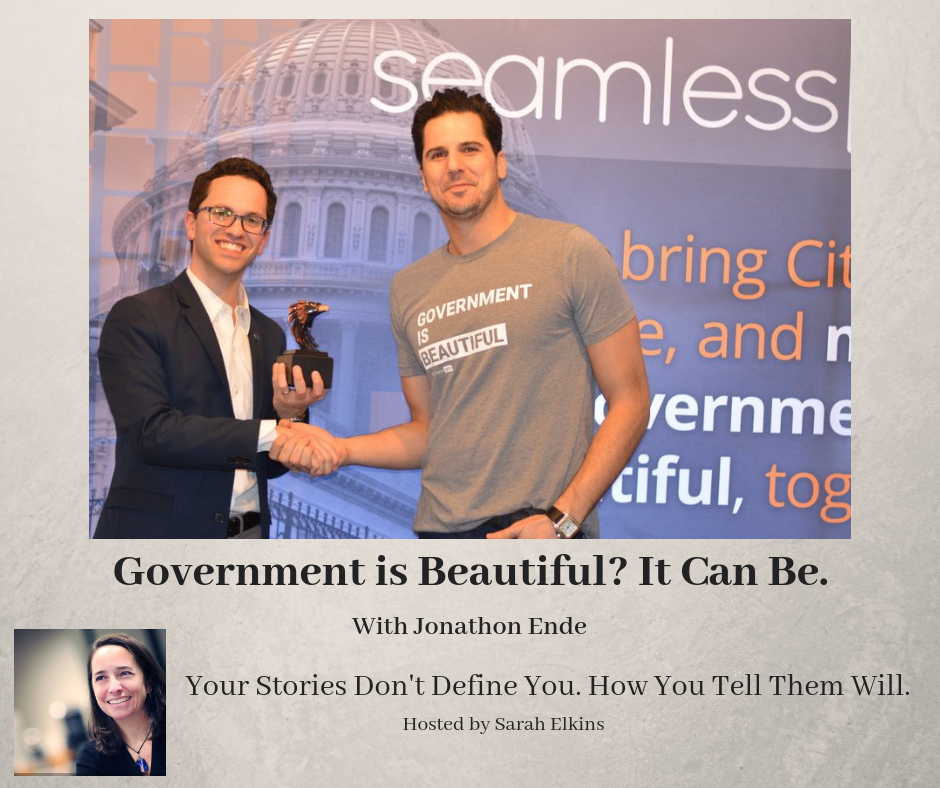
After a few years of focusing his online forms product development and sales on small businesses, he had an enlightening conversation with a government employee who was as enthusiastic as Jonathon was about the potential use of the product.
It was the conversation with this public sector employee that clarified the direction SeamlessDocs would take, shifting its focus entirely from small business to government agencies. All the right things and people came together to confirm his lightning bolt moment of insight about the need and desire for improving interactions among agencies and between agencies and their constituents, and Jonathon was propelled by a new vision and mission.
The motto, Government is Beautiful, is rarely an easy sell to anyone who has ever had an interaction with government, whether that’s at the department of motor vehicles, the post office, or trying to get a permit for a parade or event in a city. And yet, after speaking with anyone at SeamlessDocs, or any of the government employees who have had the opportunity to work with that team and their product, people have a completely different view of their jobs and their governments; some parts of government absolutely CAN be beautiful.
The beauty of government can be found in those public employees who make it their mission to improve relationships with their residents, the ones you don’t see working behind the scenes to make sure your water is safe to drink, the ones who work to meet the complex restrictions on wastewater release into the environment, and the ones who care deeply for their community and demonstrate that every day in whatever role they play in your local government.
Learn more about Jonathon and SeamlessDocs by connecting with him on LinkedIn, and visiting the website. You can read about my early experience with the product in my blog post here.