

Your Stories Don’t Define You
How You Tell Them Will
A podcast to unlock your stories and uncover meaningful insights.
Help Appears When You Least Expect It
He was driving a new, fancy car, living in a beautiful apartment, wearing expensive clothes, and living a life he considered pretty luxurious. So why was he sinking?
Stories of Friendship and Angels in Disguise
When he was struggling in a job that a was a terrible fit, Robert Downs suddenly developed a craving for a burrito - in a city more than 8 hours drive away. He arrived in the city where he had lived before, connected with a couple of friends, ate a burrito, and then drove back.

It took time for him to process the why behind his spontaneous craving, and a few other examples of that kind of behavior, for him to realize he was sinking. He was driving a new, fancy car, living in a beautiful apartment, wearing expensive clothes, and living a life he considered pretty luxurious. So why was he sinking?
Many of us have a skewed version of what we consider success in our lives, especially early in our careers. We seek out happiness based on that skewed version of what success looks like, and when it falls short of making us happy, we think something is wrong with us.
When he finally decided to truly follow his heart - and his familial roots in creativity and art, help appeared. Is it always easy? No, of course not. But when you know you’re doing what you were meant to do, the right people fall into your path to keep you company. And when you have the opportunity to give back into that system of support and encouragement, you take it.
I know you want to learn more about Robert Downs and his life as a photographer. My favorite way of keeping up with this guy and his adventures is his always-insightful blog posts.
You can also follow him on Instagram, and visit his website.
From his website:
ROBERT DOWNS
For many an artist, creativity is in the genes. For photographer Robert Downs that creativity springs from both sides of parental well. His mother was a graphic artist and father was a photojournalist for more than forty years with the Atlanta Journal and Constitutionwhich is where they met.
“I used to beg my father to take me to work with him on the weekends,” Robert remembers. “My job would be to carry all the staff photographer’s cameras to the football field and pick up film at half-time. My reward was I got to use a camera and dump my film in with the rest of the guys. Whether it was or cruel joke, or just fate, my shots started showing up in the paper. I was 13 when I scored the front page of the sports section. It was then I knew that I wanted to be a photographer.”
Over the past 10 years, Robert Downs has sustained that dreammaking a living combining art and commerce with clients ranging from the Los Angeles Times and Sony Pictures to Kaman Music, SKB, Audix Microphones and Gibson Guitars. His work has been featured extensively on covers and editorial spreads for for Drum! and Traps magazines, plus a host of the world’s top drum companies such as Pearl, Gretsch, Tama, Bosphorus and Zildjian. He’s also photographed some of the top musicians and bands on the charts including Incubus, Stone Temple Pilots, Deftones, Tommy Lee, Public Enemy, Hatebreed, Cult, Linkin Park, and many more.
Disruption Through Distraction: Adventures in Fighting Boredom
When Disruption Takes the Form of Self-Sabotage

Tara Bradford had everything going for her business, and the majority of her clients came directly from the video marketing she had been doing for a year. Suddenly, she decided to stop doing the videos. She was bored. And instead of finding ways to change her videos, and exploring other options in addition to the successful video activity, she. Just. Stopped.
This is just one example we spoke about in terms of the choices we’ve made out of boredom and being too comfortable, that ended up taking us in completely different directions - and not always in a good way.
Some of us just don’t recognize when we’re bored early enough to change direction with intention, rather than as impulse. Eventually, though, with enough self-reflection, we can start to see the symptoms before they become overwhelming. That’s the first step. The next step must be to consider our own roles in the scenario. And then? We must make the decision to take small steps toward digging us out of the situation, rather than rushing off into something we’re not really sure will take us where we want to go. Tara’s brilliant strategy was to put herself into situations that a) made her uncomfortable, and b) had her interacting with people and industries she would never have otherwise experienced.
How many times have you made a rash decision because you were dissatisfied, bored, or simply in maintenance mode in your life and/or business? What lessons did you learn from those experiences, and how do you choose to tell the stories so you’re learning from them, rather than being a victim of circumstances?
Tara Bradford helps individuals gain clarity on their goals and objectives, communicate confidently about themselves and their businesses, feel more understood in their professional relationships, and reach a global audience with their message so they can become Best Selling Authors, TEDx Speakers and, if we dream even bigger, Nobel Peace Price recipients.
Visit her website to learn more about what she can do to help you move forward - without those lateral distractions! And connect with her on LinkedIn to keep up with her extraordinary contributions to our global community.
Government is Beautiful? It Can Be.
Personal Stories to Challenge Our Perspectives
For a serial entrepreneur to develop a love for government seems counter-intuitive and a ridiculous contradiction, but Jonathon Ende did exactly that.
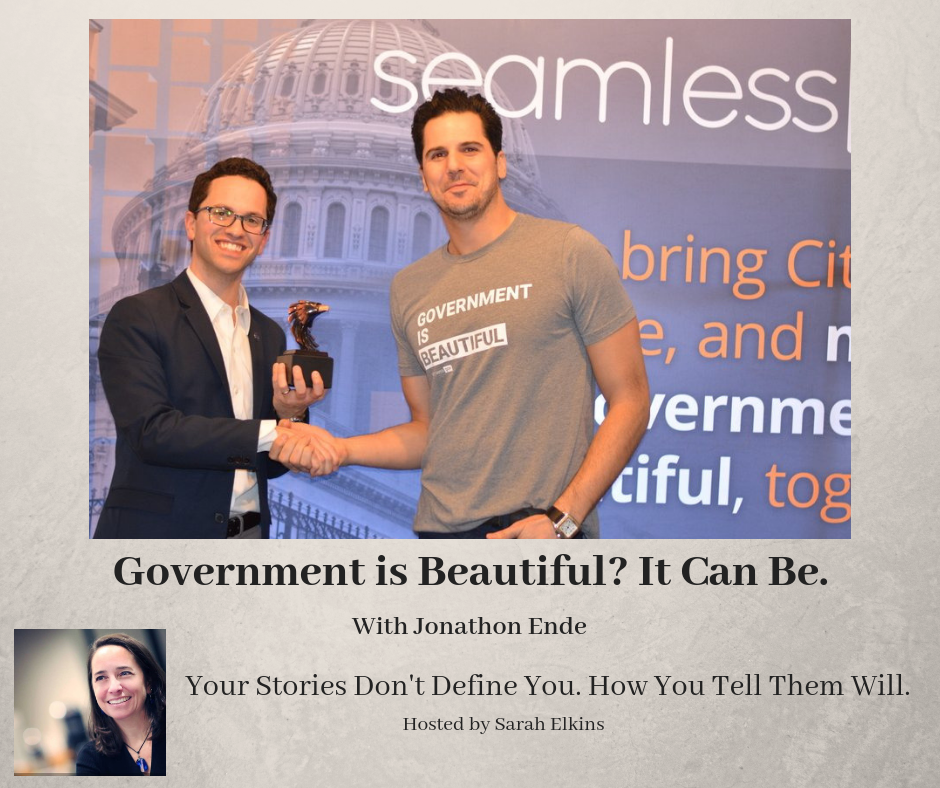
After a few years of focusing his online forms product development and sales on small businesses, he had an enlightening conversation with a government employee who was as enthusiastic as Jonathon was about the potential use of the product.
It was the conversation with this public sector employee that clarified the direction SeamlessDocs would take, shifting its focus entirely from small business to government agencies. All the right things and people came together to confirm his lightning bolt moment of insight about the need and desire for improving interactions among agencies and between agencies and their constituents, and Jonathon was propelled by a new vision and mission.
The motto, Government is Beautiful, is rarely an easy sell to anyone who has ever had an interaction with government, whether that’s at the department of motor vehicles, the post office, or trying to get a permit for a parade or event in a city. And yet, after speaking with anyone at SeamlessDocs, or any of the government employees who have had the opportunity to work with that team and their product, people have a completely different view of their jobs and their governments; some parts of government absolutely CAN be beautiful.
The beauty of government can be found in those public employees who make it their mission to improve relationships with their residents, the ones you don’t see working behind the scenes to make sure your water is safe to drink, the ones who work to meet the complex restrictions on wastewater release into the environment, and the ones who care deeply for their community and demonstrate that every day in whatever role they play in your local government.
Learn more about Jonathon and SeamlessDocs by connecting with him on LinkedIn, and visiting the website. You can read about my early experience with the product in my blog post here.
Our Culture, and How It Colors Our Communication
Using Stories to Uncover Our Deeper Connections

We know innately that when we find things in common with each other, we forge deeper connections, but how do we do that with intention and true curiosity? And how do we make this the first part of communication, the priority, so our discussions don’t immediately devolve into defensiveness and hostility?
Zach and I believe that if we understand our own perspectives, where they come from, what we’re reading to bring us to certain conclusions, and why we trust the resources we trust, we could make a start toward better understanding and appreciation for others’ perspectives.
One key to starting those conversations is simply finding common ground, and that can be found in culture. During our conversation in this podcast, we discuss a less traditional definition of culture; lifestyle culture. Are you a dog person? A cat person? Are you part of the mountain biking culture? Each of us can live in many different lifestyle cultures, which makes it much easier to find common ground.
Zach Messler knows a lot about communication strategy, and he uses own cultural commonalities to strengthen his work.
Connect with Zach on LinkedIn, and be sure to check out his website to learn more about how he can help you develop your messages, your content, to be clear and compelling!
From Zach’s website:
I help entrepreneurs know what to say and how to say it so they make a bigger impact on the world…and their wallets.
So, yeah. I’m on a mission to help entrepreneurs find relevance…and revenue.
Embracing Life Transitions as the New Normal
We are Living in Transition Now, What Stories Help Us Navigate this New Normal?

Kris Macchiarola left the corporate world because her activities there just didn’t align with her core values and priorities. What she discovered after leaving that world is a community of women in varying types of transitions in their lives: Divorce, empty nesting, career changes, priority changes, and a general desire for something different in their lives.
There appears to be three responses to these major life adjustments:
People see an open door and choose to turn back around to the known dynamics of their previous jobs, industries and types of partners, regardless of happiness and fulfillment.
People see an open door and freeze, not knowing which opportunity to take because there seem to be too many options.
People see an open door and leap across the threshold, choosing risk over safety and comfort because there are simply no other options for them.
In this podcast episode, we share some of our own stories of transition, the stories of some of our friends, and some important strategies and thought processes to consider in this changing world of transition.
Kris Macchiarola is a consultant, speaker, leader, and coach. She specializes in helping organizations create a culture where employees feel energized, enabled, and engaged, ultimately, giving them a competitive advantage. She is an EQ champion and specializes in Human to Human. Connect with her on LinkedIn, check out her Patreon profile, and visit her website to learn more.
Giving Thanks When You Don't Have Much to Give
Shiquita Yarbrough is a single mom, which isn’t too unusual these days. What makes her really special is her incredibly generous spirit, and commitment to not only being a positive and active community member, she’s committed to helping her children see the importance of being a productive and kind member of your community.
Family Traditions Build Lasting Stories and Strong Relationships

Shiquita Yarbrough is a single mom, which isn’t too unusual these days. What makes her really special is her incredibly generous spirit, and commitment to not only being a positive and active community member, she’s committed to helping her children see the importance of being a productive and kind member of your community.
After her divorce, she decided to start over again with her three youngest children, the oldest was in college. She researched parts of the US, knew generally what she wanted in a community, and landed in Austin, Texas. It’s not easy to start over, especially with three young children and a full time job. Shiquita found herself immediately welcomed into that community, which if you’ve met her wouldn’t surprise you.
Neighbors, teachers, parents of friends all saw what she was trying to do with her children - getting them involved in the community through sports - and started to offer help with rides to and from activities. As the Christmas season was in view, she thought hard about how to demonstrate her appreciation for all the people who were helping her. Gifts seemed not quite personal enough, especially because she simply didn’t have a lot of money to spend.
But she loves to cook, and people love to eat what she cooks, so she talked it over with her children and they all agreed to host a Giving Thanks dinner the night before Thanksgiving. This would give the family an opportunity to show their appreciation, while leaving the traditional holiday for them to spend the way they choose. That first year her children invited a few friends, teachers, and parents of friends, a relatively small group. But by the last year they were in Austin, it had grown to over 40.
Shiquita’s family Giving Thanks dinner became an important and well-loved tradition, offering all kinds of lessons for her children and her community. Because when you feed people like Shiquita feeds people, you’re not only filling their bellies, you’re nurturing their souls.
She exudes warmth and generosity of spirit, and I was lucky enough to meet her at the Atlanta airport when we were both on our way home.
Shiquita is the Office Manager at the Community Foundation of Boulder County, but she doesn’t end her days there. She’s also on the boards of her local YWCA and League of Women Voters, and has a monthly radio show for single parents. This is one generous member of the community.
30 Minutes Can Change Your Life Plans: A Library Story
A Thoughtful, Persuasive Leader Can Change Your Life in 30 Minutes
He had no intention of working for public libraries when John Spears walked into an interview with George. His plan as he worked through his Masters in Library Science had always been to find a cushy job in an academic library, where funding is rarely an issue.
But in that 30 minute interview, his perspective about public libraries was permanently shifted. George was ahead of his time; he knew the role of public libraries was growing dramatically in the age of mis-information, and that public libraries would be serving community needs in completely different ways in the very near future.
That 30 minute conversation pushed John in a different direction than he expected, and he has spent his entire career in public libraries - and never looked back.
John isn't what you might think of as a typical librarian. The challenges he has faced in life might just be the stories that make him so approachable, and such an incredible role model for perseverance, self-reflection, and personal growth.
John Spears is the Chief Librarian and CEO of Pikes Peak Library District in Colorado. He has been making waves in that community, and finding incredible opportunities to contribute even more to the community by sharing his story.