Your Stories Don’t Define You
How You Tell Them Will
A podcast to unlock your stories and uncover meaningful insights.
Episode 87: Share Stories and OWN Your Talents
Al Swanson has always been an outdoorsy guy, so much that his first plan out of high school was to study turf management. Yes, turf management. His interest began with a manager who was on the cutting edge of sustainable, ecologically healthy golf course management. That manager was way ahead of his time, and Al knew it.
Don’t tell people what you’re good at. Demonstrate it with a story!
Al Swanson in his studio in Helena, Montana
Al Swanson has always been an outdoorsy guy, so much that his first plan out of high school was to study turf management. Yes, turf management. His interest began with a manager who was on the cutting edge of sustainable, ecologically healthy golf course management. That manager was way ahead of his time, and Al knew it. That experience is part of what inspired him to continue his work as a sustainable craftsman.
A back injury prevented him from taking his degree to work, so to speak, and after a few learning opportunities, he came back to his roots (so to speak), in woodworking with sustainably harvested trees.
Al Swanson’s Shop, Helena, Montana

Delicious beer from Lewis & Clark Brewing Company
We spoke at his shop in Helena, Montana, while sipping some local beers with the extraordinary scent of cedar and pine all around us.
There are two reasons I asked Al to be a guest on the podcast. One was that during our last conversation, he told me a story about running into some people at a brewery in Phillipsburg, Montana, and having a moment of celebrity status - and owning it. I was intrigued with his idea about being comfortable with that feeling and choosing to be exactly what your admirers expect you to be. It’s not about being a know-it-all, or any kind of superiority. It’s about owning what you’re awesome at, knowing you’re still growing and learning, and acknowledging and appreciating it when people recognize your magic.
Al is well known for his fly fishing accessories, but he developed his reputation for fine art and craftsmanship in his furniture business. That’s how I met him; I coveted an absolutely stunning piece he had donated to an auction for our Prickly Pear Land Trust annual event, the Harvest Moon Banquet.
Fly boxes custom made for Patagonia
The other reason I asked Al to chat with me was that his work is truly extraordinary, and I wanted to learn more about his motivation behind what he does. We share the theory that when we provide a service or product, it’s the details that make your work unique. Similar to my conversation with Rocky Connell, the artisan bread maker at Park Avenue Bakery, we spoke about the energy we put into everything we do.
In Al’s case, a huge part of receiving a piece built by him is how he packages the gift. It’s all about the experience, not just the beautiful artistry in the piece itself. Al includes cedar, hand shaved into fragrant, curly, fine strips in the box. When that box is opened, the receiver is instantly transported to the shop where the piece was made, with a sense of belonging and longing for the forest where the wood was harvested.
One of the great stories he shared was about how he was inspired to create fly fishing accessories, many are available thanks to his relationship with Orvis. Because of Al’s generous spirit, he fixed a broken landing net (used to carefully scoop up a fish after catching it) that was meaningful to a young man who happened to walk into the A.L. Swanson gallery in downtown Helena. That young man was about to join the leadership team at Orvis.
Episode 86: The Importance of Inauthenticity with Mark Bowden
Mark Bowden’s TEDxToronto in 2013 had a huge impact on how I think about authenticity. As I was laboring over my book, Your Stories Don’t Define You, I realized the influence that talk has had on me over the past 5 years in my work with coaching clients. When I encourage people to step out of their comfort zones to discover their hidden talents and joy, I often refer to Mark’s work.
You Don’t Know How Amazing You Can Be. Stories You Tell May Be Limiting Your Growth and Success

Mark Bowden, Truthplane
Mark Bowden’s TEDxToronto in 2013 had a huge impact on how I think about authenticity. As I was laboring over my book, Your Stories Don’t Define You, I realized the influence that talk has had on me over the past 5 years in my work with coaching clients. When I encourage people to step out of their comfort zones to discover their hidden talents and joy, I often refer to Mark’s work.
As always, I asked my guest to share something about himself that most people don’t know, something we wouldn’t find in his bio or his LinkedIn profile, something he hasn’t written in one of his many books and articles, something that would connect our audience to him in a personal and intriguing way. He did not disappoint! Mark has been a traditional Morris Dancer for many years. I had to do a little digging into this because I was completely unfamiliar, and I’m so glad I did! Here’s an example from YouTube:
Our conversation centered on why Mark believes authenticity isn’t something everyone should strive for, necessarily. What I loved about this discussion was what seemed like a direct conflict with so much of what is being written and talked about in relation to that word: Authenticity.
As we explored Mark’s work, I realized it isn’t necessarily in conflict. For instance, though Kimberly Davis’ book, Brave Leadership, centers around the word authenticity, she states: “Your brave unfolds one situation at a time.” Mark and I spoke a little about that, but using the word authenticity instead of brave. “Your authenticity is discovered one situation at a time.”
Mark spoke about the two major dangers in trying to define authenticity or use it as a litmus test for personal behavior:
Authenticity Shaming - This has become even more common, and a much bigger issue as we use authenticity as a buzzword across all aspects of life. How can we make a judgment about what is authentic for someone else? It’s like telling someone their feelings aren’t valid; we cannot know what is authentic for anyone but ourselves.
Authenticity as an Excuse - How many times have you heard someone say they chose not to take a certain path because it didn’t “feel authentic?” The danger in focusing on a solid, foundational definition of personal authenticity is the limits that places on you in terms of growth and adaptability. If you decide one version of you is your authentic self, where does that leave you in terms of curiosity and stepping out of your comfort zone?
Mark got particularly excited when he spoke about his mentor, Robert Anton Wilson, philosopher, author, and playwright. He mentioned Orson Well’s movie, F is for Fake, and the Banksy film, Exit Through the Gift Shop, in the context of making judgments about what is fake vs. what is real, and the philosophy that when we see things as black and white we will experience the death of intelligence. The key to the concepts here is that oftentimes when you’re in the midst of transformation, you may not feel like your own authentic self. Building your Self takes time and curiosity, and sometimes it gets broken and rebuilt in the midst of major transformation. One of his early memories of exploring the concept of Self as a growing, changing, very personal experience is when he worked with Phillippe Gaulier, a brilliant and controversial figure in British theatre.

Many quotes from the conversation are memorable, and I particularly appreciated our discussion of the depth of beauty and humanity in Jim Henson’s The Muppet Show. Here’s one I’ll hold onto forever.
Another one that struck me was this: “Coincidence, traced back far enough, becomes inevitability.” Found in a Hindu Temple near New Delhi, India.
Learn more about Mark Bowden, and visit the Truthplane website to contact him.
Expert Body Language Keynote Speaker Mark Bowden
Voted the #1 Body Language Professional in the world for two years running, Mark Bowden is passionate about giving your audience the most influential and persuasive communication techniques to stand out, win trust, and gain credibility every time they speak. Inspiring, energetic, engaging, and entirely entertaining, Mark’s memorable talks and training programs not only educate but have proven life-changing in helping people and organizations grow across all industries and sectors.
Mark’s work is consistently invaluable to sales and leadership teams, CEOs of Fortune 500 companies, and prime ministers of G7 powers. His highly acclaimed TEDx talk has reached millions of people, and he has presented to many of the biggest, coolest, and most innovative organizations in the world, including Shopify, Dell, Viacom, RBC, Fidelity, Amex, Unilever, Daimler, Microsoft, Toyota, VW, Samsung, KPMG, GSK, Walmart, Nestle, and even Real Madrid.
Episode 85: What Feels Like Internal Conflicts Are Likely Close Connections
Caroline Mays felt conflicted, almost like she had two completely separate lives. She had her life on the road as an endurance runner, with a group of peers and friends she could share all the aches, pains, and achievements of that sport. And she had her life as a writer, with other writers and friends she could share the disappointments, obstacles, and accomplishments in her work.
Conflicting Personal Stories Uncover Depth of Personality
Caroline Mays felt conflicted, almost like she had two completely separate lives. She had her life on the road as an endurance runner, with a group of peers and friends she could share all the aches, pains, and achievements of that sport. And she had her life as a writer, with other writers and friends she could share the disappointments, obstacles, and accomplishments in her work.
Deadline August 31, 2019!
Don't miss this opportunity to preorder my book, Your Stories Don't Define You, How You Tell Them Will. I'm offering valuable bonuses for the purchase of multiple copies, including one-to-one storytelling coaching sessions with me!
Click here for more information about the book, and to preorder your copies.
It seemed to her the two pieces of her life were always in conflict; few athletes she knew were professional writers, and few professional writers she knew were athletes.
But as she worked through her own brand theories and intentions, she realized those two parts were not in conflict, they ran in parallels.
Caroline is a writer of bios for professionals, but that doesn't even come close to describing what she does. That would be like saying Meryl Streep is an actress. There is so much more to the art and style Caroline employs to create a unique and compelling bio, in writing and via video storytelling.
Here's her bio, as an example:
To really stand out, we have to know how to share those unique parts of us, the parts that might at first look conflicting or mismatched. The best way to do that is to tell a story that connects us not only within our own lives, but to connect us with others.
Our conversation was broad and deep, and we spoke about everything from her endurance running to the why behind what we do with storytelling for our clients. One thing we agreed strongly about was that people often misunderstand their own stories, sharing them as if they were a linear experience, one thing happens, and then the next, without any context for what we learn and how we grow in between.
Connect with Caroline on LinkedIn to learn more, and check out her company’s website, Switchblade Lemonade, making waves, thanks to that powerful video.
Episode 84: Never Try to Be Something You're Not
You wouldn’t think that word could cause such discouragement and frustration.
Focus.
It was the Women’s Leadership Retreat in early January, and my first experience on a board of a community organization. I was that year’s Vice President, and my primary responsibility for the year was to organize, coordinate, and host the annual conference that fall.
When You Know Your Limits, You Uncover Your Strengths
You know how important stories are in effective communication, but did you know that the stories you choose to share, and how you choose to share them have a huge impact on your internal messages, and in how you’re being perceived by the people around you?
This book will help you identify pivot points in your life – those moments that really shape who you are and why, and can help you figure out where certain damaging internal messages came from. When you understand that, you can find patterns in your life and address those messages and communication challenges that are limiting your success at work and in your relationships.
Focus
You wouldn’t think that word could cause such discouragement and frustration.
Focus.
It was the Women’s Leadership Retreat in early January, and my first experience on a board of a community organization. I was that year’s Vice President, and my primary responsibility for the year was to organize, coordinate, and host the annual conference that fall.
That evening over our dinner in that beautiful lodge just outside of White Sulpher Springs, Montana surrounded by encouraging, inspiring women, Mary, our Past President, told us about her family’s New Year tradition:
We each pick a single word to focus on for the year. That is a word which helps us prioritize our activities, and our choices in how we spend our time. My word this year is “healing.” Last year was a hard one for me, and I don’t feel like I’ve spent enough time recovering from those difficult situations. This year, I’ll be paying attention to healing from those painful experiences. Every choice I make in terms of how I spend my time will be viewed through that one word.
Each of us in the room took some time to think about this, and to offer our word for the year. Cassie, the incoming President, and I both picked the word FOCUS. We picked it for different reasons; she had jumped into multiple businesses the previous year and was running herself ragged with kids and work. She had been offered many exciting opportunities, and felt compelled to accept them without really considering the impact on her health and happiness. Cassie decided on FOCUS as a word to help her prioritize which opportunities she would take, and which she would reject with grace.
For me, the word focus had more to do with my inability to stop multitasking. It was about the way I went about my days, flitting from one thing to the next and not spending uninterrupted, focused time on any one thing. I was the queen of distraction, and wanted to address that weakness.
I wrote FOCUS on small sticky notes and placed them on my monitor at work, my laptop at home, on the bathroom mirror, and even on the dashboard of my car. Every once in a while I would switch them up on different colored paper, doodle drawings around the written word, and different colors of markers, because I know our brains start to ignore the things we get used to seeing.
The entire year was spent looking at that word, working hard to remember to focus on one thing at a time… and failing.
Literally – for an entire year I tried hard to be someone who could focus on something for longer periods of time, and consistently beat myself up over not being able to do that.
January came around again, and this time I was President of Women’s Leadership Network, Helena, and it was my turn to host the annual new board retreat. I told Mary’s story about her family tradition and asked the board members to think about their word for 2018. I started:
“My word this year, like last year, is FOCUS. I failed miserably in 2017 with my word, but this year will be different. I’m going to make this work! I may need your help, though, so please be my accountability partners?”
We went around the table after dinner; everyone shared their word for 2018 with enthusiasm, eager to use this tool to help prioritize time and energy.
Focus.
Focus.
Focus.
I tried hard, with a variety of tools, and by March was highly discouraged, frustrated with myself, and felt like a failure in that part of my life. By April I had completely given up, had thrown away all the sticky notes and other reminders, and beat myself up over it for weeks. We are our own worst critics, right?
In mid 2018 I took the StrengthsFinders assessment and wasn’t at all surprised by my results.
Of 34 themes, FOCUS is number 29.
The lightbulb went on. Memories of my best, most effective studying times came back in a rush: Sitting in a coffee shop or busy student center in college, just enough activity around me to keep my brain focused on the textbook or notes in front of me, and intermittent interruptions of friends stopping to say hi, or a nice waiter/waitress offering more coffee.
Focus is NOT one of my top strengths. I beat myself up for a year and a half for trying hard to be something I’m not. It was like hating myself for not being a famous basketball player – I’m just over five feet tall and probably the least coordinated musician you’ll ever know.
One of the things I love most about my work as a communication coach is the time I’ve spent being coached. (I believe strongly that you cannot be a great coach without getting great coaching.) And what I’ve really enjoyed in my 150+ of hours coaching using the StrengthsFinders tool is the “ah ha” moments I’ve experienced with my clients.
The beauty in knowing your strengths, those go-to skills that you use so naturally to solve problems and build relationships, is that you also know what doesn’twork for you. I see the word focus these days, and I laugh out loud, imagining myself trying a jump shot at the basketball court across the street. Uh uh. Not going to happen.
That doesn’t mean I never have a use for focus, it just means I have to use my innate strengths to achieve the same goal, I have to do things differently to get from point A to point B. Rather than hunker down in a quiet spot to focus, I think strategically about what it’s going to take, what helpful vs. harmful distractions I’ll experience, and how long the task is likely to take if I include the breaks I need to recharge and return to the project.
Hint: It’ll take LESS time if I use my strengths, rather than try to force myself to focus in a way that doesn’t come naturally to me.
Now it’s your turn:
What do you beat yourself up over that you have no natural, innate ability? Is there another way to accomplish a goal, other than to force-fit yourself into a specific method of doing things?
If you’re interested in figuring out what your top strengths are, I published a post & podcast called “What is your top strength?” that offers some ideas to help you identify your top strengths. When you know them, you might just be able to apply what you learn to do what you do even better.
Or better yet, I’m accepting new coaching clients now, individuals & teams; contact me for more information!
Episode 83: Your Strengths are Your Stories
Lisa was promoted and knew she would work hard to be a great manager. She had enough experiences, good and bad, to know what she didn’t want to do. But she had an immediate challenge in one of her employees, and had almost decided to find a way to let her go, to fire her. Something about having that kind of power, the ability to make a decision that would at least temporarily have a big impact on a person’s life, made her question her decision, thank goodness.
Personality Assessments are Meaningless Unless You Find Application For What You Learned
Lisa was promoted and knew she would work hard to be a great manager. She had enough experiences, good and bad, to know what she didn’t want to do. But she had an immediate challenge in one of her employees, and had almost decided to find a way to let her go, to fire her. Something about having that kind of power, the ability to make a decision that would at least temporarily have a big impact on a person’s life, made her question her decision, thank goodness.
That was when she was introduced to StrengthsFinders. She took the assessment, began digging into applying what she was learning about herself through the reports generated for her results, and realized she could be a much better manager as she became more self-reflective. What really opened her eyes, though, was the realization that she could be an even better manager if she knew the results of her staff using that assessment. She recognized the value of better understanding not only what motivated them, but what they were particularly good at - what lit them up.
She used that tool for years, uncovering strengths in her staff while becoming more and more aware of her own filters and bias' in how she saw her team. With the woman she had considered letting go, she realized how great a complement that woman could be on the team because she thinks so differently from Lisa.
In this episode, we spoke about some of our strengths, and discussed how we coach people within their specific themes. The Maximizer theme came up a couple of times, and I referred to the movie This Is Spinal Tap, a mock-umentary, a fake rock band documentary. Here’s the scene I mentioned:
A maximizer is someone who sees something that’s a 7.5 or an 8 on a 10 point scale and immediately has ideas about how to make it even better, they want to make it an 11. Think about the person in your life who always has an idea about something to add to improve an already awesome recipe. They’re usually perfectionists and have a hard time stepping away from something. The only time you’d hear this person say: “That’s good enough.” is when they weren’t all that excited about the project to begin with - they didn’t see the potential for it to be GREAT.
We also spoke about the differences in how people get from point A to point B, and the fact that there are always multiple ways to do that, but most of the time we have a narrow vision based on our own experience and strengths. When we recognize others for the value they bring, we find more effective ways to accomplish our goals.
Connect with Lisa Cummings on LinkedIn, and check out her website Lead Through Strengths.
Speaking of strengths, have you seen Heather Younger’s TEDx about finding strength in adversity? I highly recommend you listen in:
Episode 82: Baking Bread is More than Flour, Water, and Yeast
Rocky Connell, raised in Glasgow, Montana, which is as close to the Canadian border as you can get - and at the western edge of North Dakota, had a very unusual first job "milking" bulls for his father's veterinary business.

Rocky in his element
Analogies for Life, Stories of An Artisanal Bread Baker
Rocky Connell, raised in Glasgow, Montana, which is as close to the Canadian border as you can get - and at the western edge of North Dakota, had a very unusual first job "milking" bulls for his father's veterinary business.
That's how we started this living room couch episode of Your Stories Don't Define You, How You Tell Them Will.
How he transitioned from his work with bulls to baking artisanal bread for Park Avenue Bakery in Helena, Montana is a long story, and one you'll want to hear.
We spoke about the movie Like Water for Chocolate, particularly a scene when Tita, the main character, made a dish that made everyone cry. I couldn’t find that clip to share, but I did find one that embodies the sentiment: We put our energy into everything we do, everything we make:
Baking bread is a great analogy for personal growth and development. It takes time, there are few shortcuts, and every shift in the environment and ingredients can be the difference between a delicious loaf and an inedible one.
Rocky and I met at the Helena, Montana airport getting ready to board a plane. When I found out he was the genius to bring real French baguette to our little town, I felt like I was sitting with a celebrity. As he described the process and the trial and error to get to this prized creation, I couldn’t help but see the relationship between baking bread and everything else we do.
You infuse your energy into everything you do. Positive or negative, whatever you put into a project, relationship, or event is what will come out of it. I shared my story about baking challah (the Jewish bread for the Sabbath and festivals) at high altitude, and the difficulties I had in that first year living in Montana. Rocky could relate, but not with the altitude aspect because he has only ever baked at high altitude! He could relate to the trial and error of the process, and to the euphoric feeling of pulling the perfect loaf out of the oven to share with friends and family.

Starting challah with yeast, water, and flour

Kneading it with love and care
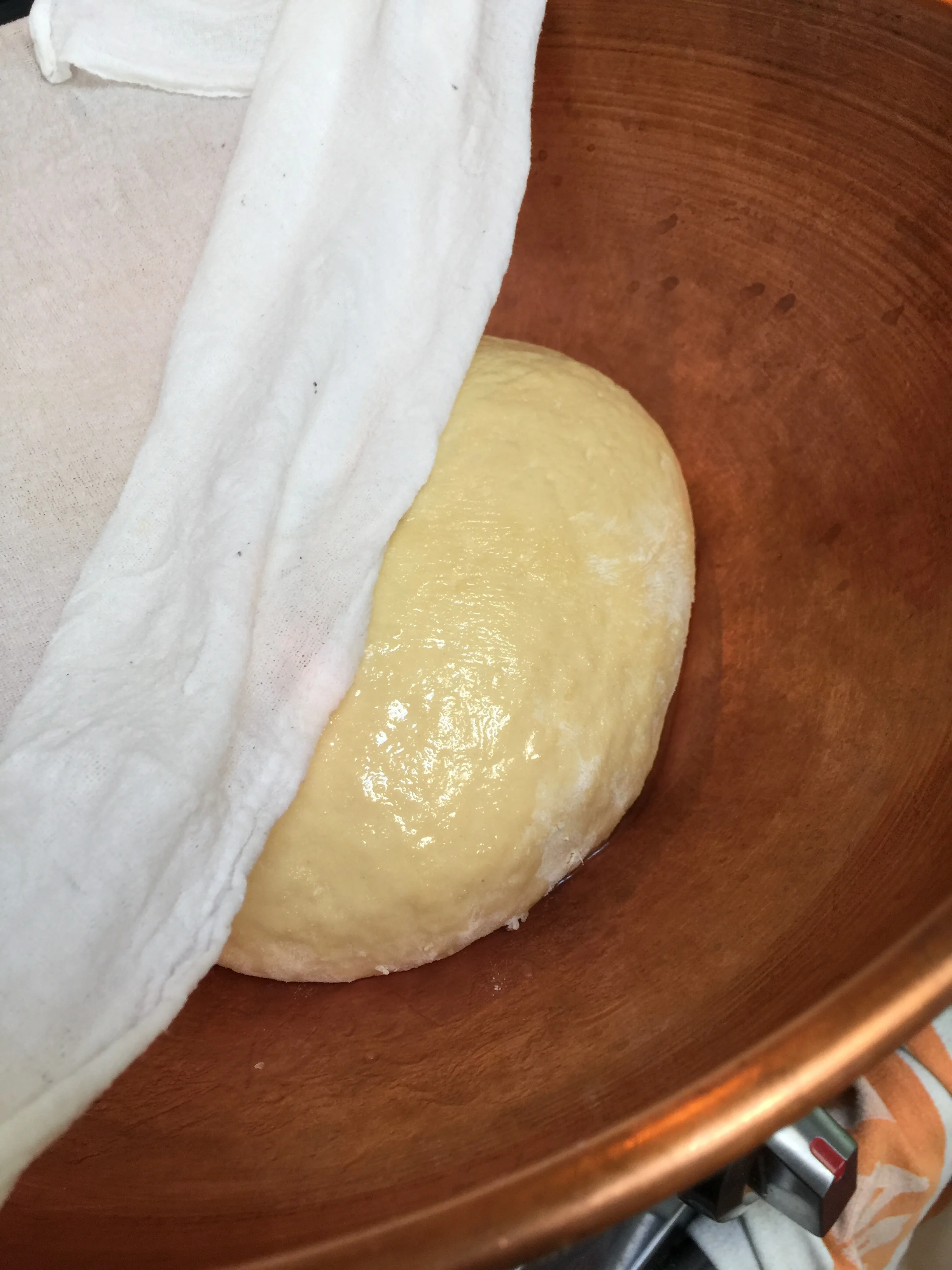
Leave it to rise
5 strand braided challah
One story he shared has stayed with me even more than the others: When he first started baking in Billings, Montana, for a local bakery, he figured out an extraordinary ciabatta. He would make a big batch in the very early mornings and felt connected to each loaf. He knew he poured himself into every part of the process, from softening the yeast to carefully placing the loaves into the hot oven. He remembered one customer who came in and bought every. single. loaf. At first, Rocky was almost hostile toward the customer, frustrated that all of his early morning hard work would be gone first thing that day. But then the man explained:
I’m bringing these to my son and his family in Great Falls, Montana today. Last time I visited, I brought one of these delicious loaves to him, and my son was so impressed that he asked me to bring more next time. He said he’d freeze loaves for later, but please bring as many as you can!
Rocky looked back at that incident and saw it as a pivot point, it was that moment when he realized he wasn’t baking bread just because he loved to bake bread - it wasn’t just for him. He realized that he wasn’t just feeding people, he was nourishing them.
What do you do that you can feel that good about? When did you realize that the energy you put into something was exactly the energy that came out of it?
Rocky’s creation: Black & Brie Baguette
Rocky loves his work at Park Avenue Bakery in Helena, Montana. If you make it in there, be sure to ask for him so you can hear about his latest outstanding creation, the Black & Brie Baguette. (I had mine with fresh sliced tomatoes and basil from my garden… mmmm.)
Episode 81: Your "Ah Ha" Moments are Your Career and Life Pivot Points
Dr. Carla Cooke might be what you’d call a late bloomer. Her stories about her late teens and early 20s aren’t about a driven, ambitious young woman. She worked hard in whatever job she had, but that often wasn’t enough to break through barriers. It took a painful experience with racism for her to realize her first calling to counseling and psychology. She knew there was more to that behavior than what she could see, and her compassion for every being was on full display.
When the Lightbulb Goes on, Your Story Takes Shape
Dr. Carla Cooke might be what you’d call a late bloomer. Her stories about her late teens and early 20s aren’t about a driven, ambitious young woman. She worked hard in whatever job she had, but that often wasn’t enough to break through barriers. It took a painful experience with racism for her to realize her first calling to counseling and psychology. She knew there was more to that behavior than what she could see, and her compassion for every being was on full display.
She started to see her gifts as an intuitive and active listener and observer as her calling. Once she figured out the nature of these skills, she was highly motivated to learn more and grow to help others.
After decades of helping people through her counseling practice, she started to feel too comfortable. Not bored, though what she was doing in her work no longer excited her as it used to. She still loved it, she still valued it, but the day-to-day work didn’t fit the same way it. During our conversation, we used the analogy of clothes she wore 20 years ago: They still fit, but differently. Things have shifted.
She was asked to present a session at a women’s event and jumped at the opportunity. My favorite part of our conversation was this story:
As Dr. Cooke was walking the hallways of the conference venue, a participant walked up to her to have a conversation. This participant hadn’t actually attended her session, but said she felt like she had benefitted from it. She had been in discussions with women who were there, and the session was so insightful and relevant that the discussions were carrying over into buzzing, energetic conversations with women who didn’t attend it.
The women said to Dr. Cooke: “You need to do this more. This topic is important and you make a difference!”
It took her a few days to process what happened, and to choose to make a substantial shift in her practice and her business, but it didn’t take long once she made that choice. And it didn’t take long for her to realize she was absolutely on the right path, the one where she could and did make the positive impact on people’s lives that she KNEW was her calling this time around.
Connect with Dr. Carla Cooke on LinkedIn, check out her website to learn more, and I highly recommend her workbook, On Being Well.