
Your Stories Don’t Define You
How You Tell Them Will
A podcast to unlock your stories and uncover meaningful insights.

Episode 109: The Microwave Generation
It was somewhere in the late 1970s when my father came home with a microwave oven. Definitely one of the first on our block and huge, my father proudly showed it to my mom as the "next great invention."
Distraction May Not Be the Opposite of Focus - Why Boredom is a Good Thing
It was somewhere in the late 1970s when my father came home with a microwave oven. Definitely one of the first on our block and huge, my father proudly showed it to my mom as the "next great invention."
We had no idea what to do with it, though the booklet had recipes, and settings to defrost meats and soften butter. I remember using it regularly to heat up our frozen vegetables, peas, corn, green beans. I also remember experimenting with the defrost feature, and failing miserably, cooking to death a beautiful steak or a pound of ground beef to devastating effects -- precious commodities because money was tight. We made scrambled eggs a few times, but cleaning the crusty containers was a hassle so we didn't do that very often.
When my parents splurged on a baby sitter for a date night, I remember the excitement of getting to pick out special frozen dinners at the store, made especially for heating in the microwave. Full of salt and fat, they were such a luxury for me and my siblings. Ick. We would walk through the frozen food aisle, gazing longingly at the variety of Swanson's and Banquet options, knowing we had to avoid any in foil containers, which was most of them.
When we would find a few "Now in Microwaveable Containers!", we would excitedly pull them from the reach-in freezer and read the directions on the back of the package. While I was perfectly happy to pick one that read "hot and ready to eat in 18 minutes", my younger sister would compromise on her selection to get one that took less time, maybe 15 or 16 minutes.
A few years later, as the microwave generation started to take off and find its way through the frozen food aisle, I remember looking at the back of the package and returning it to the freezer if it said anything more than 12 minutes. Those 6 minutes meant hot food even faster! It was also a signal, now that I can see it from a few decades into the future, that our tolerance for waiting for anything had dropped dramatically, in a very short amount of time.

Solitaire is my go-to distraction.
We don't use the microwave for TV dinners or other prepared food in our household now, except for the occasional Hot Pocket snuck into the house by one of our boys, but we do use it (very carefully) to defrost meats & fish, to warm up leftovers and frozen peas, and to soften butter and boil water. When we upgraded our old microwave a couple of years ago, I was pleasantly surprised to find the technology had improved so much that I could now boil water in under 3 minutes.
Oh dear.
This is why I call my generation the microwave generation. Every time we improve our technology and make things move faster, we decrease our tolerance and patience for waiting. You do NOT want to see me at Sea World or LEGOLAND these days.
What about you? Have you noticed a decrease in your tolerance for waiting -- for everything? What do you attribute that to? Do you find it more and more difficult to settle in and wait for things?
I noticed a while ago that people, myself included, avoid boredom by picking up their devices, phone, laptop, tablet, when they’re waiting for anything. My go-to is whatever version of Solitair is handy, or maybe scrolling through Facebook, checking my email, etc.
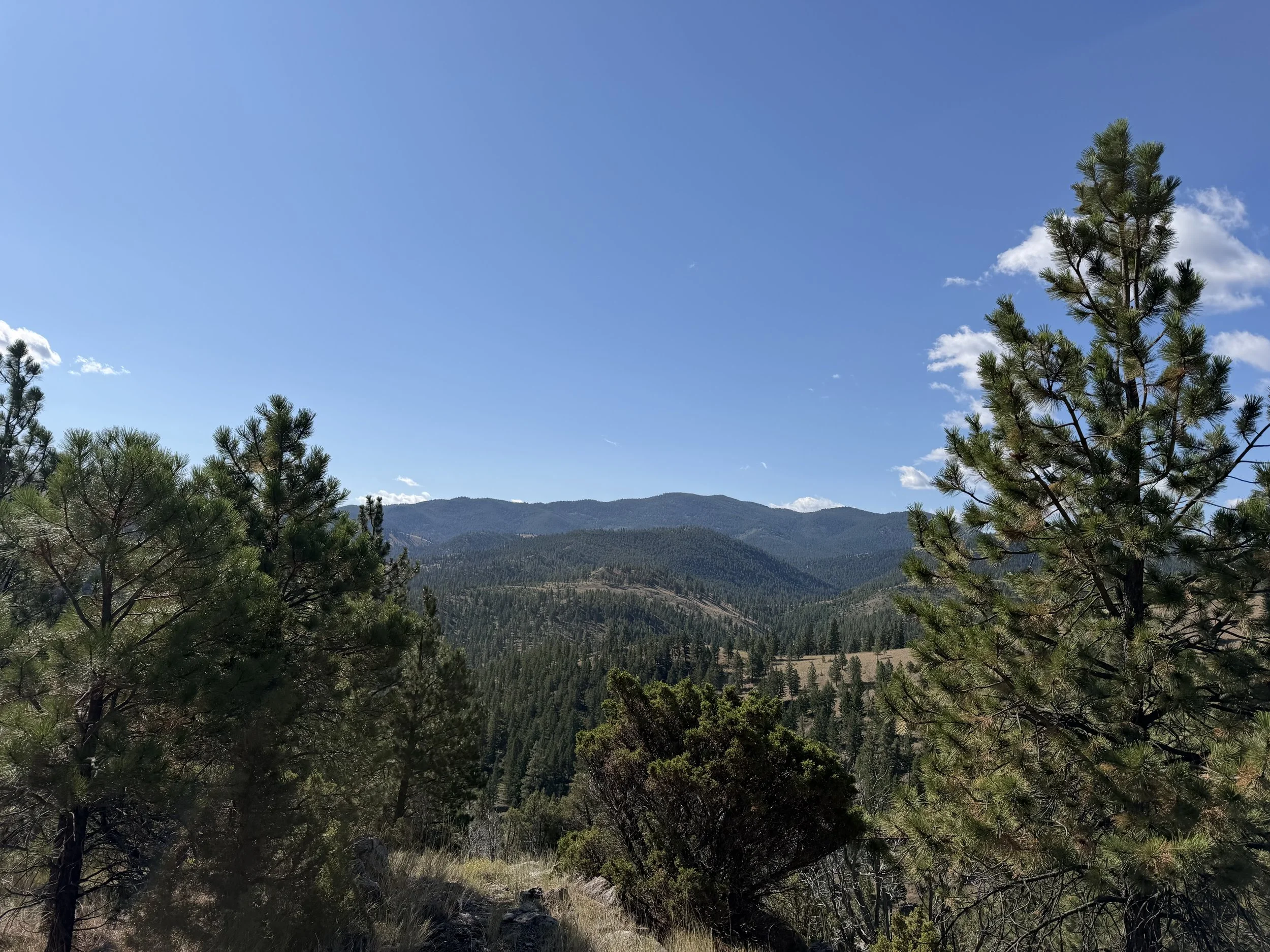
Outside of Lewistown, Montana - 7+ hour road trip can lead to major boredom!
What we’re doing, though, is limiting our opportunities to be mindful, to exploring our thoughts and letting our minds wander and explore. Why is that important?
I recently read an article by Jamie Ducharme on the Time website about boredom and its relationship to creativity and innovation. The author suggested that one of the critical factors in our lack of creativity is the fact that we have so much distraction available to us, that we’re rarely bored.
“If you’re waiting for brilliance to strike, try getting bored first. That’s the takeaway of a study published recently in the journal Academy of Management Discoveries, which found that boredom can spark individual productivity and creativity.” (Link to the article.)
The author suggested that we allow ourselves to sit with boredom when we experience it, to choose not to pick up our phone while waiting at a railroad crossing – or while we’re on the toilet. He suggested that when we allow ourselves to be bored for a little while, our brains start to wake up again, to start that slow whirring of idea creation, to begin to take a detour from our regular patterns of thought and explore different perspectives – it gives our brains the space to be creative again.
Distraction isn’t necessarily the opposite of focus, and mindfulness isn’t actually about focus, specifically. Mindfulness is about allowing your thoughts to shift, while coming back periodically to the moment, to paying attention to your physical body, and changing your relationship with those thoughts that cross your mind.
My friend Shelley Brown talks about mindfulness in a truly applied, accessible way. She suggests that when we stop to consider where our thoughts come from, to take a few moments to think about the thought from the perspective of someone on the outside looking in, we can see the reality behind the thoughts, which may be totally based in fear, unrealistic in their assumptions, and damaging to our relationships with ourselves and others. Perhaps if we give ourselves opportunities to be bored, we can also take a little time between a frustrating experience or conversation – and how we choose to respond to it.
There is that moment, after all, between stimulus and response, where we can choose how we see that stimulus. When something happens, like waking up to six inches of snow and single digit temperatures in April, we can choose how we respond to it. I can choose to see it as negative, positive, or neutral. My first reaction is usually: “No! I’m so sick of winter!” But if I take a moment to consider how I want to respond, I realize that the weather isn’t good or bad – it just IS, and I have no control over it.
I think it’s important to allow ourselves a negative response sometimes, at least for a few minutes, but after taking some time to be mindful of our emotions, we do have a choice.
The next time you’re waiting in line for your Starbucks pumpkin spiced latte, waiting for the download of the latest operating system update, or waiting for the water to boil in the microwave to make tea, try not to open the game or email or social media app on your phone. Instead, let your mind wander. Let thoughts come and go, like clouds shifting overhead. Maybe, just maybe, you’ll have an “ah ha” moment, a brilliant idea, a realization about how to solve a major problem you’ve been grappling with.
Use your short attention span to practice mindfulness – rather than finding distraction while you’re waiting, try being bored for a few minutes. Yes, really. It may be just the thing to help you find what you’re looking for.
Episode 105: What Works in Distributed Teams: Stories of Growth & Learning
John O’Duinn, pronounced John Oh.Dinn, is an engineer, and he sees almost everything in his life as a system. That means that with every problem he experiences or obstacle he needs to address, he sees it not as a stand-alone issue, but as part of something bigger. He understands how to dig into a problem by seeing it from a larger perspective, that a solution must address the overall health of a system, not just one small part of it.
Our Human Workplace Requires Clear Communication Systems

John O’Duinn, author of Distributed Teams
John O’Duinn (pronounced Oh.Dinn) is an engineer, and he sees everything in life as a system. That means that with every problem he experiences or obstacle he needs to address, he sees it not as a stand-alone issue, but as part of something bigger. He understands how to dig into a problem by seeing it from a larger perspective, that a solution must address the overall health of a system, not just one small part of it.
This unique way of seeing things makes him really good at problem-solving, and made him exactly the right person to write about remote workers, what makes remote work appealing and beneficial, and how to make remote working effective. His book, Distributed Teams, dives deeply into the benefits of remote teams, and then gives step-by-step guidelines to make remote working a successful endeavor.
There is so much to consider when hiring people, building a business, and setting up for an intentional culture, and one of those decisions must be whether to require people to work in a specific physical office location. It’s not easy to create a culture of communication in terms of clear processes and rules, but it’s critical as a company grows beyond 4-6 people, whether you’re sharing an office or whether your team is distributed.
My biggest take-away from the book is the dramatic improvement in the diversity of workplaces when remote working is an option and well-planned and executed. There were so many interesting parts to this conversation with John, and I came away from it with a huge appreciation for that aspect of his book and our discussion. There is plenty of evidence to support the value of diverse workplaces in terms of innovation, productivity, problem-solving and the resulting bottom-line improvement. This conversation, plus John’s book, make an excellent case for increasing the opportunities for people to work remotely, on distributed teams.
He referred to a study funded by the World Bank on urban mobility, which took place in Buenos Aires. Here’s the piece that we discussed:
If women are indeed constrained to smaller commutes, it also means they have access to fewer employment opportunities – with inevitable consequences on their wage rates and related labor market outcomes.
To read the full article, click here.
Connect with John on LinkedIn, and I highly recommend you check out his book, Distributed Teams, whether you’re a remote worker, work from home, or simply want to improve your team’s communication and processes. John referred to a book by Michael Lopp, Managing Humans, which can be found here.
Episode 92: Active Listening: The Power of Unlocking the Stories of Others
I love my work. Every client, every group brings new challenges and learning to me. I had an incredible opportunity to work with dependents of National Guardsmen who had been, or were currently deployed. The woman who hired me described the students as resilient, curious, and full of compassion. And when I met them that day, I completely agreed with her assessment. I’ve never worked with a group quite like these teenagers. They were welcoming, warm, and very bright. Every one of them had something to contribute to each conversation I facilitated, when I left, I had more hope than ever for the future of our communities.
Build Trust, Connect, and Deepen Your Relationships
I love my work. Every client, every group brings new challenges and learning to me. I had an incredible opportunity to work with dependents of National Guardsmen who had been, or were currently deployed. The woman who hired me described the students as resilient, curious, and full of compassion. And when I met them that day, I completely agreed with her assessment. I’ve never worked with a group quite like these teenagers. They were welcoming, warm, and very bright. Every one of them had something to contribute to each conversation I facilitated, when I left, I had more hope than ever for the future of our communities.
When we started the workshop, I talked about personal brand, being an ambassador for your people – no matter who you represented at any given time, to any audience. We discussed how we can share specific stories about our experiences in order to demonstrate the qualities we want to demonstrate to an audience, whether that’s a friend, family member, in an interview, or any other situation.
It was the last hour of our time together, and time to focus on listening, rather than sharing.
We were sitting in a large circle on white folding chairs, 12 teenagers between 13 and 17 years old, talking about storytelling and active listening.
I had described some of the techniques I use for active listening, like repeating words back to people to make sure I understand them, leaning forward, and making sure my body language is open and approachable, but I knew a demonstration would be more effective for the group.
Turning my chair to face the boy sitting to my right, a shy athlete with his arms crossed over his chest, I started to ask him questions. I leaned forward slightly, my hands relaxed on my lap. I was fully present, and as I started the conversation, my full attention was on him, the others just faded away for me.
“I know you love sports, and that you’ve had some great moments playing baseball and football. What else do you do?”
“Not much. Hang out with friends, I guess.”
“Do you have a dog?”
“Yes.”
“What’s your dog’s name?”
“Henry.”

Australian Shepherd/Lab Mix: Aussiedor
“Henry! What a great name for a dog. What is his breed?”
“He’s an Australian Shephard/lab mix.”
“I bet he’s really sweet. How do you spend time with him? Walks? Snuggles?”
“We walk together almost every day.” He smiled subtly, just the edges of his lips turning upward.
“I’ll bet you really love Henry and he loves you! Did you get him as a puppy, or did you adopt him?”
“We got him when he was only 8 weeks old.”
“Oh, how sweet. Was he super snuggly with you back then?”
“Yes.”
“Do you miss his snuggly puppy days?”
He smiled sweetly this time, an obvious grin at the memory of Henry as a puppy. That’s when his hands dropped into his lap, relaxed.
“I love puppies, even though they’re a lot of work. Did you train Henry to do any tricks?
“Yes, he’s really smart. One time I taught him to...”
He went on, sharing a story of how he trained his dog to do a trick. We wrapped up the conversation, and I turned my chair to face the rest of the group.
“Anyone notice what happened there?”
Almost immediately, and almost in unison, the teens said:
“Yes! He put his hands down from crossing them across his chest! He dropped his hands into his lap.”
I couldn’t have planned a better demonstration of the power of active listening, and that audience immediately understood that power when they saw the shift in their friend’s body language. They had spent a lot of time with him but hadn’t heard the story of how he trained his dog to do a trick.
If we want to truly connect with a person, we have to help them feel safe. One of the best ways to do that is to open our body language and ask questions to draw out stories.
Episode 91: When You Find Your Purpose, Your Story Shifts
Stories About a Purpose-Driven Life
Central Park, September 22, 2019
Marcia Polas came into my life when we were both in extremely uncomfortable situations. I was in a job with a difficult boss with lots of opportunities for growth, and she was navigating a relationship gone wrong while deciding where she wanted to go from her home in Denver, Colorado to explore the next iteration of her business. She ended up in New York City, and I shifted to a job that was a much better fit, but not before we spent many hours in deep, sad, enlightening conversations - with plenty of tears.
In one of those conversations, Marcia shared a valuable tool for difficult conversations, one that I have used and shared at least 100 times since then. I was about to walk into a meeting with my boss and her boss, and I was expecting the worst. I knew it would be ugly, and as I walked and talked to Marcia a few minutes before the meeting, she said:
Pretend there’s a camera recording the entire conversation. Think about watching the video in a few years, and consider how you would want to see yourself at that time.
I sat in the meeting and considered my facial expressions, my body language, and every response to her verbal attacks to be sure I could describe myself later as having handled the situation with grace, dignity, and compassion. It completely shifted the meeting in my favor, and I walked away satisfied and relieved.
Visiting NYC this month, I had an opportunity to sit with Marcia in the courtyard of the fabulous Lincoln Center and chat.
We talked about how we met, the beautiful friendship we developed at a distance, and the power of living with purpose.
Marcia has incredible instinct when it comes to body mechanics. She started as a Pilates practitioner and has grown her knowledge and practice into all aspects of body work. Her mantra is “It shouldn’t hurt to do your job,” and she works in high burnout industries like bartending, theatre & dance. Marcia can see immediately where your body is out of alignment, and what is likely causing pain.
She is rewarded in her work when her clients realize they don’t have to live with pain, that they have some responsibility to make adjustments to remove pain from their daily lives, and that they can be happier and more satisfied without having to leave a job they love.
What a beautiful world we can create when we serve with purpose!
Connect with Marcia on LinkedIn and learn more by visiting her website.
From her website:
I discovered Pilates in Denver, Colorado, in 1999. I was hooked from my first class. Eight months and a serious car accident later, my physical therapist used Pilates to rehabilitate my back and neck. I was better but still had chronic pain. Two marketing jobs and two cities later, I walked into Pendleton Pilates in Cincinnati, Ohio. After six months of serious Pilates, I no longer had back pain and began Pendleton’s intense four-month teacher training program. My goal was simple, to become a better Pilates student. The result was finding my calling in life.
I taught at Pendleton for the next year as a “hobby” — and in 2004, left my 14-year marketing and communications career, to pursue my passion and teach Pilates full-time. After building a successful Pilates program within a country club, I opened the first incarnation of polaspilates in Columbus, Ohio. With the help of a loyal and dedicated group of clients, the studio succeeded and I learned much about running a small business, Pilates and myself.
Episode 90: How You Tell a Story May Limit Your Potential for Learning From It
Sharing Your Story with the Right Person Makes a Difference
My book, based on this podcast, is designed to help walk you through a similar process as my podcast guests experience, to help you identify specific points in your life that can become some of your best stories to share.
The stories you share matter. They color your memories and self-confidence, they help create your internal messages, and they impact the perception people have of you. This book will help you uncover those stories that continue to shape your internal perceptions and relationships.
The preorder campaign, similar to a Kickstarter campaign, but for books, was extended by a few days because I am so close to reaching my goal of 250 books sold! To order your copy and take advantage of the early investor bonuses included, click here:
Panting, stopping to breathe and get my heartrate back to a reasonable pace, I looked up ahead to more steep climbing up the mountain. Then I looked down at the path I had just hiked up and smiled. It was a rigorous hike and I hadn’t really planned to take such a hard trail to the summit this time.
The dog needed water, so I stopped in a shady spot just off the trail to fill his bowl and let him rehydrate. It’s nice to have the dog around as an excuse to stop and catch my breath again. With his heavy fur coat, he’s even less comfortable than I am on this nearly 80 degree day before noon. But he’s just as happy as I am to be outside on our mountain.
Taking one last look back, I started up another steep climb, knowing I wasn’t far from the summit.
As I listened to the randomly shuffled song that came through my headphones, I had to stop again to look up and down from the middle of the steep climb:
Glory glory, halleluiah,
The sun is shining, shining down
Glory glory, halleluiah,
I’m alive, and I’m feeling, feeling fine.
Hearing those words sung by JJ Grey, I started thinking about what compelled me to take this hard route to the top of the mountain. My top strengths, according to the Gallup assessment, didn’t include Achiever or Competition, two of the themes I could imagine would drive someone to do what I was doing. So what was it?
It was in that moment I realized character has little to do with any assessment results.
I use my strengths to develop my character, not the other way around.
It had been a tough morning, which is why I knew I needed to hike. Getting outside always helps me clear my head and make sense of things. The email I received was cruel and unprofessional, a response to what I considered very reasonable requests for information. Words clouded my vision as I walked up the mountain, feeling attacked, defensive, angry, and self-conscious.
Had I failed in this assignment? Was it my work that triggered this unprofessional, rude response? I felt my confidence start to slip back down the mountain behind me.
Pushing myself harder, pressing my feet solidly into the slippery, rocky trail, I ascended another steep 15 feet of the mountain.
I felt nothing but exhilaration and pride as I took a step onto the rocks at the summit. Looking down, I could imagine myself when I was partway up the mountain, panting, pushing, and clearing the frustration and anxiety out of my way.
Now that I was at the top and looking back down, the path still looked crazy hard, but the feelings of inadequacy at the mid-point were no longer with me.
It was the next day, as I was telling a friend about my inspiration on the mountain that I realized I had missed a big part of the lesson.
I told her the story with my optimistic nature showing in full force, using those words that popped into my head as I sweated and panted up the steepest part of the mountain: Persistence, resilience, grit.
“… shame, feelings of inadequacy, self-punishment…”
Damn. As she added those words, I realized she was right. I didn’t take that hard route simply because I was demonstrating resilience and grit. I was punishing myself for what I thought I had done wrong. I was pushing away the shame I felt as I remembered the words in the email. I was proving to myself that I WAS resilient, strong, and even if I failed at one thing, I would be DAMN SURE NOT TO FAIL at this.
Our conversation shifted from why we punish ourselves to why it mattered. After all, punishing myself by climbing up a mountain had to be one of the healthiest and constructive ways to do that, right?
Well, yes. Knowing WHY I was pushing myself so hard matters. If I’m working away these feelings, these frustrations, giving those feelings a name will help me address them, specifically, rather than blowing off arbitrary steam.
When we know the why behind our actions, we can be more intentional about not only processing our feelings behind those actions, we open our minds to learn the necessary lessons the experience can teach us.
I shared the story of my hike with my friend so I could talk through thoughts I knew could contribute to life lessons, to apply my thoughts to actual improvement in future similar situations. When we tell a story like this to a friend, we create arbitrary constraints around the experience, we create a box for the story to fit into based on prior experience. That means we look for what we want to see, set limits for understanding the context of our stories, and miss all kinds of potential for lessons and growth. But when we share the story with the right friend, they might just ask the questions we need to ask ourselves – the harder questions – and that conversation is likely to remove some of those constraints.
In the book The Art of Possibility, a gift I received from my friend Jeff Ikler, the very first chapter is about exactly that: Based on past experience, we make assumptions that create a box, or constraints, for ourselves. I made assumptions based on my optimistic nature, assumptions about the reason behind the negative email I had received, assumptions about the lessons I was meant to learn from the experience. Not all of those assumptions are bad things, necessarily, but without some opportunity to question them and work through the stories I was telling myself, I may have limited my potential for personal growth.
Who do you have in your life that helps you work through this kind of internal message? Which of your friends or acquaintances can you count on to help you ask yourself the tough questions, and get the most out of an experience? If you can’t think of anyone right away, be intentional about building relationships with the people who can help you process your thoughts and experiences. People you can trust, be vulnerable with, and who will add positive support and encouragement. Self-reflection is a great start, but if you’re not expanding that reflection by sharing it with people you trust, you’re limiting your opportunities to apply that self-reflection, deepen it, and improve your communication and relationships as a result.
Episode 89: Ending the Mental Illness Stigma One Story at a Time
Illness Might Just Be a Misnomer: Learn to Love Your Special Talents
Dale Morris caught my attention a few years ago on LinkedIn with his headline: “If you’re trying to think outside of the box, you’re still constrained by the box.”
I thought for days about that. Although I believe constraints often lead to extraordinary creativity, some of us don’t think in the context of constraints. We don’t know what we don’t know, so we try things others might think were impossible. Our older son and I are perfect examples of that. When we get an idea in our heads, we don’t think about what wouldn’t work. We think about what WILL work. When it comes to the idea of thinking outside of a box, we’re more likely to think: “Wait. Was there a box? Was I supposed to do something with a box? Damn. A box?” Sometimes that works against us, other times, it definitely works in our favor.
Dale is one of those people who doesn’t even consider why something won’t work, he just moves forward with his idea. That’s why he’s so good at what he does, both in art and in IT work.
We shared a great discussion about the possibility that certain diagnoses we call mental illness might actually be evolutionary shifts to address our very real over-stimulating environments. We also talked about how some people choose to see a diagnoses in the light of possibility - using that different way of thinking to be really good at certain tasks and jobs.
I especially loved the part of our conversation about Dale’s art when he was in college. He had a literature professor who required an essay about a work by an American author within a specific time period. Because of his differently-abled mind, he struggled with the essay. She offered to adjust his assignment: Paint your feelings about a work of literature.
He selected the protagonist from Steinbeck’s The Chrysanthemums. I won’t spoil the story by sharing it here, just listen.
Connect with Dale on LinkedIn to learn more about his extraordinary talent in un-puzzling IT puzzles.
Episode 88: Great Adventures Often Begin with Zero Preparation
Until very recently, women working in traditionally male roles like ranching and agriculture had to either wear clothes for men that simply didn’t fit, or women’s clothes they knew wouldn’t last or protect them properly.
The Story of Work Clothes for Women is Born of Necessity, and Raised in an Airstream
Until very recently, women working in traditionally male roles like ranching and agriculture had to either wear clothes for men that simply didn’t fit, or women’s clothes they knew wouldn’t last or protect them properly.
Sarah Calhoun saw a need in the market and found a way to fill it. Her story begins with her childhood, growing up on a llama farm with her sister, and works its way across the country with direct sales out of an Airstream RV. Red Ants Pants was born of necessity and raised by working women across the country. And not just any working women: Women who work in rural America on ranches and farms, and who never had clothes made to fit them that would protect their skin when working in tough environments.
I was intrigued about her background and motivation after a friend shared her website with me, a page in the Red Ants Pants Foundation about a girl’s leadership program. We talked about why she started this program for young women heading into their junior year of high school in rural Montana. And I heard some great stories about starting a business with almost zero preparation.
Check out the Red Ants Pants website, the Foundation website, and don’t miss the one devoted to building women leaders in rural America.