Your Stories Don’t Define You
How You Tell Them Will
A podcast to unlock your stories and uncover meaningful insights.
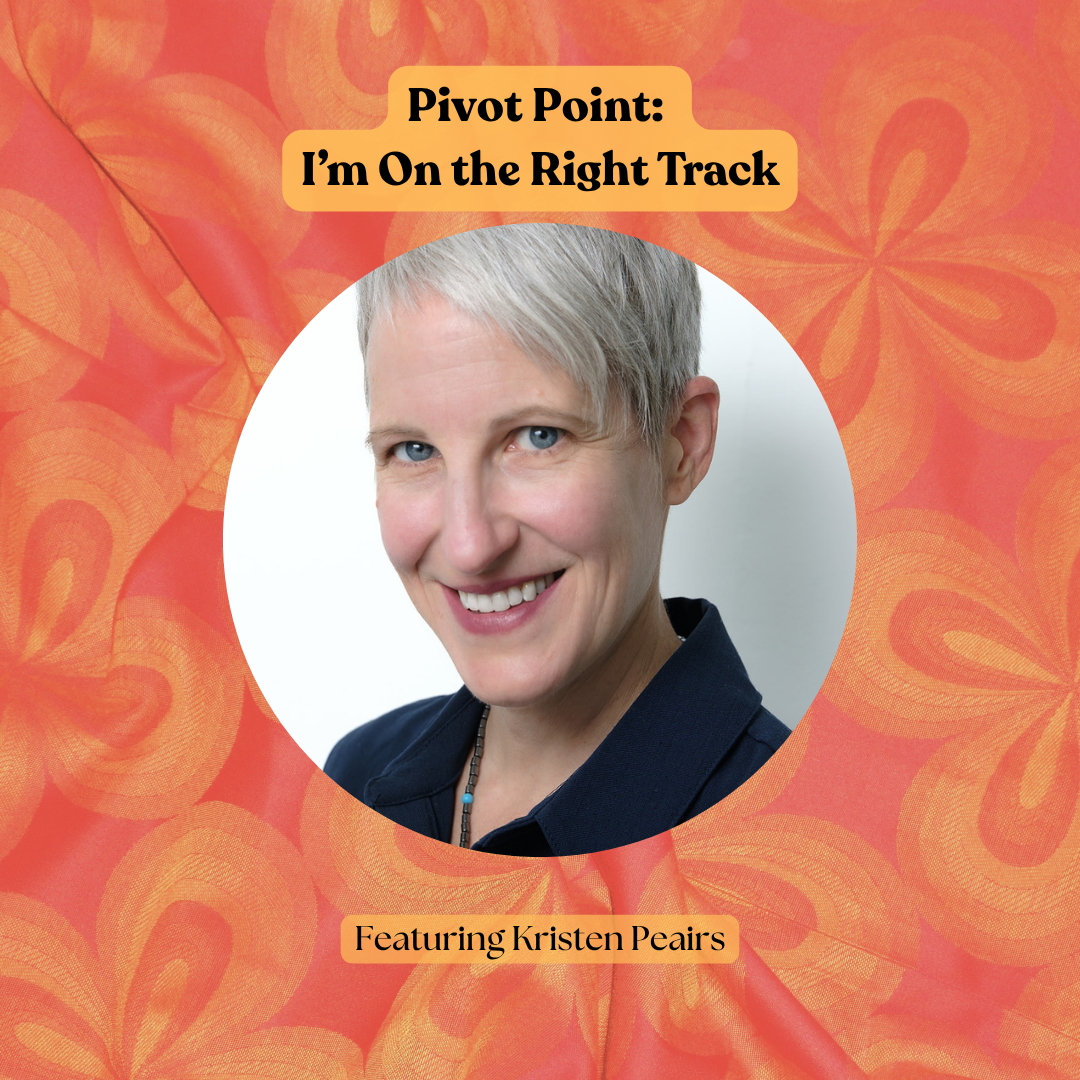
451 Pivot Point: I’m On the Right Track featuring Kristen Peairs
“…And I just watch their whole body relax and their faces would light up even more.
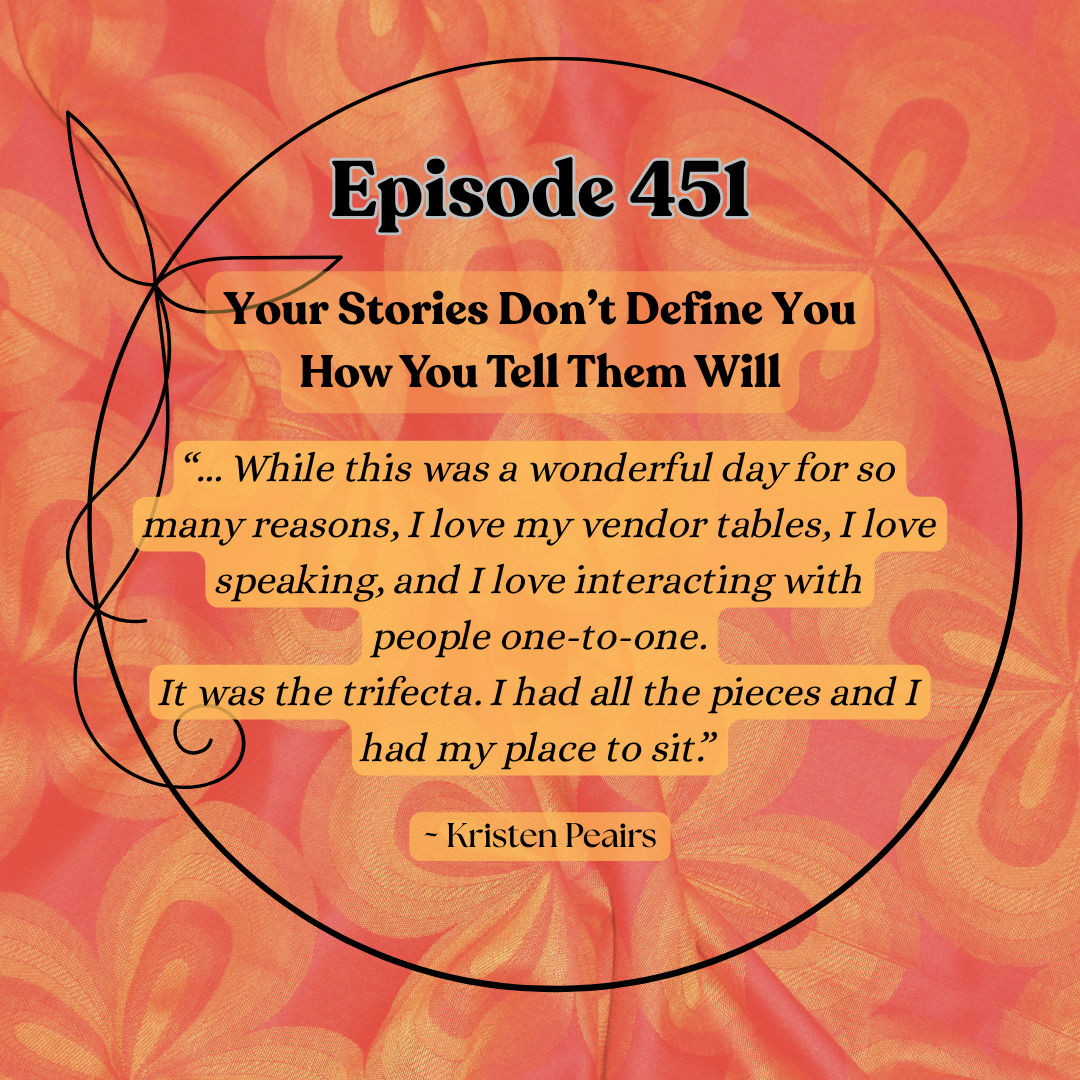
…For me too, because while this was a wonderful day for so many reasons, I love my vendor tables, I love speaking, and I love interacting with people one-to-one.
It was the trifecta. I had all the pieces and I had my place to sit. And… I was in a beautiful space.”
“…And I just watch their whole body relax and their faces would light up even more.
For me too, because while this was a wonderful day for so many reasons, I love my vendor tables, I love speaking, and I love interacting with people one-to-one.
It was the trifecta. I had all the pieces and I had my place to sit. And honestly, I mentioned earlier that I was in a beautiful space.”
For Kristen Peairs, this was a pivotal moment, the realization that her work over the past many years brought her to exactly this point in time. Through trial and error, she recognized exactly what she needs to feel successful, to know she’s making an impact and is on the right track.
Before her keynote speech she and her assistant set up a vendor table at the conference. The space was beautiful, full of light, and the other vendors seemed to get the same message: Make space that’s welcoming, safe, intriguing.
Before she spoke, a handful of people wandered by her table, some stopped to glance at the greeting cards she creates. But after her post-lunch keynote, back at her table, people came over and really engaged. They bought cards, and many picked up a “standing in the question” story card and read it out loud. Kristen guided them in what the question might uncover for whatever is feeling stuck for them, and they’d light up with wonder and insight.
Like many of us, Kristen can be very outgoing in certain situations, and this was one of them. Also like many of us, she was exhausted after a full day of being “on”. At the same time, she couldn’t shake the feeling that she had just experienced something important to her.
Now, looking back and sharing the story, she knows what it was: A pivotal moment when the pieces seemed to just fit together, telling the story of how far she’s come and what that means for her future.
Listeners, now it's your turn:
What will you take from this conversation?
Did any memories come up for you, a time when you suddenly realized you were in exactly the right place in that moment?
Did you notice your own body’s response to Kristen’s joy in describing where she was? Did you feel that light, that sense of awe she felt as she described it?
Will you take a moment to notice the energy you’re sharing as you tell a story? Is it positive? Is it energetic?
Episode Highlights
Pivotal Insight: A conference keynote revealed Kristen Peairs' true joy comes from deep, 1-on-1 connections at a vendor table, not the speaking itself.
"Constellation of Joy": This insight led to the "constellation of joy" framework—a personal ecosystem of people, spaces, and support (e.g., AV tech, food) that enables thriving.
Podcast Story: The episode will focus on the conference story, contrasting pre- and post-keynote vendor table interactions to illustrate the power of connection.
As always, thanks for listening to your stories don't define you, how you tell them will.
About Kristen:
Kristen Peairs, MS, ACC, is a professional speaker, stick figure artist, and ICF-certified coach who helps entrepreneurs and professionals find clarity when they feel stuck, overwhelmed, and unsure of what to do next.
In 2022, she created the Standing in the Question Navigational Tool to illustrate how we can sustainably move forward during times of hardship and uncertainty. Her work is a reminder that humanity is not separate from business success - it is often the foundation of it.
Kristen holds degrees in Hospitality Management and Nutrition and has spent more than 20 years studying leadership, communication, and personal wellbeing. Her fascination with the energy underlying human connection has led her to explore Human Design, the ways people influence one another, and the role our relationships and environments play in how we thrive. She also hosts a growing YouTube channel focused on energy, relationships, and how we can begin shifting our experiences before ever saying a word. Connect with her on LinkedIn and let her know you heard this episode!
Lately I’ve been focused on brief, less than 20-minute episodes that keep your attention while still offering insights and entertainment.
What you’ve been hearing is a brief story of a pivotal moment, and then a thread pulled to generate insights about it.
I have two goals for you:
One – to uncover your related story for you to add to your collection to practice and have ready when the opportunity presents itself.
And two – to demonstrate storytelling in a practical, approachable way so you hear how I compose my words, phrases, and use tone-of-voice to add dynamics and meaning.
I’ve often said that your stories don’t have to be epic, they need to be meaningful. My point is that everyday moments of joy, grief, and humor, can be far more relatable than the “I almost died” or celebrity sighting stories.
But there is a time and a place for an epic story, for the entertainment value, and for the long tail it generates of meaningful moments in the days, months, and years afterward. The lessons you learned, the evidence of resilience you carry, and the relationships that grew and changed as a result of that epic experience.
After more than 430 episodes of this podcast, I was recently inspired to change the format of the show.
The new format for my show aligns with what I’m learning about narrative identity (how the stories we tell about ourselves internally and externally influence our identity) and demonstrates what I’ve been teaching for years: Sharing a story to reveal who you are and what matters to you.
My hope is that future episodes will offer more clarity about great storytelling and how to find and explore pivotal moments to demonstrate who we are.
About Sarah:
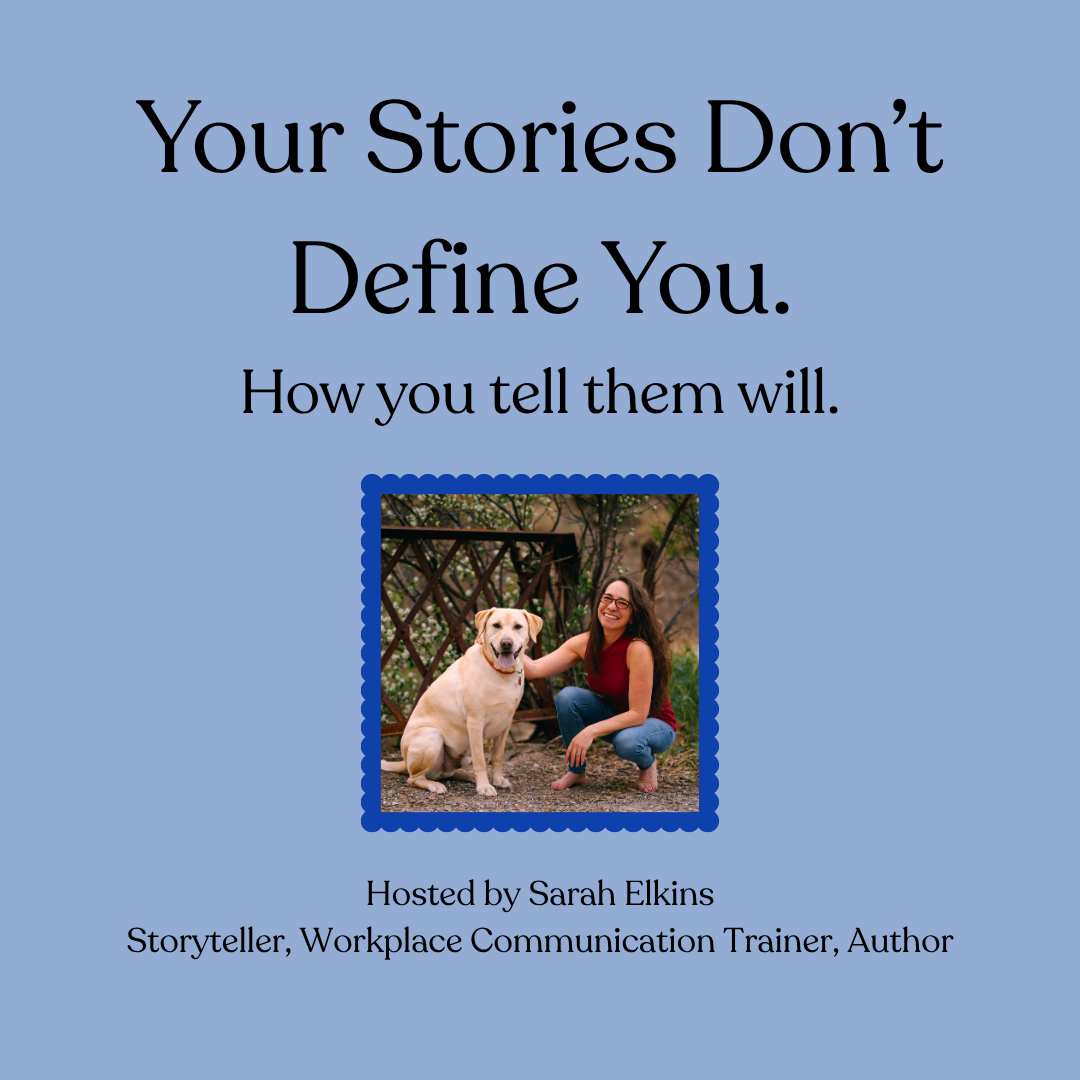
Sarah is a Montana based workplace communication trainer, TEDx speaker, DisruptHR speaker, public speaking coach, professional storyteller, musician, and podcast host. Her workshops and coaching packages with teams and their leaders are known to address and reduce miscommunication – the most common cause of tension and stress in the workplace. Using the team’s results from the StrengthsFinder assessment, she guides teams in learning to speak each other’s “language”, learning to value each other’s strengths and connecting with each other through enhanced self-reflection and effective listening.
Sarah’s nearly 20 years working in government agencies inspired her to complete her MBA and to achieve her StrengthsFinder certification to improve work environments for others, guiding teams toward increased satisfaction, productivity, and happiness.
Visit her website to purchase her book, Your Stories Don't Define You in paperback or audiobook.
450 Pivot Point: My Life Reimagined in a Moment featuring Ezra Vancil
"And I just couldn't do it. And I wrote the guy at the publishing company in LA and said I can't do this....
Because I'd finally found, I think, the holy grail of life, which is peace of mind and people that love you. And to sign that contract would put me back on the road."
Ezra Vancil had been a successful musician, and with that came years of addiction and eventually the destruction of his marriage and his relationship with his teenaged son.
But at 40 he got help, gave up alcohol and drugs, and one of his original song recordings posted on social media caught the attention of a couple of publishing companies. He was this close to signing a contract, realizing what he thought was his dream, and turned it down.
"And I just couldn't do it. And I wrote the guy at the publishing company in LA and said I can't do this....
Because I'd finally found, I think, the holy grail of life, which is peace of mind and people that love you. And to sign that contract would put me back on the road."
Ezra Vancil had been a successful musician, and with that came years of addiction and eventually the destruction of his marriage and his relationship with his teenaged son.
But at 40 he got help, gave up alcohol and drugs, and one of his original song recordings posted on social media caught the attention of a couple of publishing companies. He was this close to signing a contract, realizing what he thought was his dream, and turned it down.
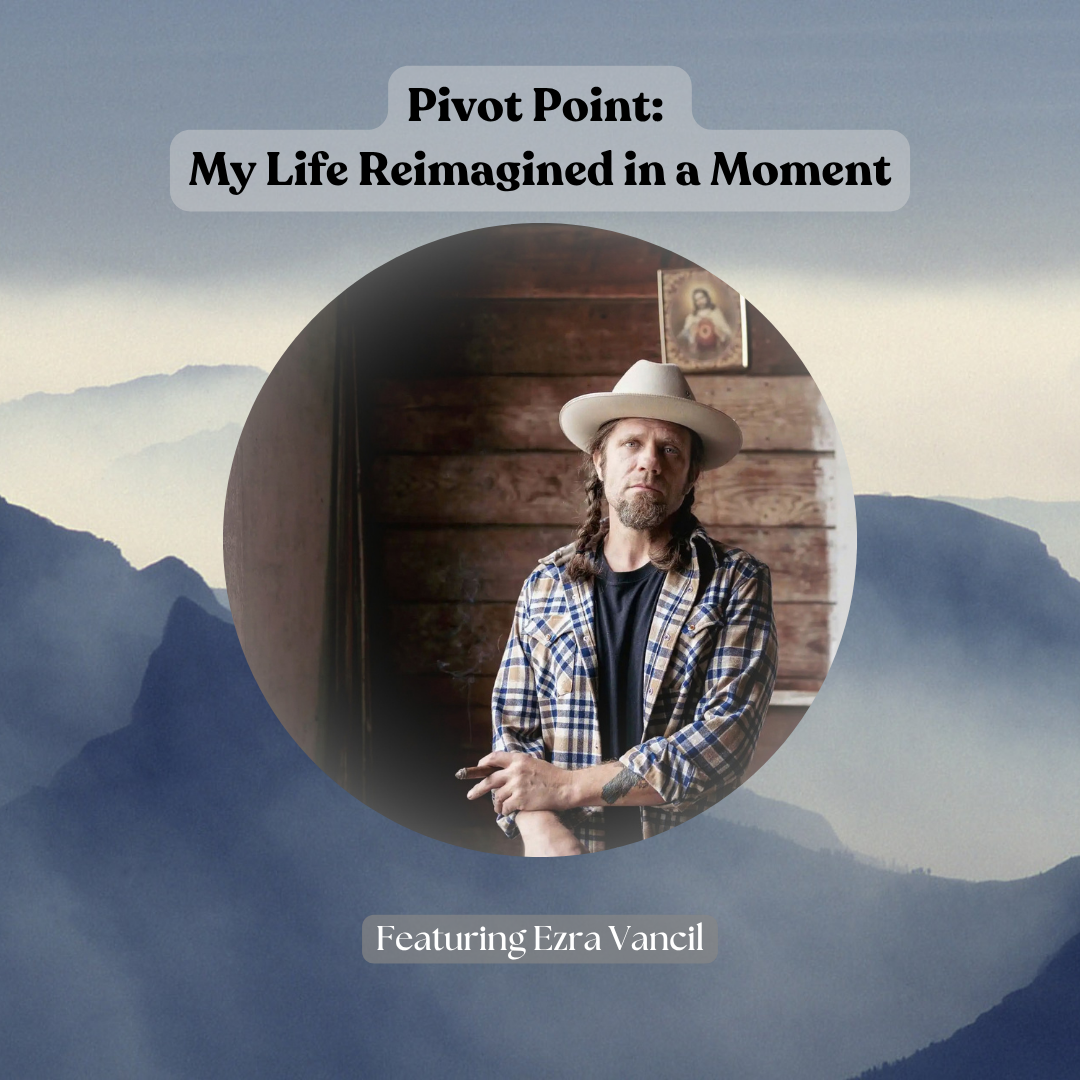
"And it's just my chest would sink every time I sat down and talked to these people or sat down and worked on the contract. It would just sink. And I didn't know why. You know, I couldn't figure out why - what this fear was."
He was looking down at the contract, pen in hand, when his older brother called. "I think I could help you start a company. And I think think you'd be really good at it."
Ezra put down the pen.
He didn't really know what a pivotal moment that was until years later. Looking back, he can see it clear as day, that was the moment he took inventory and realized his dreams, his aspirations, his definition of success, had completely changed.
Listen to the story of that moment, and as we pull threads you'll hear a related moment in time, years later, that might just bring tears to your eyes.
Listeners, now it's your turn:
What will you take from this conversation?
Did any memories come up for you, a time when you realized your goal had shifted? Did you keep going, head down, or did you pivot?
Will you be somebody who now takes inventory before you get single-minded about a goal over the long term
Will you be a person who sees a decision and the potential for consequences of the choice you made?
Will you be more present in this moment, knowing that it's not the things that happen to you, that define you, but the way you talk about them?
As always, thanks for listening to your stories don't define you, how you tell them will.

About Ezra:
Ezra Vancil is an award-winning Texas singer-songwriter, entrepreneur, and marketing executive whose career has spanned music, business, and personal reinvention. After signing a development deal early in his music career, addiction derailed both his life and career for more than a decade before he rebuilt through recovery. Today, he leads a successful marketing company with his son, while continuing to write and record music independently, including a father-daughter collaboration with his daughter, Cozi. His story is one of second chances, choosing family over fame, and discovering that success is measured less by recognition than by the life you build.
Follow Ezra on Instagram, and check out his website to hear his music and learn more about his story.
Lately I’ve been focused on brief, less than 20-minute episodes that keep your attention while still offering insights and entertainment.
What you’ve been hearing is a brief story of a pivotal moment, and then a thread pulled to generate insights about it.
I have two goals for you:
One – to uncover your related story for you to add to your collection to practice and have ready when the opportunity presents itself.
And two – to demonstrate storytelling in a practical, approachable way so you hear how I compose my words, phrases, and use tone-of-voice to add dynamics and meaning.
I’ve often said that your stories don’t have to be epic, they need to be meaningful. My point is that everyday moments of joy, grief, and humor, can be far more relatable than the “I almost died” or celebrity sighting stories.
But there is a time and a place for an epic story, for the entertainment value, and for the long tail it generates of meaningful moments in the days, months, and years afterward. The lessons you learned, the evidence of resilience you carry, and the relationships that grew and changed as a result of that epic experience.
After more than 430 episodes of this podcast, I was recently inspired to change the format of the show.
The new format for my show aligns with what I’m learning about narrative identity (how the stories we tell about ourselves internally and externally influence our identity) and demonstrates what I’ve been teaching for years: Sharing a story to reveal who you are and what matters to you.
My hope is that future episodes will offer more clarity about great storytelling and how to find and explore pivotal moments to demonstrate who we are.
About Sarah:
Sarah is a Montana based workplace communication trainer, TEDx speaker, DisruptHR speaker, public speaking coach, professional storyteller, musician, and podcast host. Her workshops and coaching packages with teams and their leaders are known to address and reduce miscommunication – the most common cause of tension and stress in the workplace. Using the team’s results from the StrengthsFinder assessment, she guides teams in learning to speak each other’s “language”, learning to value each other’s strengths and connecting with each other through enhanced self-reflection and effective listening.
Sarah’s nearly 20 years working in government agencies inspired her to complete her MBA and to achieve her StrengthsFinder certification to improve work environments for others, guiding teams toward increased satisfaction, productivity, and happiness.
Visit her website to purchase her book, Your Stories Don't Define You in paperback or audiobook.
449 Pivot Point: The Long Tail of an Epic Story
I was on my way back from a hike with my dog and nodded a greeting to a woman walking up the trail with a variety of small and medium dogs. We smiled at each other as our dogs had a very polite “meet and greet”.
When I asked about her fur babies, there was a catch in her voice as she said: “These two were my mother’s. She passed away two weeks ago.”
In episode 447 I shared the story of how my friend Stephanie showed up for me in an unexpected and powerful way, and what I learned from her support about receiving and community-building.
Today’s story is another related one, and takes place many years later.
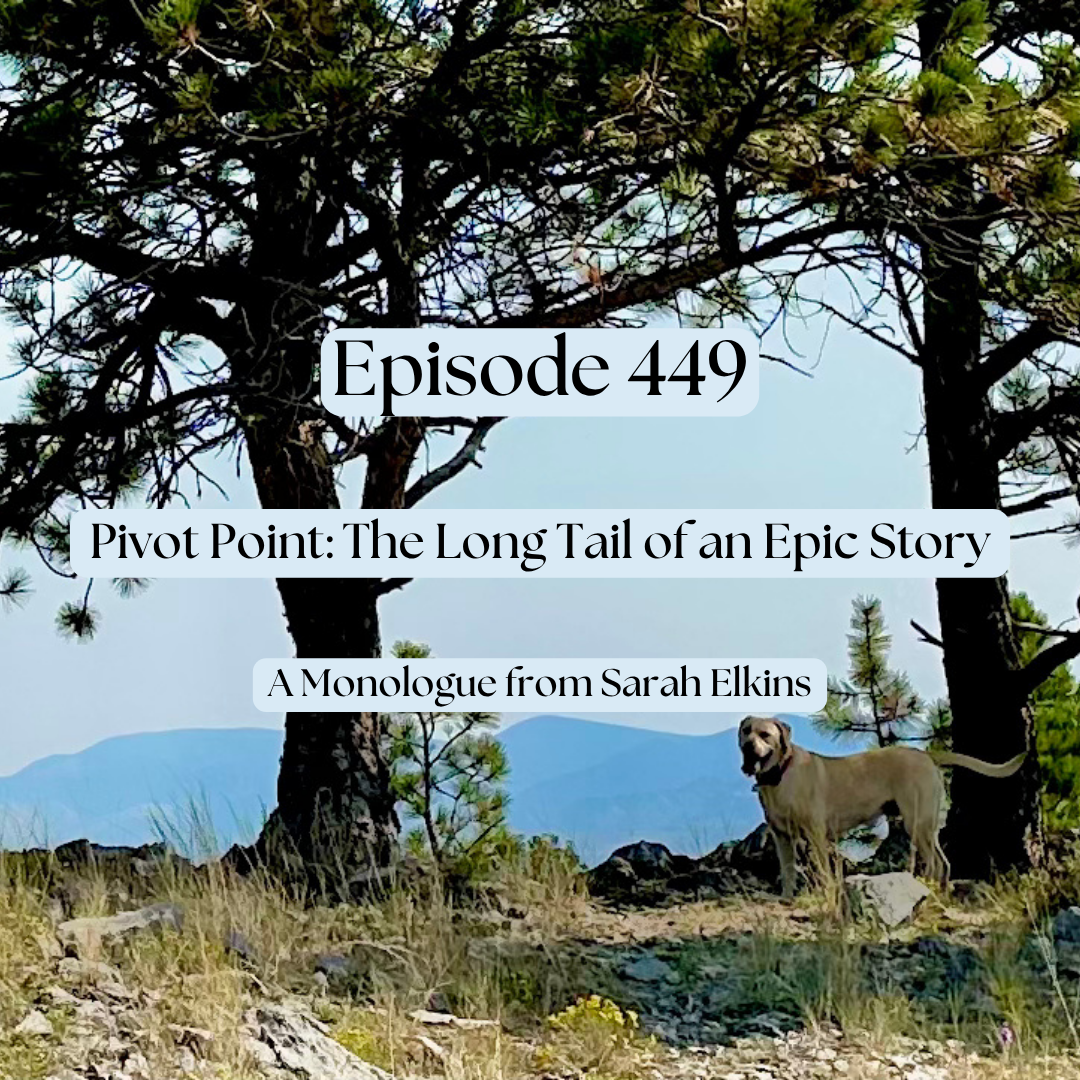
I was on my way back from a hike with my dog and nodded a greeting to a woman walking up the trail with a variety of small and medium dogs. We smiled at each other as our dogs had a very polite “meet and greet”.
When I asked about her fur babies, there was a catch in her voice as she said: “These two were my mother’s. She passed away two weeks ago.”
Lately I’ve been focused on brief, less than 20-minute episodes that keep your attention while still offering insights and entertainment.
What you’ve been hearing is a brief story of a pivotal moment, and then a thread pulled to generate insights about it.
I have two goals for you:
One – to uncover your related story for you to add to your collection to practice and have ready when the opportunity presents itself.
And two – to demonstrate storytelling in a practical, approachable way so you hear how I compose my words, phrases, and use tone-of-voice to add dynamics and meaning.
I shared an epic story in episode 446 about a crazy adventure that happened just over 20 years ago when my husband broke his leg about 2 miles from a trailhead on a remote mountain in Montana, and I got our 2 boys, then 4 & 6, my husband, and our two dogs off the mountain and to the emergency room.
I’ve often said that your stories don’t have to be epic, they need to be meaningful. My point is that everyday moments of joy, grief, and humor, can be far more relatable than the “I almost died” or celebrity sighting stories.
But there is a time and a place for an epic story, for the entertainment value, and for the long tail it generates of meaningful moments in the days, months, and years afterward. The lessons you learned, the evidence of resilience you carry, and the relationships that grew and changed as a result of that epic experience.
I couldn’t see her eyes, we were both wearing sunglasses, but I could feel her grief coming in waves between us.
I walked toward her, arms open, and she stepped forward so I could hug her – hard. She sobbed and I held space for her grief.
When we separated, she told me about her mom’s death and about her mom’s life. There was humor laced in with the grief and I was there for all of it. Fully present and leaning in.
What the woman didn’t know (and I'll never tell her) is that I was experiencing significant grief, too. I had lost my father recently and was still struggling with that grief.
We continue to run into each other once in a while, but not often, and just a few months ago I saw her with her partner and dogs on the trail. She said: “Hey there! You know… I still tell the story of how we met, and I still call you my Trail Angel.” She hugged me before we went our separate ways.
There was a time when it was a real challenge for me to receive – to accept help – and even harder to ask for it.
But in the months following my husband’s accident I learned a lot about receiving with grace and gratitude. It’s taken me a lot longer to learn how to receive with the vulnerability that connects us even more deeply.
What I’ve learned is that when we practice receiving, when we learn to take inventory about our needs and know who to ask for help, support, and encouragement, we become much better at giving, too.
I was able to hold space for this stranger because I have received that gift over and over again.
It was the months after my epic story of getting my family off a mountain that taught me some of my most important lessons about community.
We can’t build a strong, meaningful, and sustainable community if we don’t allow and encourage others to contribute.
And community doesn’t happen by accident.
We build community when we step out of our comfort zone to say hello to our neighbors, invite them for a coffee or a meal, and learn what kind of giving lights them up.
We build community by receiving with grace, gratitude, and vulnerability.
It’s not easy for most people, especially in the years following the pandemic’s social restrictions.
But if we don’t model community-making for our kids, friends, and neighbors, we will continue to experience loneliness, isolation, and division.
I couldn’t be more grateful for my community and the early lessons that helped me build it.
Knowing I’m surrounded by people who care deeply about me and my family, people who have a variety of skills and abilities that serve a variety of needs – that’s what gives me the ability to give when I’m also grieving.
Listeners, now it’s your turn:
What story can you share about a time when a person showed up for you in a meaningful and maybe unexpected way?
Did my story remind you of an experience when you had an opportunity to show up for someone when you were going through a rough time, too?
Can you share a story of showing up for someone without it sounding like you’re bragging or patting yourself on the back? Did you hear how I shared my story to include other characters, developed the story with small details, and shared how it made me feel at the end?
I hope you’ll collect your stories, practice them, and know when it’s time to share so you can connect more deeply and to allow another person to learn from them.
After more than 430 episodes of this podcast, I was recently inspired to change the format of the show.
The new format for my show aligns with what I’m learning about narrative identity (how the stories we tell about ourselves internally and externally influence our identity) and demonstrates what I’ve been teaching for years: Sharing a story to reveal who you are and what matters to you.
My hope is that future episodes will offer more clarity about great storytelling and how to find and explore pivotal moments to demonstrate who we are.
About Sarah:
Sarah is a Montana based workplace communication trainer, TEDx speaker, DisruptHR speaker, public speaking coach, professional storyteller, musician, and podcast host. Her workshops and coaching packages with teams and their leaders are known to address and reduce miscommunication – the most common cause of tension and stress in the workplace. Using the team’s results from the StrengthsFinder assessment, she guides teams in learning to speak each other’s “language”, learning to value each other’s strengths and connecting with each other through enhanced self-reflection and effective listening.
Sarah’s nearly 20 years working in government agencies inspired her to complete her MBA and to achieve her StrengthsFinder certification to improve work environments for others, guiding teams toward increased satisfaction, productivity, and happiness.
Visit her website to purchase her book, Your Stories Don't Define You in paperback or audiobook.
448 Pivot Point: Revealing Stories By Building Relationships with Terry Rubin
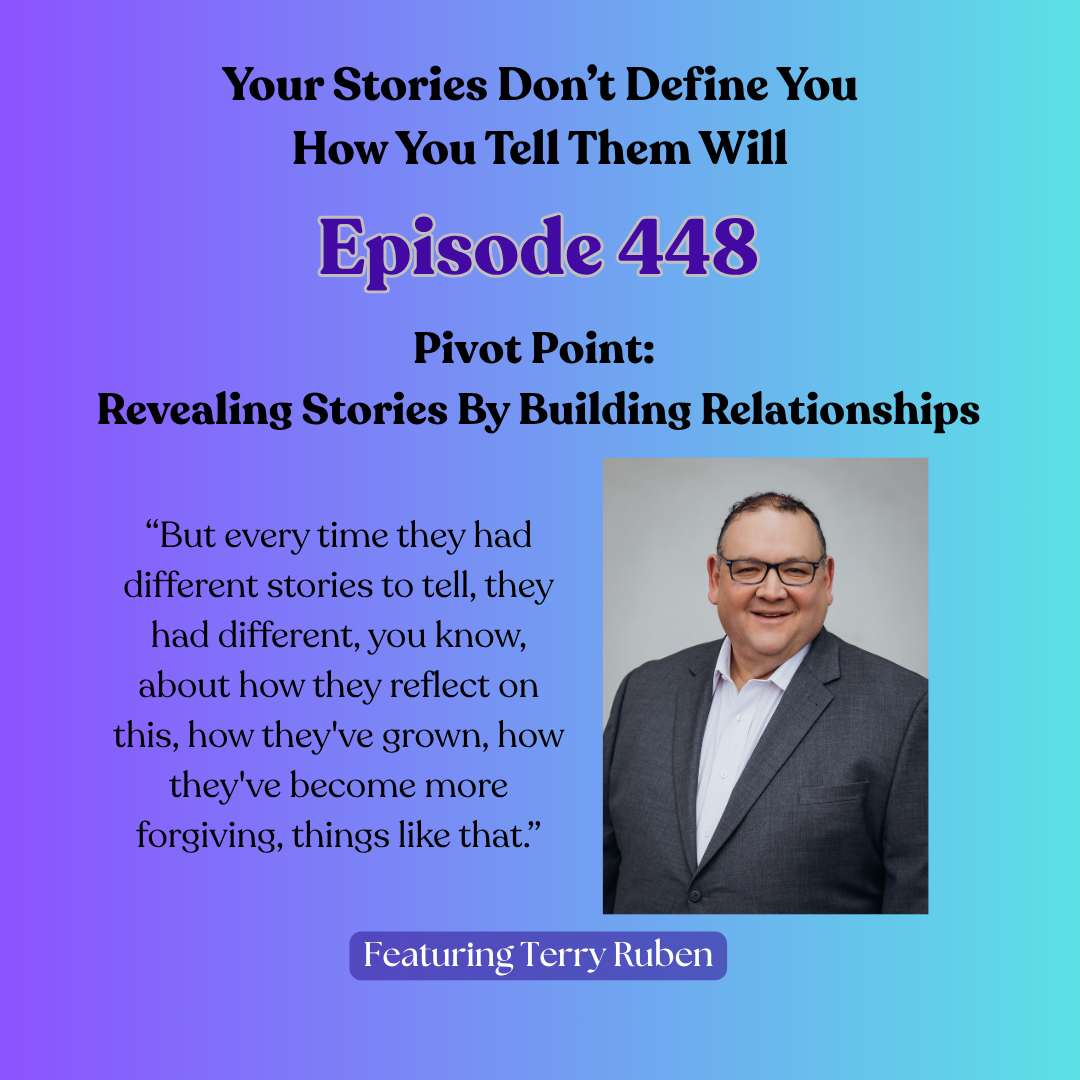
"But every time they had different stories to tell... about how they reflect on this, how they've grown, how they've become more forgiving, things like that."
Early in his career, Terry Rubin worked for The MacNeil/Lehrer NewsHour in New York City and was sent to Oklahoma City within 24 hours of the bombing of the Alfred P. Murrah Federal Building on April 19, 1995.
His job was to find the stories, connect with the right people to interview, and manage the details of coordinating crew and journalists to interview people onsite.
"But every time they had different stories to tell... about how they reflect on this, how they've grown, how they've become more forgiving, things like that."
Early in his career, Terry Rubin worked for The MacNeil/Lehrer NewsHour in New York City and was sent to Oklahoma City within 24 hours of the bombing of the Alfred P. Murrah Federal Building on April 19, 1995.
His job was to find the stories, connect with the right people to interview, and manage the details of coordinating crew and journalists to interview people onsite.
He found a bombed-out church near the site, its beautiful stained glass windows completely shattered, and the stories just started to flow. The relationships Terry developed deepened over time, and the crew returned to that community weeks and months later, hearing how their experience continued to shape their lives.
The stories evolved over time, incorporating more memories, hearing the experiences of others nearby, and with more perspective on how those events changed their lives forever.
That's the thing about these big events we experience and hear about: There are millions of stories that come out of them. Each individual has their own perception of events, each person's life changes in small and significant ways that we can't recognize until years later.
Those pivotal moments don't necessarily happen at that moment in time. They happen when we look back from a different perspective, when we notice our own courage and resilience, when we realize how our relationships with ourselves and others shifted.
As Terry and I talked about his experience then, I was transported to where I was on that day and the way that event changed our communities after. I wasn't there in Oklahoma City, I don't have a direct connection to the tragedy. But I do have stories related to it, and they're relevant and meaningful.
The "where were you when...?" questions can bring deep connection, as long we are open to the ripple effects of events and not comparing our experiences in a way that judges them for proximity.
Listeners, now it's your turn:
Did our stories remind you of your answers to the "where were you when..." question?
Can you see now how those experiences shaped your current worldview?
Can you find a meaningful moment that was a direct result of each of those experiences?
What do those moments offer in terms of lessons for you?
Key Takeaways
Pivotal Story: A last-minute assignment to the 1995 Oklahoma City bombing coverage launched Terry Rubin's career, accelerating his promotion to field producer at age 29.
Core Insight: The experience taught Rubin that meaningful stories are found in small, human moments (e.g., a pastor's resolve, a child's song), not just the epic events themselves.
Business Application: This insight now drives Rubin's work at The Professional Communicators, where he helps clients use strategic storytelling to make abstract business concepts tangible and build stronger connections with their intended audience.
As always, thanks for listening to Your Stories Don’t Define You, How You Tell Them Will. Are you curious to learn about working with me? Visit my website to schedule time to chat and sign up for periodic updates about my work, and connect with me on Instagram, LinkedIn, and Facebook for content about Strengthsfinder, storytelling, and public speaking.
After more than 430 episodes of this podcast, I was recently inspired to change the format of the show.
The new format for my show aligns with what I’m learning about narrative identity (how the stories we tell about ourselves internally and externally influence our identity) and demonstrates what I’ve been teaching for years: Sharing a story to reveal who you are and what matters to you.
My hope is that future episodes will offer more clarity about great storytelling and how to find and explore pivotal moments to demonstrate who we are.
About Terry:
I am the Co-founder/co-owner of the Professional Communicators, a communication training, coaching, and consulting firm. We have been in business for 9 years, and worked with almost 200 clients and thousands of executives, mid level managers, and sales teams helping them improve their public speaking and communication skills. Prior I was a Journalist for the PBS NewsHour for 20 plus years and a high School Speech and Debate coach.
My current work combines the best of those worlds as I help people tell their stories and be better communicators.
Whether complicated technical information, loads of data, or wanting to be motivational and call people to action, I help people reach their communication goals. I am married to an amazing wife and have two fantastic kids who are 7 and 9. I am a huge Indiana University sports fan and love the performing arts.
Visit Terry's website to learn more, and connect with him on LinkedIn to see the great content he shares on that platform.
About Sarah:
Sarah is a Montana based workplace communication trainer, TEDx speaker, DisruptHR speaker, public speaking coach, professional storyteller, musician, and podcast host. Her workshops and coaching packages with teams and their leaders are known to address and reduce miscommunication – the most common cause of tension and stress in the workplace. Using the team’s results from the StrengthsFinder assessment, she guides teams in learning to speak each other’s “language”, learning to value each other’s strengths and connecting with each other through enhanced self-reflection and effective listening.
Sarah’s nearly 20 years working in government agencies inspired her to complete her MBA and to achieve her StrengthsFinder certification to improve work environments for others, guiding teams toward increased satisfaction, productivity, and happiness.
Visit her website to purchase her book, Your Stories Don't Define You in paperback or audiobook.
447 Pivot Point: An Epic Story Leads to Meaningful Moments
You've probably heard me say: "Your stories don't have to be epic. They have to be meaningful." But there is a time and a place for an epic story. They can be life-defining, entertaining, and a great way to gather people together.
“I was frustrated, exhausted, and close to tears, when I suddenly heard a lawn mower outside our bay window. Our neighbor was mowing our lawn.”
I didn't ask him to do it. I didn't even know he knew the stress that was happening in our house.
When my husband broke his leg two miles from the trailhead in a remote part of Montana, I learned about my own resilience, resourcefulness, and grit. It was an epic adventure getting my family off a mountain, and I love to share it when the opportunity arises.
But it's not the epic story that holds the most meaning for me. It's the experiences it generates days, months, and years later.
“I was frustrated, exhausted, and close to tears, when I suddenly heard a lawn mower outside our bay window. Our neighbor was mowing our lawn.”
I didn't ask him to do it. I didn't even know he knew the stress that was happening in our house.
When my husband broke his leg two miles from the trailhead in a remote part of Montana, I learned about my own resilience, resourcefulness, and grit. It was an epic adventure getting my family off a mountain, and I love to share it when the opportunity arises.
But it's not the epic story that holds the most meaning for me. It's the experiences it generates days, months, and years later.
I shared the story in episode 446, and this week's episode is about how our community showed up for us in our recovery from that adventure.
Most of us are much better at giving than receiving, but to build and nurture a strong community we must be able to accept help with grace and gratitude. Strong relationships require an aspect of reciprocity, not constant selfless service.
Listeners, now it's your turn:
Did my story remind you of something from your past?
Can you see now how that difficult experience helped shape you, and the meaningful moments that were a direct or indirect result of the epic story?
What do those moments offer in terms of lessons for you?
As always, thanks for listening to Your Stories Don’t Define You, How You Tell Them Will. Are you curious to learn about working with me? Visit my website to schedule time to chat and sign up for periodic updates about my work, and connect with me on Instagram, LinkedIn, and Facebook for content about Strengthsfinder, storytelling, and public speaking.
After more than 430 episodes of this podcast, I was recently inspired to change the format of the show.
The new format for my show aligns with what I’m learning about narrative identity (how the stories we tell about ourselves internally and externally influence our identity) and demonstrates what I’ve been teaching for years: Sharing a story to reveal who you are and what matters to you.
My hope is that future episodes will offer more clarity about great storytelling and how to find and explore pivotal moments to demonstrate who we are.
About Sarah:
Sarah is a Montana based workplace communication trainer, TEDx speaker, DisruptHR speaker, public speaking coach, professional storyteller, musician, and podcast host. Her workshops and coaching packages with teams and their leaders are known to address and reduce miscommunication – the most common cause of tension and stress in the workplace. Using the team’s results from the StrengthsFinder assessment, she guides teams in learning to speak each other’s “language”, learning to value each other’s strengths and connecting with each other through enhanced self-reflection and effective listening.
Sarah’s nearly 20 years working in government agencies inspired her to complete her MBA and to achieve her StrengthsFinder certification to improve work environments for others, guiding teams toward increased satisfaction, productivity, and happiness.
Visit her website to purchase her book, Your Stories Don't Define You in paperback or audiobook.
446 Pivot Point: There’s a Time and a Place for an Epic Story
You've probably heard me say: "Your stories don't have to be epic. They have to be meaningful." But there is a time and a place for an epic story. They can be life-defining, entertaining, and a great way to gather people together.
And it's the days, months, and years of related stories generated from the experience that offer far deeper insights and lessons than the experience itself.
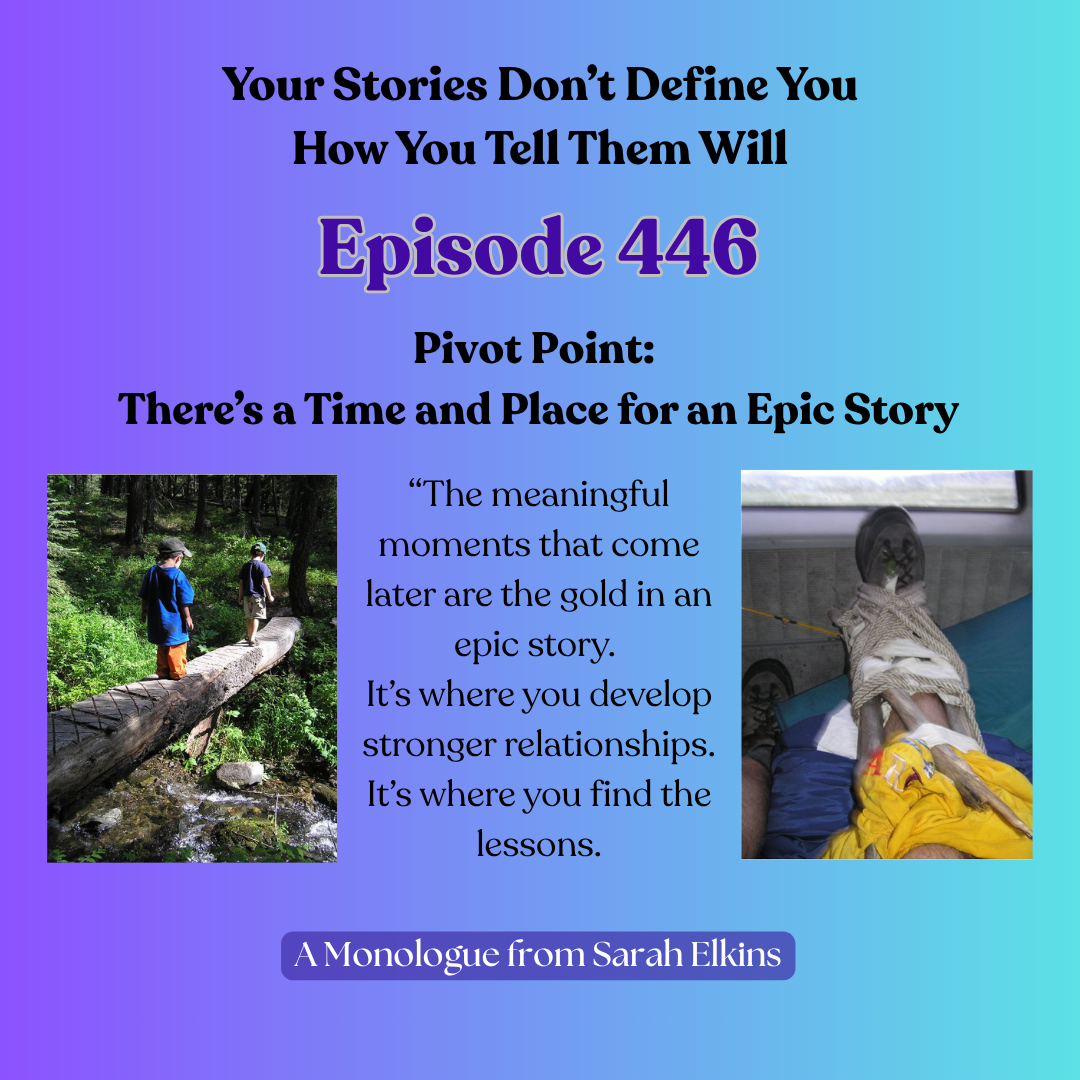
In today’s episode you’ll hear one of my epic stories, when, 20+ years ago, my husband broke his leg about 2 miles from a trailhead in a remote wilderness area. I had to find a way to get my husband off the side of a mountain, along with our 4 and 6-year-old boys and a puppy.
Over the next few weeks, I'll share some of the meaningful moments that were generated by the epic event. These are the gold of the story - the lessons learned, the deep friendships, and the self-realizations - that happen when you're truly put to the test. This is where we learn grit, resilience, and the importance of being able to receive.
Summertime is hard on podcasters!
We lose a lot of our listeners this time of year and it can be difficult to be motivated to keep putting out quality content when we know people aren’t as likely to listen.
This summer I’ve been focused on brief, less than 20-minute episodes that keep a person’s attention while still offering insights and entertainment.
What you’ve been hearing, and will continue to hear in each episode, is a brief story of a pivotal moment in a person’s life, and then a thread pulled to generate insights about it. I have two goals for you:
One – to uncover your related story for you to add to your collection to practice and have ready when the opportunity presents itself.
And two – to demonstrate storytelling in a practical, approachable way. Acknowledging that small, meaningful moments make great stories.
You've probably heard me say: "Your stories don't have to be epic. They have to be meaningful." But there is a time and a place for an epic story. They can be life-defining, entertaining, and a great way to gather people together.
And it's the days, months, and years of related stories generated from the experience that offer far deeper insights and lessons than the experience itself.
In today’s episode you’ll hear one of my epic stories, when, 20+ years ago, my husband broke his leg about 2 miles from a trailhead in a remote wilderness area. I had to find a way to get my husband off the side of a mountain, along with our 4 and 6-year-old boys and a puppy.
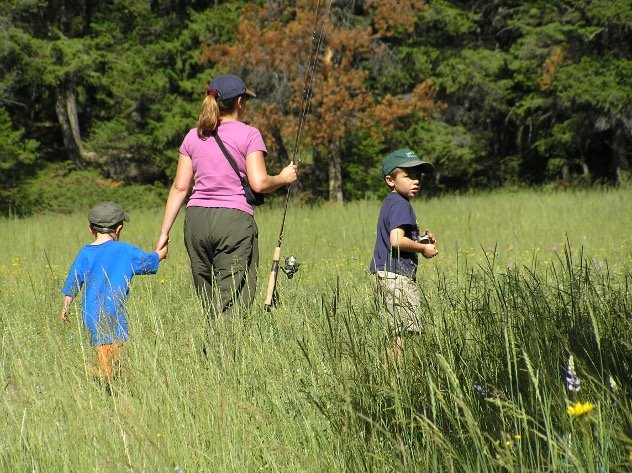
Hike to Crow Creek Lake 2005
Over the next few weeks, I'll share some of the meaningful moments that were generated by the epic event. These are the gold of the story - the lessons learned, the deep friendships, and the self-realizations that happen when you're truly put to the test. This is where we learn grit, resilience, and the importance of being able to receive.
After you’ve heard my story, listeners, it’ll be your turn:
Were you reminded of an epic event in your life?
Can you recall the related stories from that event, the meaningful moments generated by it?
What lessons can you take away? Can you share those stories without sharing details of the epic event itself?
As always, thanks for listening to Your Stories Don’t Define You, How You Tell Them Will. Are you curious to learn about working with me? Visit my website to schedule time to chat and sign up for periodic updates about my work, and connect with me on Instagram, LinkedIn, and Facebook for content about Strengthsfinder, storytelling, and public speaking.
After more than 430 episodes of this podcast, I was recently inspired to change the format of the show.
The new format for my show aligns with what I’m learning about narrative identity (how the stories we tell about ourselves internally and externally influence our identity) and demonstrates what I’ve been teaching for years: Sharing a story to reveal who you are and what matters to you.
My hope is that future episodes will offer more clarity about great storytelling and how to find and explore pivotal moments to demonstrate who we are.
About Sarah:
Sarah is a Montana based workplace communication trainer, TEDx speaker, DisruptHR speaker, public speaking coach, professional storyteller, musician, and podcast host. Her workshops and coaching packages with teams and their leaders are known to address and reduce miscommunication – the most common cause of tension and stress in the workplace. Using the team’s results from the StrengthsFinder assessment, she guides teams in learning to speak each other’s “language”, learning to value each other’s strengths and connecting with each other through enhanced self-reflection and effective listening.
Sarah’s nearly 20 years working in government agencies inspired her to complete her MBA and to achieve her StrengthsFinder certification to improve work environments for others, guiding teams toward increased satisfaction, productivity, and happiness.
Visit her website to purchase her book, Your Stories Don't Define You in paperback or audiobook.
445 Pivot Point: Finding Your Lost Mojo featuring Thomas Lion
In today’s episode you’ll hear about Thomas Lion’s recovery from the loss of his home in western Oregon to a wildfire. The fire took his home and everything in it, including the first draft of his book, Gridless in Seattle.
So, what do you do when you've lost everything?
Pivotal Moment: A 2015 wildfire destroyed his home, including the 180-page hard-copy manuscript for his latest novel, Gridless Near Seattle.
Summertime is hard on podcasters!
We lose a lot of our listeners this time of year and it can be difficult to be motivated to keep putting out quality content when we know people aren’t as likely to listen.
This summer I’ve been focused on brief, less than 20-minute episodes that keep a person’s attention while still offering insights and entertainment.
What you’ve been hearing, and will continue to hear in each episode, is a brief story of a pivotal moment in a person’s life, and then a thread pulled to generate insights about it. I have two goals for you:

One – to uncover your related story for you to add to your collection to practice and have ready when the opportunity presents itself.
And two – to demonstrate storytelling in a practical, approachable way. Acknowledging that small, meaningful moments make great stories.
In today’s episode you’ll hear about Thomas Lion’s recovery from the loss of his home to a wildfire. The fire took his home and everything in it, including the first draft of his book, Gridless Near Seattle.
So, what do you do when you've lost everything?
Pivotal Moment: A 2015 wildfire destroyed his home, including the 180-page hard-copy manuscript for his latest novel, Gridless Near Seattle.
He rebuilt his life over and over again in the past, but after a wildfire took out his beautiful log home along with the draft of his novel, Thomas couldn't bring himself to go back to it.
That momentum-killer of loss held him for 7 years - until the right messenger showed up to remind him he's a writer, a talented one, and that he needed to sit down and get started again.
He restarted the novel, changed the title to Osprey Gold, and incorporated real-life experiences like his loss of a newly planted vinyard, thanks to highly motivated bears, and the pivot to a legal cannabis growing farm.
Curious? Listen to the episode, and then buy the book. I'd love to hear your thoughts!
Listeners, now it's your turn:
What will you get back to work on, after hearing Thomas' story of resilience and persistence?
Who are the people who advocated for you, who are the people you'll listen to when you need a champion and cheerleader?
---
From Thomas Lion
I’ve lived a long, colorful life — retiring from major marijuana wholesaling at 25, followed by five fugitive years that ended in an Unsolved Mysteries capture and years incarcerated teaching GED classes. My 1998 memoir was later optioned by Lions Gate. Between Osprey Gold and the Unsolved Mysteries American Fugitive memoir arc that came before it — the long road, the phoenix rise after losing everything in the 2015 wildfires, the rebuild, and the late‑life return to the writing rodeo — I’ve got a story your Boomer audience will connect with deeply. It’s one of those rare indie author journeys that’s truly worth telling. My writing comes from lived experience and resilience, with Osprey Gold shaped by the emotional engine of a modern‑day family facing crisis and reconciliation in polarized rural western America.
Check out the reviews of Tom's book, Osprey Gold:
Amazon.com: Osprey Gold: 9781662970191: Lion, Thomas: Books
Interview with Thomas Lion, Author of Osprey Gold - Seattle Book Review
Book review of Osprey Gold - Readers' Favorite: Book Reviews and Award Contest
After more than 430 episodes of this podcast, I was recently inspired to change the format of the show.
The new format for my show aligns with what I’m learning about narrative identity (how the stories we tell about ourselves internally and externally influence our identity) and demonstrates what I’ve been teaching for years: Sharing a story to reveal who you are and what matters to you.
My hope is that future episodes will offer more clarity about great storytelling and how to find and explore pivotal moments to demonstrate who we are.
About Sarah:
Sarah is a Montana based workplace communication trainer, TEDx speaker, DisruptHR speaker, public speaking coach, professional storyteller, musician, and podcast host. Her workshops and coaching packages with teams and their leaders are known to address and reduce miscommunication – the most common cause of tension and stress in the workplace. Using the team’s results from the StrengthsFinder assessment, she guides teams in learning to speak each other’s “language”, learning to value each other’s strengths and connecting with each other through enhanced self-reflection and effective listening.
Sarah’s nearly 20 years working in government agencies inspired her to complete her MBA and to achieve her StrengthsFinder certification to improve work environments for others, guiding teams toward increased satisfaction, productivity, and happiness.
Visit her website to purchase her book, Your Stories Don't Define You in paperback or audiobook.