

Your Stories Don’t Define You
How You Tell Them Will
A podcast to unlock your stories and uncover meaningful insights.
391 Stories and Connection
It is vital to our own communities that we remember our stories and share them with one another, not to dwell on regrets and what ifs, but to reach out and connect with one another so that we all can learn and grow together, and hopefully create more grand stories on the paths we walk together.
In this revisited episode, Sarah Elkins and Lee Keylock discuss their own stories and how they have healed through sharing stories and listening to the stories that others share with us.
391 Stories and Connection

It is vital to our own communities that we remember our stories and share them with one another, not to dwell on regrets and what ifs, but to reach out and connect with one another so that we all can learn and grow together, and hopefully create more grand stories on the paths we walk together.
In this revisited episode, Sarah Elkins and Lee Keylock discuss their own stories and how they have healed through sharing stories and listening to the stories that others share with us.
Highlights
Connecting with people through sharing stories.
Healing from trauma through stories and the community that sharing those stories creates.
The changing paths our decisions create and how we should live in the moment and not dwell on what ifs.
Greet the world and the challenges offered with open minds and a willingness to learn.
Quotes
“No regrets. Life is sliding doors right? If it’s meant to be, it's meant to be.”
“We’re perpetual students, right? I’ve never approached anything I’ve ever done as an authority on anything.”
“It’s not enough to just hear stories. That can be brilliant and beautiful and life changing and you can have those moments, but when we work with youth we want them to think about how they can use stories to think about themselves, their communities, and the world and their place in it, and how they can become agents of change.”
About Lee
Lee Keylock is Director of Global Programs at Narrative 4 and oversees the coordination and administration of all aspects of N4’s ongoing programmatic development. Originally from Britain, Lee immigrated to the United States in 1989 and taught English at Newtown High School in Connecticut for thirteen years. He has served as an adjunct professor teaching Creative Writing and Composition at Southern Connecticut State University in New Haven, where he also earned his MFA in Creative Writing.
Connect with Lee on LinkedIn, Facebook, or Instagram! And make sure you check out his website Narrative 4!
About Sarah
"Uncovering the right stories for the right audiences so executives, leaders, public speakers, and job seekers can clearly and actively demonstrate their character, values, and vision."
In my work with coaching clients, I guide people to improve their communication using storytelling as the foundation of our work together. What I’ve realized over years of coaching and podcasting is that the majority of people don’t realize the impact of the stories they share - on their internal messages, and on the people they’re sharing them with.
My work with leaders and people who aspire to be leaders follows a similar path to the interviews on my podcast, uncovering pivotal moments in their lives and learning how to share them to connect more authentically with others, to make their presentations and speaking more engaging, to reveal patterns that have kept them stuck or moved them forward, and to improve their relationships at work and at home.
The audiobook, Your Stories Don’t Define You, How You Tell Them Will is now available!
Included with your purchase are two bonus tracks, songs recorded by Sarah's band, Spare Change, in her living room in Montana.
Be sure to check out the Storytelling For Professionals Course as well to make sure you nail that next interview!
Episode 112: Why Do We Believe Lyrics?
I opened my eyes and the restaurant had become very quiet. Many of the conversations had stopped momentarily, and I noticed the host and a server standing at the edge of the dining room, listening. For the first time that evening, I had the attention of the busy customers and staff. Finishing the song, I could see from the expressions that the song hit its mark.
Lyrics Create Powerful Internal Connections through Stories and Emotion
“...but it’s the little things, the little things,
not expectations
that make life worth living, worth living.”
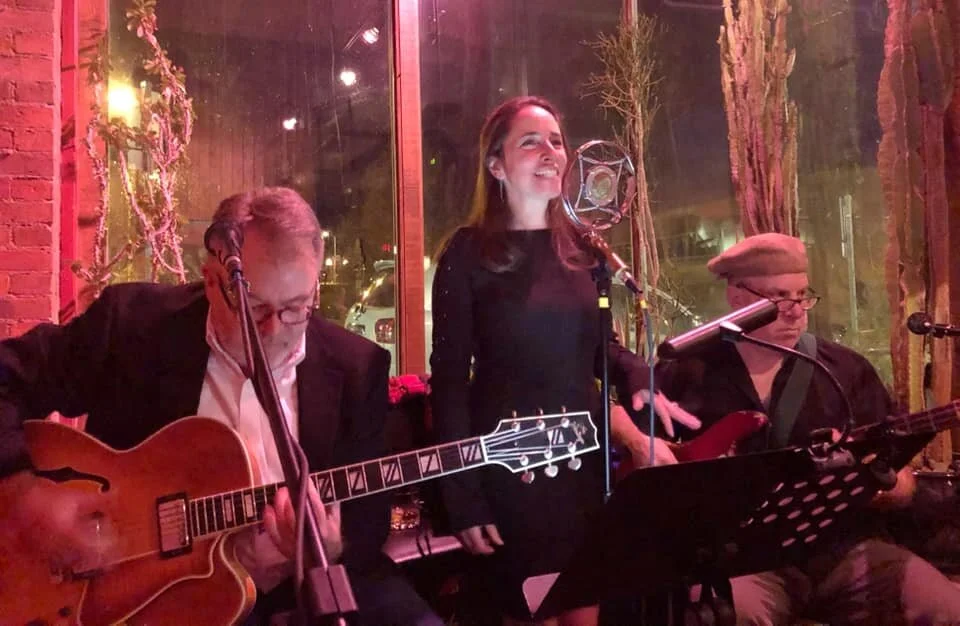
Spare Change at On Broadway, Helena, Montana (Photo credit, Angie Fiskum)
Those were the lyrics I was hearing in my head over and over again as I processed the previous two weeks of drama at our house. My husband had discovered this song by JJ Grey and Mofro, and had suggested we work on it to perform with one of our bands.
The first time we practiced that song, it was everything in me to sing it without tears dripping down my cheeks. The soulfulness that JJ Grey infuses as he performs it, through his tone, his phrasing, and his emotion, is captivating and heartbreaking.
I hadn't heard of JJ Grey before we started learning that song, but it didn't take long for me to find a few songs that were equally powerful.
As I performed it for the first time at a gig, I closed my eyes as I reached the chorus:
“Glory glory, hallelujah
The sun is shining, shining down
Glory glory, hallelujah
I’m alive, and I’m feeling, feeling fine.”
I opened my eyes and the restaurant had become very quiet. Many of the conversations had stopped momentarily, and I noticed the host and a server standing at the edge of the dining room, listening. For the first time that evening, I had the attention of the busy customers and staff. Finishing the song, I could see from the expressions that the song hit its mark.
Later that evening, as I was visiting with another musician who had come to support us, she asked me about the song. “I could tell it was really meaningful to you, Sarah.”
I couldn’t stop thinking about the response of the audience to that song as I tried to go to sleep that night. It struck me how powerful lyrics can be, and I started to wonder what it is about songs, lyrics, poems, and other forms of art that reach into your heart and soul and grip them in fierce joy and devastating sorrow.
What is it about music and lyrics that make us BELIEVE them? Why is it that we believe that there is truth in them, without any knowledge of the songwriter's credentials? Is he a psychoanalyst? How does she KNOW?
Think about the song you listen to when you’re sad, when you’re happy, the music that helps you process experiences. They tell stories with messages in them, and for some reason, even with no data or research to support the assertions, we believe them. Why?
Maybe it’s the fact that they speak to a human condition, common themes that we experience in life, isolation, pain, love, heartbreak. All the things we experience on a unique, individual level, but that resonate across all human life - even as we say: “You don’t understand” to someone who tries to help.

Spare Change at Draughtworks, Missoula, Montana 2019
Isn’t it puzzling that we respond in that way, to our parents, to our friends, “you don’t understand”, but then listen to a song written by a total stranger and find great comfort that he or she understands, even when the lyrics have nothing in common with our actual, individual experience?
My friend Trent doesn’t believe in empathy, and I can understand why. He says that when we say: “I know how you feel,” we’re shifting the conversation and making it about ourselves. How can we possibly know how someone feels if we cannot hear the internal voice that’s screaming at them?
And yet… we know, thanks to neuroscience, that we often cannot help mirroring - reflecting the emotions of another person. Which is basically the definition of empathy. But that’s not actually FEELING what someone else is feeling. It’s reflecting our version of their emotion, based on our own experience and internal messaging.
I do believe in empathy. I believe some people can actually feel what another is feeling, in terms of emotion, otherwise music and lyrics simply wouldn’t have the impact they have on us. And I don’t believe empathy is something we can or should teach. I would much prefer to help people learn compassion by learning to observe the emotions in others, and maybe have a sense through those observations about their happiness and pain through our own lens of experience.
Lyrics and music speaks to our humanity, our common language of the spectrum of emotion from euphoria to sorrow, bringing us comfort by demonstrating, through the songwriter and performer, that we are not alone in this world, that someone, somewhere went through something similar and came out on the other side.
I’m a big believer in identifying theme songs for different situations in our lives, selecting songs that speak to us when we’re feeling insecure, sad, lonely, or absurdly happy and satisfied.
I’ve found that when I have my theme song in my head, James Brown’s I Feel Good, before I step in front of an audience for a keynote, my energy is almost immediately transferred to the people in front of me.
What will your theme song be the next time you’re stepping out of your comfort zone? What lyrics will you have in your head that bring you comfort, that you believe to be absolutely true, to know you’re not alone as you step into the spotlight?