Your Stories Don’t Define You
How You Tell Them Will
A podcast to unlock your stories and uncover meaningful insights.
Episode 198: At What Point Do We Respond to Past Trauma to Define Ourselves with Intention?
At what point in our lives do we respond to our trauma and define who we are?
In Sarah Elkins' latest podcast, she and writer Cheryl Bostrom,
talk about Cheryl’s newest novel, "Sugar Birds", and the connections between the characters and pieces of ourselves.
Strengthen your trajectory in life as Sarah and Cheryl draw deeper into this topic of self-discovery through hardship.
Sugar Birds by Cheryl Bostrom: Entertaining and Full of Soul
*Note from Sarah: We're just two weeks away from publishing our 200th episode! If you're a fan of the podcast, we'd love to hear from you and include your words at the beginning of that episode. Simply email your thoughts to sarahelkins@elkinsconsulting.com, or record a short voice memo on your phone and email it to me. Thank you in advance for helping us celebrate this milestone!*

At what point in our lives do we respond to our trauma and define who we are?
In Sarah Elkins' latest podcast, she and writer Cheryl Bostrom,
talk about Cheryl’s newest novel, "Sugar Birds", and the connections between the characters and pieces of ourselves.
Cheryl discusses her characters in terms of her own experiences, some of which we may relate to including: running from trauma, struggling with depression, dodging emotional bullets, and becoming self-reflective.

Strengthen your trajectory in life as Sarah and Cheryl draw deeper into this topic of self-discovery through hardship.
"It arrived as so many of these things have for me, like pieces in the jigsaw puzzle or like you said like the mosaic that composes us or that helps us to see who we are becoming and how we are being shaped.”
*Show notes contributed by Tracy Ackeret
About Cheryl:
Cheryl Bostrom is the author of the award-winning novel, “Sugar
Birds”, a Pacific Northwest naturalist, photographer, and editor. Cheryl has also written two non-fiction books entitled “The View from Goose Ridge: Watching Nature Seeing Life” and “Children At Promise: 9 Principles to Help Kids Thrive in an at Risk World” with Dr. Tim Stuart.
Cheryl attended Pacific Lutheran University and Washington State University.
Visit Cheryl’s website, check out her books, and follow Cheryl on LinkedIn and Twitter to learn more!
*podcast show notes contributed by Tracy Ackeret
ABOUT SARAH:

Image of Sarah Elkins and her dog in the snow with Elkins Consulting logo and StrengthsFinder logo
"Uncovering the right stories for the right audiences so executives, leaders, public speakers, and job seekers can clearly and actively demonstrate their character, values, and vision."
In my work with coaching clients, I guide people to improve their communication using storytelling as the foundation of our work together. What I’ve realized over years of coaching and podcasting is that the majority of people don’t realize the impact of the stories they share - on their internal messages, and on the people they’re sharing them with.

My work with leaders and people who aspire to be leaders follows a similar path to the interviews on my podcast, uncovering pivotal moments in their lives and learning how to share them to connect more authentically with others, to make their presentations and speaking more engaging, to reveal patterns that have kept them stuck or moved them forward, and to improve their relationships at work and at home.
The audiobook, Your Stories Don’t Define You, How You Tell Them Will is now available!
Included with your purchase are two bonus tracks, songs recorded by Sarah's band, Spare Change, in her living room in Montana.
Episode 186: True Stories Can Bring Your Work of Fiction to Life
Our conversation easily flowed from topic to topic, and it was clear to both of us that the themes from the book are highly relevant in many of our friends' lives, as well as our own.
Each of the protagonists is in a very different place in their lives, one in her early 30s, another in her mid 40s, and another in her late 60s. And yet, each is grappling with transition and transformation in their lives, which is what brings them together.
A Novel About Transformation and Resilience Includes Aspects of Truth
Suzanne Simonetti sees parts of herself in each of her characters, but she relates most closely with Krystal in her award-winning novel The Sounds of Wings.
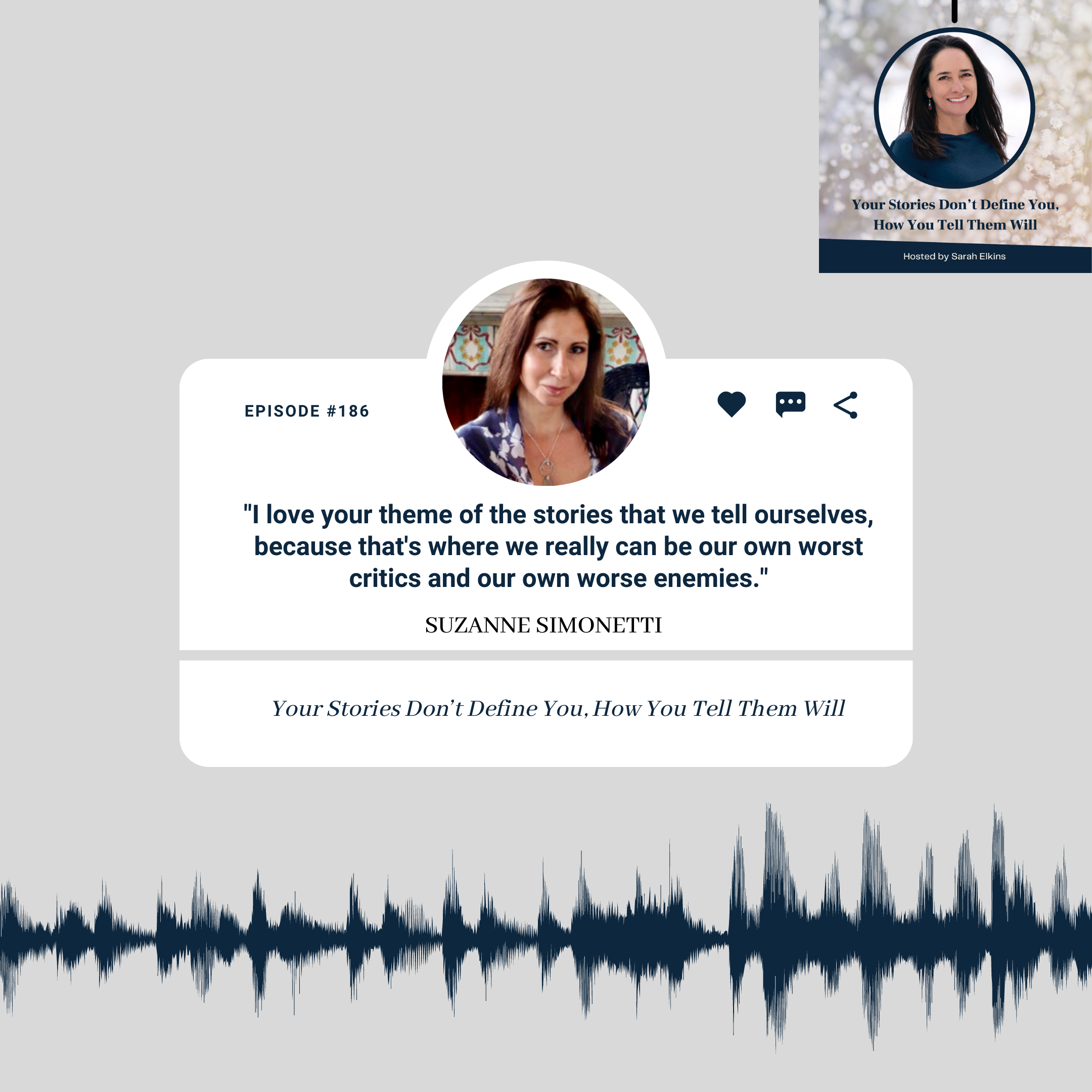
Suzanne Simonetti podcast episode cover art with image and quote
Our conversation easily flowed from topic to topic, and it was clear to both of us that the themes from the book are highly relevant in many of our friends' lives, as well as our own.
Each of the protagonists is in a very different place in their lives, one in her early 30s, another in her mid 40s, and another in her late 60s. And yet, each is grappling with transition and transformation in their lives, which is what brings them together.
Highlights for me:
A major theme of the book is silencing our own ghosts from our past. We must be able to tell the stories of our paths without reliving them, to be able to see those stories as lessons to take forward.

Suzanne Simonetti podcast episode cover art book cover and quote
A theme that resonated strongly with me is the way women grow into relationships with themselves and with (and among) other women. In the book, the three main protagonists forge unlikely friendships, despite their distinct differences. I loved seeing the personal growth each experienced as they learned to trust the other women who happened to show up in their lives.
We spoke of Suzanne's mentor, award-winning, NYT Best Selling Author Caroline Leavitt, as well as our mutual friend, Meg Nocero, also an award-winning author, both outstanding women you will be glad you discovered through this podcast.
Make sure you follow Suzanne on Instagram, and check out her website to learn more.
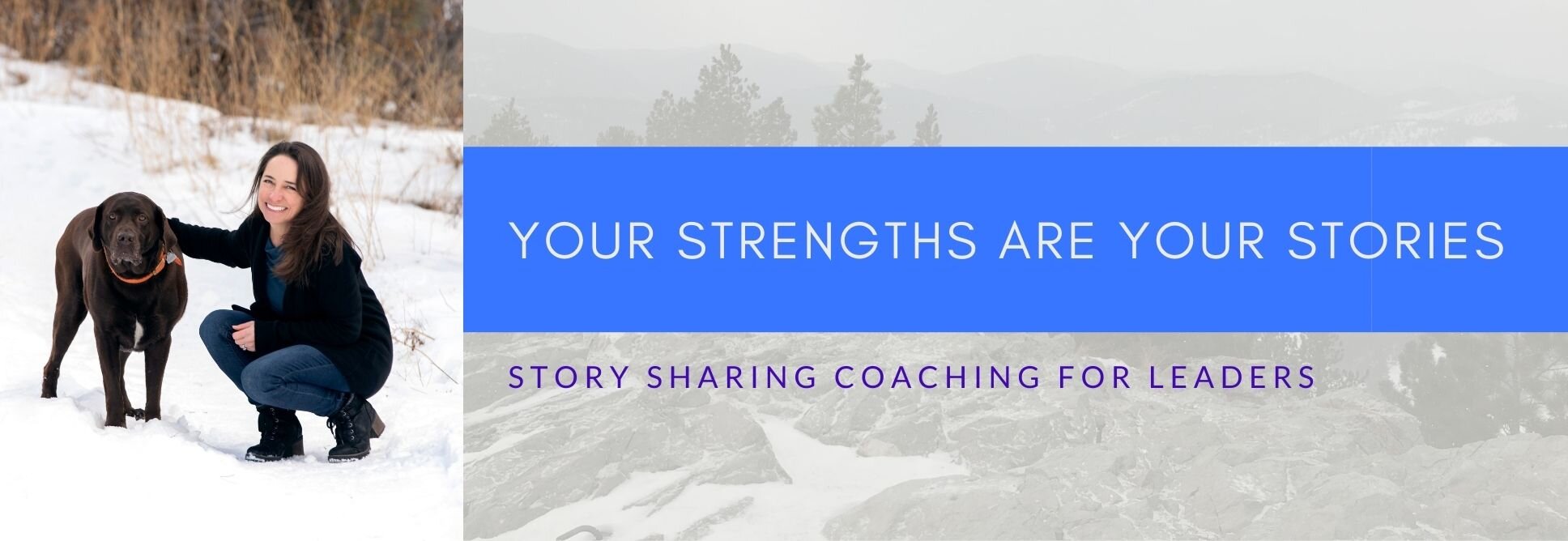
Elkins Consulting cover art image of Sarah Elkins and her dog on a wintery, snow covered mountain
ABOUT SARAH:
"Uncovering the right stories for the right audiences so executives, leaders, public speakers, and job seekers can clearly and actively demonstrate their character, values, and vision."
In my work with coaching clients, I guide people to improve their communication using storytelling as the foundation of our work together. What I’ve realized over years of coaching and podcasting is that the majority of people don’t realize the impact of the stories they share - on their internal messages, and on the people they’re sharing them with.
My work with leaders and people who aspire to be leaders follows a similar path to the interviews on my podcast, uncovering pivotal moments in their lives and learning how to share them to connect more authentically with others, to make their presentations and speaking more engaging, to reveal patterns that have kept them stuck or moved them forward, and to improve their relationships at work and at home.
The audiobook, Your Stories Don’t Define You, How You Tell Them Will is now available!
Included with your purchase are two bonus tracks, songs recorded by Sarah's band, Spare Change, in her living room in Montana.
Your Brain on Stories: How Stories Impact Your World View
He was sitting in the school library with his friends on a rainy day, laughing and getting the negative attention of the staff. Picking up a random novel from the shelf to hide behind and pretend to read, a sentence actually caught his attention, and he was completely transported to the world of Dune.
Impacts of Hearing and Writing Other People's Stories
He was sitting in the school library with his friends on a rainy day, laughing and getting the negative attention of the staff. Picking up a random novel from the shelf to hide behind and pretend to read, a sentence actually caught his attention, and he was transported to the world of Dune.

It was the third in the series, and when he finished it, he went back to read the first two. That fateful rainy day changed how David Amerland saw his world, and his future in it. The premise behind Dune, written in 1965 is incredibly relevant today. Like so many of our most cherished science fiction novels, we’re seeing ominous signals of our future, strangely mirroring our wildest science fiction fantasies of the past.
In Dune, the people of the future are like computers, our minds are what drive development, not the opposite, as we see today. And that’s what David saw in his future; recognizing the incredible power of the human brain, and how it’s impacted by what we observe, consciously and unconsciously.
Our thoughts and behaviors are shaped by our perceptions of all of our interactions, experiences, and observations of our stories, and we’re also shaped by other people’s stories that we hear and read. Many iterations of “rags to riches” stories capture our attention, not because they are our stories, but because we are motivated and enthralled by the stories we want to relate to. When we hear or read about the struggles, obstacles, and successes of others, we can see ourselves in those stories, even if our experiences are completely different. It’s the emotion – the feelings – behind the stories that capture our attention, not necessarily the actual experiences.
Recent studies have shown that hearing someone tell a story triggers specific activity in our brains. When we hear a story being told, the active part of our brain is the same active part of the brain as the person who is telling the story. In other words, if I share a story really well, I can get others to practically experience it.
There’s more to it, of course, involving release of oxytocin in the brain. You can read more here, and here.
Listen to this fascinating conversation with David Amerland, and let us know your thoughts in the comments.
David Amerland is an international speaker, author and business journalist. He's also a gypsy careerist (like me), because his interests span the spectrum of science and humanity. His recently published book, The Sniper Mind, takes mindfulness and focus techniques that are critical to success in that arena, and applies those techniques to professional and personal success. I'm a little conflicted with this idea, and at the same time, totally intrigued by it.
Enjoyed the podcast? Read about David on his website, connect with him on LinkedIn, and buy his book.