
Your Stories Don’t Define You
How You Tell Them Will
A podcast to unlock your stories and uncover meaningful insights.
430: Every Emotion Comes from Needs, Met and Unmet - featuring Morgane Borzée
"... we talk about feelings, but... At the end, every feeling has an underlying need. If it's a pleasant feeling, it's a met need. If it's an unpleasant feeling, it's an unmet need. And needs drive our behavior."
This conversation with Morgane Borzée filled in so many gaps in my understanding of what I've heard referred to as trauma-informed coaching, teaching, and counseling.
I thought I understood the connection between emotional intelligence and behavior, but I was missing a key component:
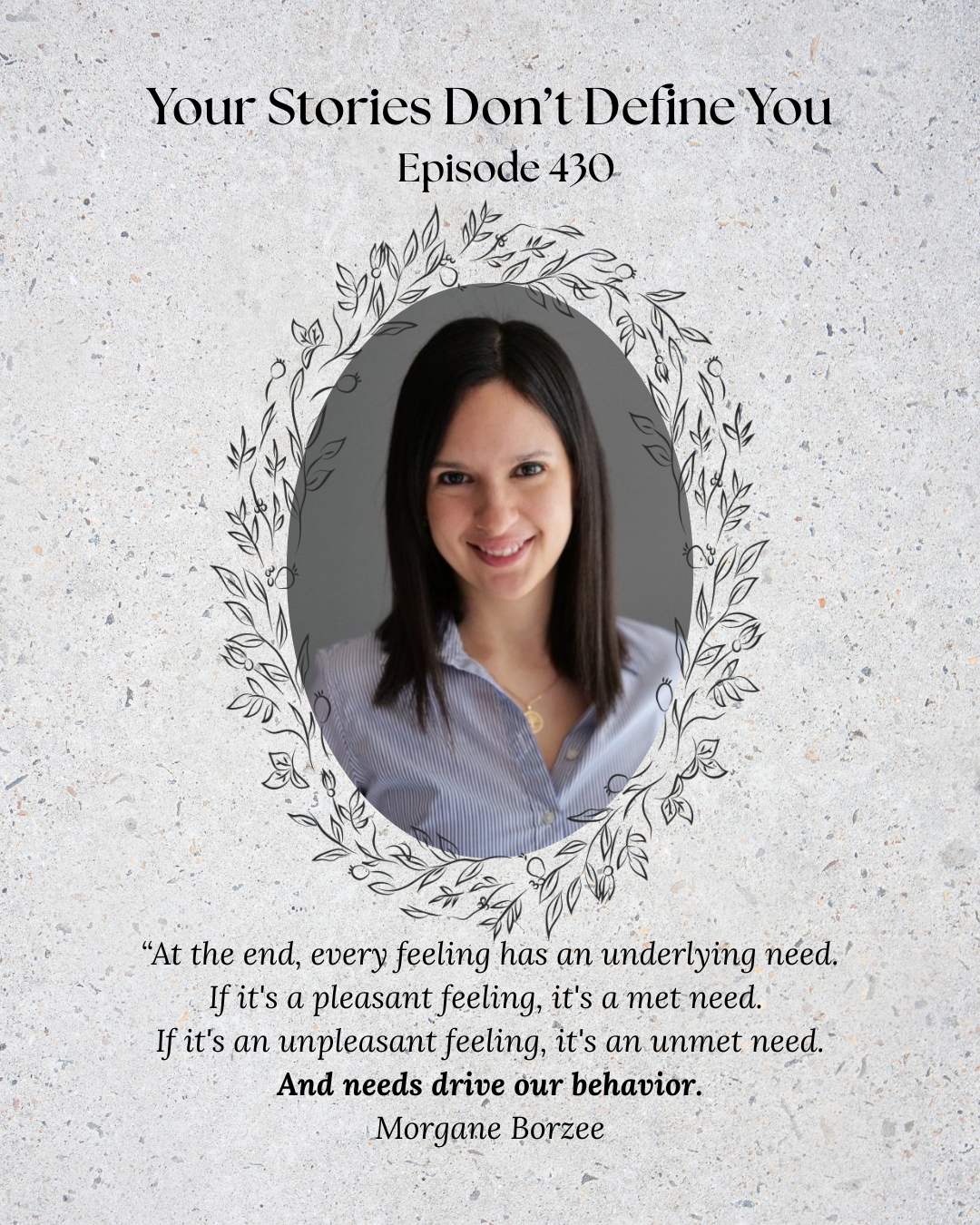
"... we talk about feelings, but... At the end, every feeling has an underlying need. If it's a pleasant feeling, it's a met need. If it's an unpleasant feeling, it's an unmet need. And needs drive our behavior."
This conversation with Morgane Borzée filled in so many gaps in my understanding of what I've heard referred to as trauma-informed coaching, teaching, and counseling.
If you're anything like me, you associated the word trauma with something dramatic, like abuse or neglect, death, major accidents, war, natural disasters, etc. Many of us don't feel comfortable using the word trauma to describe experiences in our lives that don't seem to compare with what we know others have experienced.
But trauma in childhood can be something as innocuous as an underlying current of the repression of anger, financial stress and anxiety, sibling rivalry. And each person experiences it differently. Ask your siblings or cousins about growing up and they'll remember completely different episodes as traumatic - or not.
Morgane suffered from severe anxiety as a young adult, and was referred to a therapist that she didn't realize was a trauma specialist. She thought she might be in the wrong place until she heard from the therapist that her anxiety might be coming from repression of anger. And she might be repressing anger because that's how she responded to her fear of the anger she saw expressed in her childhood home, among her family.
"... for years, I was shortcutting anger with anxiety. So whenever a situation would make me angry, I didn't feel angry, I felt anxious."
Her experience with the therapist not only gave her the tools she needed to start truly addressing the anxiety at that deeper level. It gave her the inspiration she then used to create an incredible platform to make what she was learning more accessible and approachable for others.
She took what she learned in academic, research-based, deeply intellectual settings, and translated into everyday language and characters that the rest of us can apply, learn from, and make real change in our lives and those of the people we influence.
Highlights
The word trauma feels big, feels significant, and it is, but it's also relative. Each person experiences it differently.
Needs met and unmet are what drive our emotions and behavior.
Listeners, now it's your turn. During our call, I started writing notes about my own needs and how they affect my behavior when they're not met: My need for respect and how that might show up in emotional responses and anger.
What are yours?
A need for basic food staples in your house? If somebody gets upset when you run out of peanut butter or eggs, it may be a need in terms of food security that wasn't. What is a pattern of conflict or frustration that you've experienced yourself or experienced with somebody else that might be related to this issue? When your needs are met, you have a particular emotional response, and when they're not met, you have another emotional response. I'm curious to hear what came up for you, what patterns you've uncovered, and maybe what you're going to do about it.
From Morgane:
I’m the founder of Equanima. I created it after years of struggling with anxiety and realizing how powerful emotional intelligence can be when you actually understand what’s happening inside you.
As a designer, I saw a gap between complex psychological concepts and what people can realistically use in daily life. Equanima exists to bridge that gap by turning emotional intelligence into clear, practical, and visual tools that help people understand their patterns, regulate under pressure, and live more aligned lives.
Visit my website to learn more, and be sure to connect and/or follow me on LinkedIn and Instagram.
About Sarah

Sarah is a Montana based workplace communication trainer, TEDx speaker, DisruptHR speaker, public speaking coach, professional storyteller, musician, and podcast host. Her workshops and coaching packages with teams and their leaders are known to address and reduce miscommunication – the most common cause of tension and stress in the workplace. Using the team’s results from the StrengthsFinder assessment, she guides teams in learning to speak each other’s “language”, learning to value each other’s strengths and connecting with each other through enhanced self-reflection and effective listening.
Sarah’s nearly 20 years working in government agencies inspired her to complete her MBA and to achieve her StrengthsFinder certification to improve work environments for others, guiding teams toward increased satisfaction, productivity, and happiness.
Visit her website to purchase her book, Your Stories Don't Define You in paperback or audiobook.
302 Spread Love
With how the current world is it can be incredibly easy to become desensitized and disheartened, especially when we are surrounded by ignorance, hatred, and suffering. Feeling helpless and heartbroken in times like these is completely normal, but it’s important to take a breath and consider how you can help others, your community, and yourself. Traumatic events like these take time to heal from and no one is going to be okay overnight, but we can try to spread kindness and love even when we are hurting and mourning for others.
In this episode Sarah Elkins opens her heart to express her profound sadness, despair, and fear at the current state of the world, most notably the tragedy that is occurring in the Middle East.
302 Spread Love

With how the current world is it can be incredibly easy to become desensitized and disheartened, especially when we are surrounded by ignorance, hatred, and suffering. Feeling helpless and heartbroken in times like these is completely normal, but it’s important to take a breath and consider how you can help others, your community, and yourself. Traumatic events like these take time to heal from and no one is going to be okay overnight, but we can try to spread kindness and love even when we are hurting and mourning for others.
In this episode Sarah Elkins opens her heart to express her profound sadness, despair, and fear at the current state of the world, most notably the tragedy that is occurring in the Middle East.
Highlights
It’s okay to not be okay. Especially in the unfortunate world we live in.
Protect your neighbors, your friends, and your family. Be there for those who are hurting and prove to them and others that you stand with love.
The only place to have conversations that inform and change opinions is in person, not social media.
Quotes
“Can we separate civilians from their hateful government power grabs and evil actions? Or are we somehow responsible for our own suffering from terrorism?”
“Posting on social media isn’t really about informing people. No one ever changed their mind based on a meme they saw, or an article they read that was shared on a platform like facebook, instagram, or tiktok. When we share those memes or articles that confirm our own opinions we know they’ll either antagonize people or confirm our friends' opinions, they’ll never change them.”
Dear Listeners it is now your turn,
I’m asking you right now to tell people you are grieving for the families that are victims of brutal warfare. That you understand it’s their government, it’s their leaders, it’s those power hungry, greedy people who spew hate to distract us and create divisions, who are using us as pawns in their games of global chess. This isn’t a game. This is the worst of brutality against humanity, targeting civilians, targeting children.
I’m asking you to pay attention to what you share because what you share online matters, before you share anything ask yourself; “Am I contributing to hate?” “Am I contributing to alienation?”
I’m asking you right now to stop spewing hate and to start spreading love.
And, as always, thank you for listening.
About Sarah

"Uncovering the right stories for the right audiences so executives, leaders, public speakers, and job seekers can clearly and actively demonstrate their character, values, and vision."
In my work with coaching clients, I guide people to improve their communication using storytelling as the foundation of our work together. What I’ve realized over years of coaching and podcasting is that the majority of people don’t realize the impact of the stories they share - on their internal messages, and on the people they’re sharing them with.
My work with leaders and people who aspire to be leaders follows a similar path to the interviews on my podcast, uncovering pivotal moments in their lives and learning how to share them to connect more authentically with others, to make their presentations and speaking more engaging, to reveal patterns that have kept them stuck or moved them forward, and to improve their relationships at work and at home.
The audiobook, Your Stories Don’t Define You, How You Tell Them Will is now available!
Included with your purchase are two bonus tracks, songs recorded by Sarah's band, Spare Change, in her living room in Montana.
Be sure to check out the Storytelling For Professionals Course as well to make sure you nail that next interview!