
207: Want to Bring Out the Best In People? Listen to Them.
Listen, Ask Questions, Give Them An Answer
Have you ever had a job working for a difficult or mean boss? Or maybe you are a boss that struggles to connect with your employees? Thomas Jackson’s most memorable bosses are the ones who listened to his ideas and either implemented them or let them know why not.
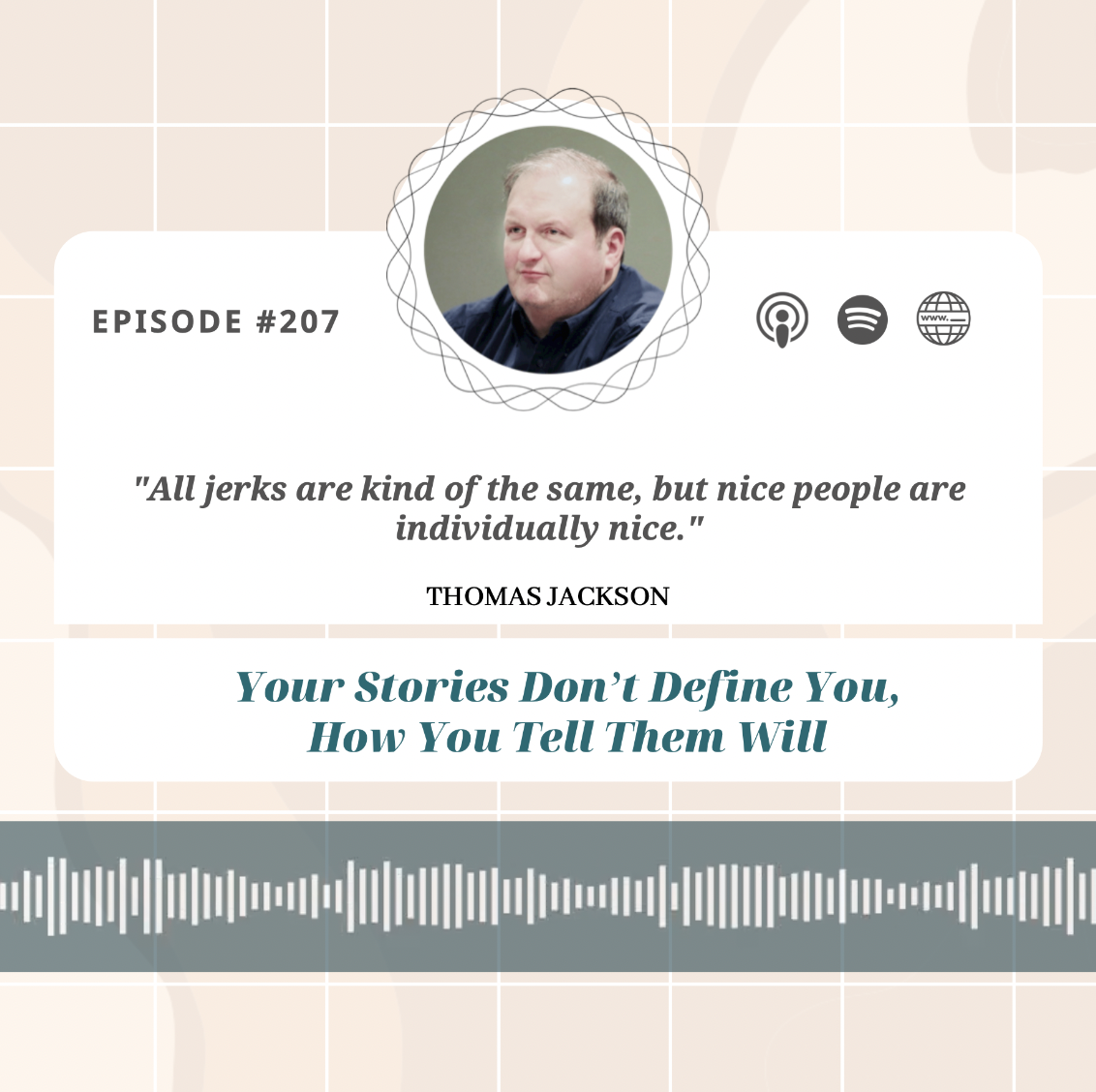
Listen to Sarah Elkins and Thomas Jackson, as they discuss the difference between an encouraging leader and a negative one. In this episode, Sarah and Thomas dive into this topic and share the memorable moments, whether good or bad, from their work experiences and the long-term effects on workers. They also talk about the No Longer Virtual event, and how you can build your professional network face-to-face.
Join in to see how your work environment can change based on the attitudes of the people around you.

“The difference between a nice person showing up in different ways, versus a mean person showing up the same way.”
*podcast show notes contributed by Tracy Ackeret

About Thomas:
Thomas Jackson is a UPS Driver Helper and Belt Splitter.
He enjoys writing articles for his LinkedIn profile and has over 2,000+ articles on the platform.
Visit Thomas’ LinkedIn profile and don’t hesitate to dive into his collection of articles.
ABOUT SARAH:

"Uncovering the right stories for the right audiences so executives, leaders, public speakers, and job seekers can clearly and actively demonstrate their character, values, and vision."
In my work with coaching clients, I guide people to improve their communication using storytelling as the foundation of our work together. What I’ve realized over years of coaching and podcasting is that the majority of people don’t realize the impact of the stories they share - on their internal messages, and on the people they’re sharing them with.
My work with leaders and people who aspire to be leaders follows a similar path to the interviews on my podcast, uncovering pivotal moments in their lives and learning how to share them to connect more authentically with others, to make their presentations and speaking more engaging, to reveal patterns that have kept them stuck or moved them forward, and to improve their relationships at work and at home.
The audiobook, Your Stories Don’t Define You, How You Tell Them Will is now available!
Included with your purchase are two bonus tracks, songs recorded by Sarah's band, Spare Change, in her living room in Montana.
Bicentennial Episode! An Accidental Podcaster Reaches Her 200th Episode
Hundreds of stories, people from all over the world, and life-changing conversations all have to lead to this special 200th episode of the "Your Stories Don’t Define You, How You Tell Them Will" podcast.
Sarah Elkins and her good friend, Neil Hughes, look back to the beginning of the podcast’s creation and the unexpected moments and lessons that emerged.
Sarah Elkins and Neil Hughes:
Origin Stories of Podcasts and Friendship

Hundreds of stories, people from all over the world, and life-changing conversations all have to lead to this special 200th episode of the "Your Stories Don’t Define You, How You Tell Them Will" podcast.
Sarah Elkins and her good friend, Neil Hughes, look back to the beginning of the podcast’s creation and the unexpected moments and lessons that emerged.
Tune in to hear more about the happy accidents and people that contribute to something bigger than yourself.
“If you’re open, the universe will nudge you in the right direction.”

*podcast show notes contributed by Tracy Ackeret
About Neil:

Neil Hughes is a tech columnist, best-selling author, LinkedIn top voice, freelance writer, ghostwriter, tech blogger, podcast host, and podcast producer.
Visit Neil’s website and follow him on LinkedIn!
*podcast show notes contributed by Tracy Ackeret
ABOUT SARAH:
"Uncovering the right stories for the right audiences so executives, leaders, public speakers, and job seekers can clearly and actively demonstrate their character, values, and vision."
In my work with coaching clients, I guide people to improve their communication using storytelling as the foundation of our work together. What I’ve realized over years of coaching and podcasting is that the majority of people don’t realize the impact of the stories they share - on their internal messages, and on the people they’re sharing them with.
My work with leaders and people who aspire to be leaders follows a similar path to the interviews on my podcast, uncovering pivotal moments in their lives and learning how to share them to connect more authentically with others, to make their presentations and speaking more engaging, to reveal patterns that have kept them stuck or moved them forward, and to improve their relationships at work and at home.
The audiobook, Your Stories Don’t Define You, How You Tell Them Will is now available!
Included with your purchase are two bonus tracks, songs recorded by Sarah's band, Spare Change, in her living room in Montana.
Episode 107: Strategies to Take Action to Avoid Future Regrets
4 Simple Strategies to Take Action
1.) Find Your Tribe – surround yourself with people who support and encourage you. Find a group of friends and peers that are doing things you want to be doing, people who will give you the hard truth about your dream and offer to help find solutions to obstacles. Make sure these are people you trust, and that you actually listen to their suggestions! You are unlikely to find support in people who have never done what you want to do, or who live with a low-risk, low-reward mentality, people who make fear-based decisions.
If You Don’t Do SOMETHING, Nothing Will Change
My dream is to create a sewing business around a design I created.
That’s terrific, Nancy, tell me about that!
I’ve always loved to sew, and I’ve created a pattern that can be easily replicated and scaled to different sizes and materials. It’s such a cool design, and I have never seen anything quite like it. It’s functional, and every person I’ve given one to as a gift, or who has seen it has loved it and wanted more.
Very cool! What are doing now to make this dream happen?
What do you mean?
I mean, in the evenings, on weekends, and when you can get breaks during your workday, what are you DOING?
Oh. Well by the time I get home from work, I’m emotionally and intellectually spent, so I don’t have the energy or even the creativity to sew. And with my mom’s health problems, and helping out with my grandkids, I just don’t have time to work on my own things.
Hmmm. Do you have space set up so that if and when you have a little time, you can jump right into creative mode and layout your next project - or start to sew?
No. My sewing room is filled with boxes and stuff from when I moved last year.
Our conversation continued along those lines, an excuse for every suggestion I made:
Maybe start by setting aside 15 minutes when you get home from work to put your sewing room in order?
Schedule 15 minutes 3x each week to organize your fabrics and start planning projects?
Think about setting a small goal, like sewing 3 of your design to take pictures and start a portfolio?
She had a reason she couldn’t do those things – for every suggestion.
So I asked her:
Will we have this same conversation a year from now, 5 years from now? Will you regret not doing something to change this?
If you don’t take action right now – today – you will not see any changes in your life. Guaranteed. You’re unhappy, but unwilling to change anything, so you will continue to be unhappy and dissatisfied. How do you think that impacts your relationship with your kids, grandkids, and coworkers? Do you think they don’t know you’re unhappy, do you think you’re hiding it?
That’s when she walked away from me - I felt like I had failed my friend. She walked away with her shoulders slumped, deflated. My heart broke, thinking I had gone too far, hurt her feelings and maybe made things worse.
I gave it a few hours, and then sent her a text message saying: “I hope I didn’t go too far. It just makes me sad to see you so unhappy because you are such a generous and compassionate person. You deserve happiness.”
She didn’t respond to my message. When we saw each other over the next few months she’d smile at me and we would exchange small talk, but I could tell she was uncomfortable. A few months later I gave my notice, said my goodbyes, and moved on to another career path, following a dream.
A year after that I was in the building again and ran into my friend. Her face absolutely glowed as she bee-lined toward me and gave me a huge hug. I hadn’t seen her like that – ever – and asked what was going on.
I have been thinking about calling you, Sarah, but I couldn’t find the right time, and I felt weird about it, even though I wanted to tell you that I’ve been sewing again and have sold a few of my designs! My ideas are flowing and I’m feeling creative again, it feels SO GOOD.
I asked her: “What changed? What was the inspiration that motivated you to do it?”
Remember when you asked me if I would regret not doing something about this dream a year from now? You asked if we were going to continue to have this same conversation year after year? It took me a few weeks to recover from that conversation. I felt like a loser. But then I remembered one of your suggestions, to schedule small chunks of time to make a physical, comfortable space for my sewing, to organize my sewing room to make it more inviting. And that’s what I did. It took MONTHS. But then, about a week after I finished, I walked into that room and was absolutely inspired to start a project.
I planned to spend 15 minutes on it, but walked out 1.5 hours later with a completed project and felt amazing. It was like a veil had lifted and my creativity returned.
Wow! I’m so happy to hear that! Has anything changed at work?
Yes! That’s the thing, I am finding my job a little more satisfying. Nothing here has changed. I still deal with the obnoxious attitude from you-know-who, and continue to have more work dumped on me than I can handle, but I look at it differently now that I’m making time for myself and having fun exploring my creative side again.
We hugged goodbye, promised to keep in touch, and I left the building as if I was walking on air.
We can talk about things we want to do, dreams we have, ideas we want to initiate and implement, but until we take a step that’s all those things are – dreams and ideas.
The only way we see change in our lives is if we initiate it or something happens to us. I would much rather be the one to initiate it most of the time, how about you?
4 Simple Strategies to Take Action
1.) Find Your Tribe – surround yourself with people who support and encourage you. Find a group of friends and peers that are doing things you want to be doing, people who will give you the hard truth about your dream and offer to help find solutions to obstacles. Make sure these are people you trust, and that you actually listen to their suggestions! You are unlikely to find support in people who have never done what you want to do, or who live with a low-risk, low-reward mentality, people who make fear-based decisions.
2.) Schedule Baby Steps – use the calendar on your phone or desk/refrigerator calendar to schedule short appointments for yourself, maybe 15 minute intervals to work on your dream in some way. If you spend 15 minutes every day being outcome-oriented toward your goal, you will see major changes in all aspects of your life. What do I mean by outcome-oriented? Think about something you can complete in that time, like organizing a pile of papers on your desk, scheduling calls or coffee dates with people who can help you, and who you feel like you can help (accountability partners, for instance), or writing up a blog post.
3.) Say Yes – when opportunities present themselves, show up. Step out of your comfort zone.
4.) Change Your Environment – Periodically changing your environment keeps your brain limber, more aware, and creative. That means weekend road trips, walks, taking different routes to work, time in nature, traveling, and exploring alternative hobbies.
If you’re tired of the same conversation, year after year, and realize you will most definitely regret NOT doing something, NOT taking action toward a dream or goal, do something about it TODAY.
Join me and an extraordinary group of professionals at the 2020, 4th annual No Longer Virtual conference on March 12 & 13th in Chicago. When I say “find your tribe”, this group is what I’m talking about. The common characteristics of people who attend are curiosity, compassion, and an entrepreneurial mindset.
The agenda is full of relevant, engaging sessions, and you’ll be surrounded by some of the most wicked-smart, generous, creative, supportive professionals around. Limited to 50 participants, you’ll have the opportunity to truly connect and build strong relationships. And the best part? You’ll avoid the “after-conference hangover” by remaining in close contact with your network after the event.
Here’s a peek at the agenda:
Supercharge your LinkedIn experience, hosted by Shelly Elsliger & Zach Messler
Turning ideas into action by clarifying your why, prioritizing, action planning & increasing accountability, hosted by Kris Macc & Craig Thomason
Non-sales workshop to engage your audience and grow your revenue, hosted by Hannah Bratterud and Arlene Mendoza
Achieving win-win relationships to improve your outcomes, with a field trip to the Art Institute of Chicago, hosted by Chris Spurvey & Megan Miller
Nurturing your emotional health to improve outcomes, hosted by Renee Smith & Kevin Strauss
DISCOUNT CODE:
Since early registration ended, here’s a $100 discount offer from the full price NLVFRIEND, and if you make arrangements with me to register two or more guests, I’ll offer a discount code for $125 off each of your registrations.
There are 13 spots left as of January 12, 2020!
I hope to see you at #nlvchicago2020, investing in yourself, taking the steps necessary to take action toward your dreams, and building and nurturing your network that can help you get there.
Episode 59: Old Stories Create New Pathways
What Stories From Your Past Still Color Your Present?

His mother went to answer the door while his family sat at the supper table. Chris heard a man's voice, and watched as his father went into the living room. A demonstration and 40 minutes of answers to every objection later, that Electrolux vacuum salesman in the brown polyester suit with bad breath left with an order for a $3,000 machine.
Chris was 10 years old, and his image of a salesman was set for decades. Not only did his family have a vacuum cleaner they didn't need and couldn't afford, his parents bickered over it for months afterward.
Fast forward to Chris as a young adult with entrepreneurial aspirations and the realization that he'd have to get more comfortable with sales if he was going to be successful. He hired a coach who was able to peel back the layers of Chris's experience to find that vacuum salesman and his impact on how Chris saw the word "salesman."

80s Style: Friendship Pins
In the beginning of our conversation, Chris mentioned his love for heavy metal music, particularly in the late 80s and early 90s. He spoke about wearing his Metallica jean jacket to church, and about having the opportunity to play guitar with a band on Sunday evenings in the same church, and blowing away the senior women with the sound. We made a few references during that part of our conversation, one to a scene in Back to the Future with Michael J. Fox, and another about my friend Ranjith Abraham, and his musical projects, Miles Apart.
Connect with Chris on LinkedIn, and check out his book, It’s Time to Sell. Learn more about Chris and his gifted approach to sales and leadership by visiting his website.
Connect Beyond the Keyboard
NLV is a two day professional development opportunity designed with a full curriculum-style agenda to help you and your business thrive. It’s limited to 50 participants, so you have the opportunity to truly get to know every person in the room. Sessions range from brain-science and mindset strategies to building your brand across platforms, hosted by some of your favorite LinkedIn connections.
So why am I recording this video on a mountain in Montana? Because the overall theme of NLV is to connect beyond the keyboard, taking your online connections to the next level in an enriching environment, filled with relevant content.
We humans are designed to use all of our senses to maintain and improve our brains, and our capacity for healthy relationships with others. LinkedIn and other platforms have offered us incredible opportunities to meet, learn from, and collaborate with people all over the world, without ever meeting face-to-face. That’s pretty amazing.
But there’s a limit to what you can accomplish from behind your keyboard. At some point, if you want to build authentic, powerful relationships, you must experience the world in first person.
You can read about climbing a mountain, look at pictures, and even feel like you’re climbing by watching someone else on a big screen, but you’re missing 90% of the experience.
As I stand here looking out over my little city, I’m breathing clean, crisp, fresh air. I’m smelling the pine needles, the damp soil that will freeze soon. I’m seeing the details of the leaves that have changed color and are barely hanging onto their trees, ready to drop for winter. I can hear the breeze coming up through the trees on the mountain, and I’m feeling the crunch of the rocks and dry grass under my feet.
I can’t experience that through a screen.
Register for No Longer Virtual today; save yourself some money by registering before November 1.
Still on the fence? Check out some of the reviews from past participants:
Join me, learn together – in the same room - with some of your favorite LinkedIn connections. Take your connections beyond the keyboard and create an even more powerful network. Visit elkinsconsulting.com to register, and for more information, and contact me directly with questions. I can’t wait to meet you at NLV!
Avoiding the After Conference Hangover
Create Memorable Stories and Relationships to Keep Your Momentum and Inspiration

No Longer Virtual, Denver 2018
I was so excited to start working on some of the ideas I had, and to apply what I had learned, I actually arrived early to work the morning I returned from the conference. That's a big deal for me; I love to sleep and rarely choose to get up any earlier than I have to. But that morning was different. That week would be different. My JOB would be different. I was on fire.
The conference had been full of great topics, from sales to leadership, from marketing to financial analysis. The keynote session and the breakout session hosted by the keynote speaker were my favorites. The topics were marketing, and he drilled down in the breakout session to help us work through some his strategies to apply them to our specific goals. He reminded me why I loved that class when I was going through my undergraduate business program. His excitement for the planning process, implementation, and follow up analysis was contagious; I couldn't wait to get back to work and start my own projects!
That Monday, I sat down at my desk and penciled in time on my busy calendar to work on a formal marketing plan. When I started that job just four months before, I dove right in and didn’t give myself any opportunity to think through a strategy to market the hotel. It’s as if I had forgotten all of what I had learned in school.
I thought that giving myself a set amount of time, maybe 30 minutes each day would get me to where I wanted to be. I started first thing that morning by looking at available online templates for a marketing plan that would fit the needs of the hotel, and selected a simple but solid format to download. My boss walked in as I was saving it; he was surprised to see me already settled into my day, earlier than usual. In an uneasy, suspicious, fake-happy tone, he asked me:
“What are you so happily working on first thing this morning?”
"You know that break-out session I went to at the conference last week? The one on marketing plans and implementation? I'm working on a marketing plan for us, to formalize some of what I've been doing, to make it easier to budget and measure the success of what we're doing here. We can’t possibly analyze whether what we’re spending money on in advertisement is working unless we find a way to measure it, right? I've been so busy since I started my job here, trying to make sales and get people in the door, I completely forgot how important this tool can be!"
He had no idea what I was talking about, and erupted at me: “Why do we need a marketing plan? You should be pounding the pavement. Didn't we have this conversation, that you need to spend less time onsite and more time selling?”
In less than ten seconds, my boss had me nearly deflated. I didn't give up, though, because I knew I was on the right track. Every time I had 15 minutes alone in the office, I worked on that marketing plan. I knew I needed the document to help me stay on track and see the results of my efforts at that job. In my optimistic mind, when I presented the finished product to my boss, he'd appreciate it -- he'd realized why we needed it.
I'll save the results of that work for another blog post; let's just say it wasn't pretty.
I tried to keep my enthusiasm that week and the next. Interactions with staff included some discussion of things I learned and ideas I wanted to share; some were motivated to work on them. Most just nodded and smiled, assuming the ideas would go away and they could get back to their routines without having to work too hard.
Within two weeks, I may as well have not gone to that conference at all. I had an after-conference hangover.
I had been all excited, full of motivation and ambition for my job when I returned from the conference, but because my boss didn’t understand the “why” behind my project ideas, my colleagues hadn’t been to the conference and hadn’t experienced the camaraderie and enthusiasm of the other participants and the speakers, and because I had zero support at work for implementation of new ideas, all of that excitement and motivation just *poof* disappeared.
What a waste of time, money, and, well, ME.
Granted, my boss wasn’t great at his job and it wasn’t a good work environment in general, but aren’t there things I could have done to prevent the deflation of my enthusiasm, if I knew in advance it was likely to happen?
I am a big believer in attending face-to-face conferences and events, especially when you’re particular about the types of events you attend. There is nothing like that face-to-face learning and interaction with others in your industry or simply with people who have similar motivation and ambition - regardless of industry.
Every event is an opportunity to improve yourself, and not just to gain skills for your current job, so how do we make the most of these conferences? And, more importantly, how do we keep our enthusiasm when we’re faced with little to no support and encouragement when we go home and back to our routines?
I have a few strategies that I’ve used in recent years and have found them to be effective when I’m consistent with them:
First - During a conference, I don’t try to meet as many people as possible - I try to meet a handful of people and get to know them well. Believe it or not, I am actually kind of shy, so this isn’t as easy as it sounds!
I make sure to attend meals and sit at tables with people I don’t know. There are a few good stories I know I can share to make people laugh, especially when I’m in a big city outside of Montana. People are always curious about Montana, so that’s a great topic to start with. And then I simply ask people questions like:
Where do you live?
Did you grow up there?
Do you have pets, kids?
Did you get any good nuggets in the morning sessions you attended, anything you’re thinking of working through when you get home?
Being a bit shy doesn’t mean I don’t like to talk to people, it just means it’s not easy for me to walk into a roomful of strangers and start talking to them. The one thing that always works for me is curiosity. When I’m genuinely curious about people, they feel it and respond to that curiosity.
When I’m asking questions, I’m looking right at the person answering, making sure I catch their name, and if they have a name tag on, looking at the written letters and then at his or her face, and creating a mental image of the name with the face. That helps me remember names and some details about the conversation.
Asking those questions is a great way to know whether this person is enthusiastic and motivated by what they do. Those are the people I make special efforts to connect more deeply with.
When I attended the Government Social Media Conference in Dallas, I met dozens of really motivated, ambitious people that I liked a lot. I connected deeply with about 6 of them. More than a year later, I’m still in touch with 4 of those people and we connect periodically to catch up. Those four people continue to motivate me!
On our last day, four of us checked out of the hotel and shared a ride to a Vietnamese restaurant across town, and three of us shared a ride to the airport after that. The experience of sharing the ride, sharing food, and then enjoying a cocktail together at the airport made the connections even more sticky, more real.
Why do I pick just a handful of people to get to know well?
Because these are the people who help me avoid that after-conference hangover, that’s the other half of my strategy - to keep in contact with that handful of people.
When I return from a conference, I go straight to my calendar and schedule follow up calls with the people I connected with. I also schedule time each week to work on whatever really excited me at the conference, even if those were not directly related to my current job.
It was when I was planning the first No Longer Virtual conference in Atlanta in 2017 that this concept, the After Conference Hangover, really took shape in my mind. After many years of attending conferences and planning events, I had a lot of ideas about what I didn’t want for No Longer Virtual, and one major component was to include strategies throughout the conference to help participants avoid that after-conference hangover. That included making sure that everyone in the room had contact information for each other, and specific communication plans following the event.
Because participation is limited to 50 people, every person had the opportunity to meet the facilitators and other participants, to truly connect with each person. Think about the value of that roomful of advocates for you, your career, and your business, when you keep in contact following an event. Not only was there learning and motivation from the event itself; the relationships that were built in those 48 hours created a sustainable energy well beyond the last session.
The next time you’re investing time and money to attend a conference, think about how you’ll be able to sustain that motivation and inspiration after you get home.
If you’re intrigued by my description of No Longer Virtual events, visit my website, elkinsconsulting.com for more information.
Your "What" Defines Your "Why", and Your "How" Follows
I walked away from the workshop with that Rock Star Feeling (RSF). It's that feeling when you walk away from an encounter, project, or situation knowing you nailed it. I call it RSF because I've experienced it as a musician; walking away from a performance with that euphoric high feeling, and knowing you will do almost anything to feel that way again... soon.
It was a valuable couple of hours for me, and not because I was paid for them. I walked away from the workshop with that Rock Star Feeling (RSF). It's that feeling when you walk away from an encounter, project, or situation knowing you nailed it. I call it RSF because I've experienced it as a musician; walking away from a performance with that euphoric high feeling, and knowing you will do almost anything to feel that way again... soon. It's that sense that you're really good at something; you've contributed, and that you're providing value to the people around you.
1.) Storytelling to Improve Sales
I had completed a two-hour workshop focused on the topic of storytelling to improve sales, as part of a two-day retreat for a regional group of sales leaders, when I walked away with that feeling. When the workshop ended, almost everyone in the room took a moment to ask me a question, share a story, or hug me before I walked out the door.
As a group, we created space for everyone in that room to feel safe, comfortable, and curious. We shared stories that connected us, and we discussed what makes a specific personal story the right story to share, when, and how to share it. We talked about reading our audience, and we came to the conclusion that in sales, we have to be in it for the long haul if we want to sustain our business and the relationships we create. It was clear that sharing a personal story is one great strategy to draw out the stories of others. We also talked about the fact that business is about people, and that when someone buys from us, they're not just buying a product; they're creating a relationship with us.
It took me a few hours to decompress and process everything that happened in those two hours, but I couldn't shake the feeling that I had discovered - or uncovered - something about myself that I had been searching for.

2.) No Longer Virtual
That was two weeks before I hosted the second annual No Longer Virtual conference, or #NLVDenver. Not quite a rock star feeling, as I decompressed in the days following #NLV, I found myself a little conflicted. I knew it was a success, and by the accounts of almost every participant, people got far more out of attending than they could have imagined. But I couldn't put my finger on what, exactly, was giving me this feeling of dissatisfaction. That is - until I was sharing this vulnerability with my dear friend Aaron Skogen, and he asked me this question:
How did you plan to define success with #NLV?
I was more than a little embarrassed. With all of my education, experience and my incredible support network, I hadn't considered this important question at all. Well, that's not exactly true. I had considered what I wanted out of #NLV, but I hadn't written it down anywhere. I hadn't told anyone, and I hadn't found ways to quantify success, other than breaking even financially in the first few years.
When I considered the question, I realized that success for NLV was simply creating an environment for people to connect authentically, and to learn and grow together. And it was certainly a success if I measured it that way.
A few years ago, I realized I'm a slow processor. It takes time for me to fully process an event, an incident, an intense conversation. By process, I mean to fully reflect on what it meant to me, the lessons I could learn from it, and how I'll apply whatever it was to future scenarios. And now, more than a year after the first #NLV, I'm finally feeling like I've fully processed the experience.
Good things come in threes, I'm told, and it was the third event that finally helped me put things together in my head.
3.) Women's Leadership Network, Helena, Membership Social
Our local Women's Leadership Network hosted a social event and invited women from all over the community to network, ride the carousel, drink champagne, and eat ice cream. The goal was to create buzz and recognition for our growing, thriving organization, and to encourage more women to join. It was a success in many ways, but the key for me was the environment we created as a board. We created space in our little community for women to be together in a casual, fun place, to share food and drinks, and to be comfortable being themselves.
For a while, I focused on my "why" as my ability to encourage people to step out of their comfort zones and take risks they wouldn't otherwise take. Now I know that ability is a component of something more dynamic. It took me figuring out my "what" to truly define my "why". Sounds backward, right? Does it matter how you get there, as long as you get there? I don't think so.
Here it is, my "what"... drum roll, please...

As I work to process this new idea, I can see that everything I've done successfully in my past has been part of this "why", from hosting guests in our home, to facilitating groups for the Montana University System, to creating a safe place in an office for people to share their frustrations and successes.
Where ever I sit, I am compelled to create an environment where people feel safe and confident to share their biggest dreams, fears, joys, and challenges. Whatever I am doing, I find my joy, my satisfaction, in creating space for people to take risks for personal and professional growth, and support and motivate them to take specific steps to achieve their goals.
And my "why" followed:

This isn't an overnight lightning bolt; it has taken years of self reflection to come to my "why", and many pivotal conversations with people who know me, and for whom I have so much respect, admiration, and gratitude. What's a little disconcerting is that one person has been telling me this for almost 20 years; I'm not sure I was ready to believe it, and I definitely didn't have a clue how to apply it to providing income for me and my family.
And now? Now I'm ready to put my "why" into my "what", so the "how" will present itself. (Thanks, Arminda Lindsay.)
I'm asking for your help in putting my "what" into action:
When you're planning a retreat or conference, and you want a session that's truly unique, engaging, and effective in creating space for your team to explore storytelling as a tool for communication and sales, call me. Let's explore how my "why" can help you fully realize your "how".