


Hungry and Scared: A Story to Build Courage
I weighed under 100 pounds when I graduated from college. My mother came for graduation and stared at me. "Are you anorexic?!" No, mom, just broke.
Leaving home to go to college can be pretty traumatic, but if you're on a traditional path and move right into a dormitory, that trauma can be mellowed a lot. You don't necessarily have to cook every meal for yourself, and you're unlikely to have to start buying your own toilet paper. There are still rules in a dormitory, so you're still expected to behave as if others are watching you.
But leaving college, moving away from friends and family, and starting something completely out of your comfort zone can be a much bigger adjustment.
When I graduated and planned to move from Fort Collins, Colorado, to Washington D.C. for a paid internship, I couldn't have been more confident and excited for my next adventure. But subconsciously, I must have had my doubts. When I drove my mother to the airport after spending graduation weekend together, I melted down. The reality that my childhood was coming to an end, and that I didn't have a plan for the next time I would see anyone in my family hit me like a ton of bricks.
It wasn't until years later that I realized the value of this story in my past, the lessons I learned, and the opportunity I had to share my vulnerability with someone who could not only handle it, but who would also learn from the experience.
I weighed under 100 pounds when I graduated from college. My mother came for graduation and stared at me. "Are you anorexic?!"
Nope. I'm just broke.
She was heartbroken that I hadn't told her I was struggling. She couldn't believe I would rather go without food than ask her for help. Really, though, that wasn't it at all.
I simply didn't consider asking for help. As I've written before, I've always been independent. And after traveling through Australia and New Zealand, I was fiercely independent. It just never occurred to me to ask for help.
My mother and I have always been close; we've also always been like oil & water. I've never doubted her love for me. There has never been a doubt that she would be there for me no matter what, and that she would always have my back. That's why, when I graduated from college, I had such a hard time saying goodbye to her. We didn't have a plan for the next time we'd see each other.
She flew in from Sacramento to Fort Collins for graduation, had a great weekend full of fun celebrations, and then the weekend was over and I was driving her to the airport. We were chatting away on the ride to the tiny airport. I was about to head off to my next adventure; a coveted position as a paid intern in Washington DC at the US International Trade Commission. As I drove her in my little blue Chevette, I wasn't thinking at all about her leaving. I was yammering about packing up my apartment, working my shift at a restaurant on New Year's Eve, and then packing up my little car to head to Colorado Springs to see my dad and sister before moving across the country. It was a full plate and my mind was spinning.
I pulled up at the entrance to the airport and helped my mom get her luggage out of the car. We hugged, her eyes teared up and I gave her the warning expression "don't start, mom." I walked her just inside the automatic doors and we hugged again. Then I walked away, got into my car, and started to drive down the bumpy road back toward I25.
It was December and the road was a little slippery, which is why, when I had a moment of sheer panic and slammed on my brakes to make a u-turn, my 180 became a 360. Somehow I managed to turn the car back toward the airport without seeing clearly through my streaming tears.
I parked right in front, in the no parking zone, and ran inside the airport. My mother had gone through what was, back then, the metal detector and security, and was sitting in the tiny waiting area at the gate. I ran right through that metal detector, right past the security guard. My mother saw me coming, tears streaming down my face, and stood up to grab me.
We hugged fiercely, both of us crying in relief, love, and grief. Yes, grief. It was the end of an era for our relationship. Even though we had been living over 1,000 miles apart for 5 years, we always knew when we'd see each other again; we always had a plan. But now, I was on my way to "adulting", moving to the big city and a big job (that's how I saw it, anyway).
Looking back, I can see that we were grieving that loss, though we were both excited for the future. At the time, all I knew was that I was leaving the comfort of young adulthood and taking on a mighty adventure... alone.
I cry every time I think about that goodbye, partly because that memory remains so strong, that feeling of loss and fear. The other reason my eyes fill when I think of that event is because I can now imagine my mother's conflicting feelings of sadness and joy at that moment. Joy for my achievement of graduation and upcoming adventure, joy at the feeling that I still needed her and loved her, and sadness at the end of this era in our relationship. This was the goodbye for her that signaled real time between visits and hugs.
Thankfully, these days we make plans to see each other regularly, and our relationship has only grown and improved over the years. When I need her, she's there. She arrived on my due date with our first son, and stayed until a couple of days after he was born. She gave him his first bath and took his tiny footprints. Six months later, she came back to DC to help me pack for our move across the country to Montana. Her dedication to writing on each box every. single. thing. she packed in it made it possible for us to settle into our rented house fairly quickly. And when we bought our first house a year later, she sent us a gift certificate for the light fixture we desperately wanted to replace a really ugly one in our living room. (We were going to have to wait, being house-poor was a reality for a few years.)
I still have trouble asking for help, but I've definitely improved over the years.
Every time I'm about to jump into a new adventure, that memory pops into my head. Sometimes I call her to share what I'm excited and nervous about, so I can feel that same relief I felt when we hugged inside the airport. I'm grateful for that memory for a couple of reasons:
Even though my heart was broken and I was really scared, I continued down that path for my adventure and it all turned out just fine, and that gives me the courage to continue on whatever path is currently opening up before me.
When I look at my own children and their independence and adventures, I remember my mother's words that day: "You'll be fine. You are smart and resourceful. You have all the tools to succeed in whatever you choose. And I'm here, no matter what, when you need me."
I'm about to step into another adventure this week. I'm excited. I'm nervous. My P/E ratio is through the roof. And I have my mother's words in my head.
What do you need to hear, what do you need to think and to know, before you step off into your next adventure? That voice can be your own. You don't need someone else to tell you what you need to hear. Just do it. Take the step. Don't regret.
THANK YOU FOR READING, COMMENTING ON, AND SHARING MY POSTS!
Please sign up here to receive email notification of new posts:
When External Expectations Improve Your Internal Story
Derek is a successful businessman, and he attributes his massive transformation from troubled kid to successful adult to one person. His childhood friend believed in him, stuck by him when he was known as a horrible person to be around, and made it clear that he wasn't going anywhere.
It was this person that inspired Derek to grow and change and transform his life - because he wanted his friend to be right in believing in him.
Derek is the CEO of At Hand Spray Systems, but prefers to be defined by his unique approach to problem solving. Most people try to solve problems in a linear way, which frequently results in symptom solving. Derek approaches problems spherically, using all 360 degrees to find solutions to the root cause, not the symptoms.

Getting Out Alive: A Story of Professional Survival
We were barreling down the road, at least double the speed limit in a 35 zone. And when we hit the highway, he was driving at least 110. For the first time since those warning signs I ignored during the interview, I realized I wasn't just risking my career, I was risking my life
"We were barreling down the road, at least double the speed limit in a 35 zone. And when we hit the highway, he was driving at least 110. For the first time since those warning signs I ignored during the interview, I realized I wasn't just risking my career, I was risking my life."
John White made the decision to invest in his future income that day - by jumping into an MBA program he'd been considering for a few years.
We had a great conversation about that moment in his life when he made the decision; have you had a moment like this one? Maybe not quite so dramatic, but still a large, negative push to follow a different path?
How Storytelling Shapes Your Internal Messages

I had the opportunity to ask Leili McKinley, founder and CEO of Identitype LLC a few questions about her pivotal moments in life, and how she was able to identify those moments, and years later was able to apply them to difficult situations.
She surprised me with her analogy of her skill in creating a corset as the foundation for a wedding gown designed during her time at Parson's School of Design in NYC. As she builds experiences, she sees those experiences as the corset-building, or foundation-building of her behavior, persistence, and success.
Visit Leili's website and LinkedIn profile for more information about the IdentitypeTM system she created (in her words):
... to help you be the leader you were born to be, build a brand, and grow your business (ME, Inc.) because you’re passionate about what you do, and because you want to create more income for yourself and the people you love.
Podcast: Is Imposter Syndrome Defining Your Internal Stories?
In other words, when you're outwardly successful, but often feel like a fraud, like at some point everyone will know about the "real" you.
Sarah Elkins | Your Stories Don't Define You | episode 2
Imposter syndrome, according to Cambridge dictionary online, is "the feeling that your achievements are not real, or that you do not deserve praise or success."

Sharing a story at Tell Us Something, Helena, Montana, April 2017
In other words, when you're outwardly successful, but often feel like a fraud, like at some point everyone will know about the "real" you.
There have been major studies about this phenomena, and great articles have been written to describe outwardly, wildly successful people who suffer from it. The article says that a person with imposter syndrome attaches almost exclusively external factors to their success, e.g. I was in the right place at the right time, I was fortunate to..., the opportunity landed in my lap, etc. While they attribute their failures internally, e.g. I'm not smart enough, I wasn't paying enough attention, etc.
Then there are those who turn it completely around, the non-imposter syndrome professionals who attribute their success almost entirely to their own intelligence, beauty, savvy, etc., and their failures are all externally driven, e.g. he didn't want me to succeed, I was in the wrong place at the wrong time, if only ---- had happened, etc. There's a Harvard Business Review article about overcoming imposter syndrome, placing the internal messages right up front in dealing with those minimizing thoughts.

I think there's a lot more to this. People who don't acknowledge the external contributing factors to their success, who describe themselves as "self made", are missing a major component of humility and humanity. No one is self-made, literally. But way beyond that, we have to consider genetics, family economic status, public utilities (if you're a manufacturer, guaranteed you use public roads to distribute your goods), education (even in the poorest communities, there are some fantastic, motivated educators), and access to mentors. Some people are driven by spite, so even a negative influence contributed to your success.
There are also those factors that contribute to failure: Do you acknowledge the internal factors? If you cannot take responsibility for those things you didn't succeed with, you're missing great opportunities for growth and connection with others. Blaming outside, external forces for failure means you do not acknowledge those moments when you were truly human. Where does that leave you?
Your internal messages come from all of your experiences, from your very early interactions, through your young adulthood. It's no wonder those messages are hard to fight; we're hard-wired to keep those messages, once they're placed in our heads. They've created pathways in our brain. It can be impossible to change them if you aren't aware of them, or where they came from.
I was walking through the open space of a friend's dorm with her, and two VERY tall basketball players stopped to say hello. One of them asked me out, and I said no thanks.
He put his huge hands on my hips and easily lifted me to set me down on top of a vending machine. I was in a sundress, the vending machine was very tall, and there was no way I could jump down.
I blushed deep pink and asked him to help me down. He laughed:
I'll help you down if you say you'll go out with me.
I shook my head no, and stared directly at his friend, the one I knew to be a nice guy.
Dude. That's not cool. Get her down from there.
He didn't, so his friend helped me down and apologized. When he put me down, I looked up (WAY up) at the culprit and said:
I. AM. NOT. A. TOY. Don't EVER do that again - to anyone.
They walked away, and I could hear the nice guy giving the other one a hard time. I was furious.
That wasn't the first time someone picked me up without my permission. As a matter of fact, it had happened many times. In elementary school, everyone wanted to give me piggy-back rides. In high school, I was asked to play one of the very young daughters in Fiddler on the Roof, though I had auditioned for a speaking, singing role.
Why? Because I'm small. I was lucky to pass 5' my freshman year of college; highly unusual for a girl to grow that late in life, but I did, and thank goodness. All I wanted was to outgrow my mother! But it's not just my height. When I graduated from college, I still weighed under 100 pounds. I couldn't find women's shoes in size 4.5 or 5, making professional outfits very difficult to complete.
I know this can sound really awesome, and it is in most ways; I am generally the most comfortable person on an airplane. Being small also means looking young, at least it does for me. The last time I was ID'd at a bar I was 41 years old. But when I was a professional in my late 20s and early 30s, looking young did not help me at all in getting others to take me seriously. In one meeting I was facilitating, a women in her 50s was dismissive toward me until I found an opportunity to share my age with the group. She looked at me, startled, and suddenly began to pay attention to me.
When a good friend recently heard about a trip I was taking, we were visiting about my expectations, and my concerns about it. I said: "It feels weird, Callie, like I'm just little Sarah from Montana, what do I have to contribute to this group?" I wasn't entirely serious; I know my value and I know I can make a difference in any situation. But that little voice spoke up, and it had to come from somewhere, right? She looked at me, a little shocked, and said: "Sarah. NO ONE thinks of you as little Sarah. NO ONE."

It took me a while to process that conversation; I had to dig into why I had that self-limiting voice still speaking to me. That's when I realized it has a lot to do with my size, and the way I was perceived because of it. When I meet someone and I'm sitting down, they are always visibly surprised to see how petite I am when I stand up. Clearly the way I'm presenting myself is much taller than my actual height.
Before my 20th high school reunion, I had dreams that I was in my old school, wandering through the halls saying hello to people. The weird thing was that I was much taller in my dream. I woke up a little disappointed, until I realized that's how I saw myself now, not as a physically taller person, but taller in stature.
A friend recently described himself as big and goofy, and I asked him where that came from, because that's not at all how I see him. He told me a story about having moved in 5th grade, and having to establish himself somehow in the new school. He found great success in being goofy; the other students responded to that silly, self-deprecating behavior, and he was able to make friends. Or, at least he could make his classmates laugh with him, rather than at him.
It got me thinking about how these childhood and young adulthood perceptions and words we used to describe ourselves - and others used to describe us - impact our current potential and success. It also got me thinking - again - about imposter syndrome and how to deal with it.
Up until recently, I thought I suffered from imposter syndrome. Now I'm thinking those internal messages are more an identity issue, a confidence issue. I attribute my success equally to hard work, experience, and introspection, and to the support network I have, the fortune of being born where and who I am, and to the relatively low-drama household in which I was raised. What I realized is that I'm not alone in feeling like a kid, like I'm just pretending to be a grown-up, and doing grown-up things. The other thing I realized is that I like that about myself, and those who relate to that sensation. It keeps us youthful, curious, adventurous, and optimistic.
What stories are you still telling yourself that are simply no longer true? Are those stories yours, or do they belong to someone else? Are you holding onto certain perceptions because they worked for you at some point? Is it time to let them go?
What are your thoughts about the difference between imposter syndrome, and self confidence?

Mid-Life Crisis? Dazed & Confused? You're Not Alone.
Are you going through a time of uncertainty? Are you feeling off-balance and lost? No one can solve your problems for you, but reaching out to encouraging, supportive, engaged friends will definitely help.
I recently read a sad article about a ridiculous number of women my age who are going through a sort of mid-life crisis. The part that caught my attention first was this:
"Hey," I said, happy to have caught her on a break from her job, "do you know anyone having a midlife crisis I could talk to?"
The phone was silent for a second.
Finally, she said, "I'm trying to think of any woman I know who's not."
When I read that exchange, I realized that women in my age range are having very similar experiences to current young adults just leaving high school and college.
Our world is so different from what I experienced as I left high school. Career paths were pretty traditional then, though there were some who took different journeys. Most of my friends didn’t think about the next step after high school because the next step was college; most of us never thought about NOT going on for a four year degree. I was surrounded by my middle class friends in suburban Colorado neighborhoods, but even my friends outside of that community knew the traditional path and generally followed it.
Those traditional paths still exist, but they’re an awful lot like where Kodak was about 30 years ago; they’re not real anymore.
Some people are seeing this as an exciting opportunity, a chance to do whatever seems right at any given moment. Others are experiencing a kind of agoraphobia, a sense of overwhelming loss and confusion. For them, it’s like being really hungry and going to a restaurant with too many menu options. They get so overwhelmed that they can’t make a decision and walk away starving.
Women who are going through this crisis are facing similarly overwhelming options, but instead of seeing this time as full of opportunity, they’re seeing it as failure, or worse, their lives completely shattered.
I have to keep reminding myself that not everyone likes to be in that “in-between” space, where I live most of the time. People who fit the equation comfort = happiness are overwhelmed by this time in their lives, while others who have consistently shifted gears to find the next adventure see this time as exciting and full of opportunity.
It’s hard to know what to do to help friends going through this phase of self-discovery and change; after all, their world is unbalanced and full of uncertainty. I’ve written about strategies for helping a person who is grieving, and they apply here, too. Remember that your friends are grieving. They’re grieving the loss of what they thought they wanted in life, the loss of their certainty, and potentially the loss of the foundation of their marriage and parents as their health deteriorates.
A good coach can help define the questions that need to be addressed, and will help clarify what the answers mean in terms of action steps and opportunities. Coaching is well worth the investment, and in combination with a counselor, can turn things around significantly. Not every counselor or coach is the same, so if you find one you don’t work well with, keep looking. Don’t stick with one you don’t feel excited to share with, but don’t give up on coaching or counseling if you have one negative or ineffective experience!
Listening is a huge part of allowing a person to grieve. If you are a good listener, that may be your primary role in helping your friends.
Being a positive force of encouragement and support is absolutely the best thing you can do for people. Make sure you have a small group that meets regularly to talk about the challenges and questions you’re all facing. More importantly, make sure the energy in that group remains positive. Each person in your group must have the ability and comfort level to intervene when a meeting turns into a rant session. A complaint-filled hour will only drag you down; when anyone in the group senses that things are going south in a conversation, they must know how to carefully switch gears and talk about actions people can take to move forward.
Are you going through a time of uncertainty? Are you feeling off-balance and lost? No one can solve your problems for you, but reaching out to encouraging, supportive, engaged friends will definitely help. I have what I call my N.A.G. group, Nudge – Advise – Guide, and we meet once each month to help us stay accountable to ourselves with our goals, to encourage and advise us when we have crazy ideas, and to guide us to make the best choices.
“If you regret any part of your past, think about your future, and make changes and efforts now, so you don’t look back again with regret.”
How you perceive this time in your life is YOUR CHOICE. You can wallow in sadness over the loss of what you thought you had, what you thought you wanted, or you can step up and live out the dreams you’ve dismissed while you were developing yourself to be who you are right now.
Dream big, take action, and be a good N.A.G. for others.
Get Out There!
I called out to her from the stage: "Come on! I can tell you want to let loose and dance! Come on out and have some fun!"
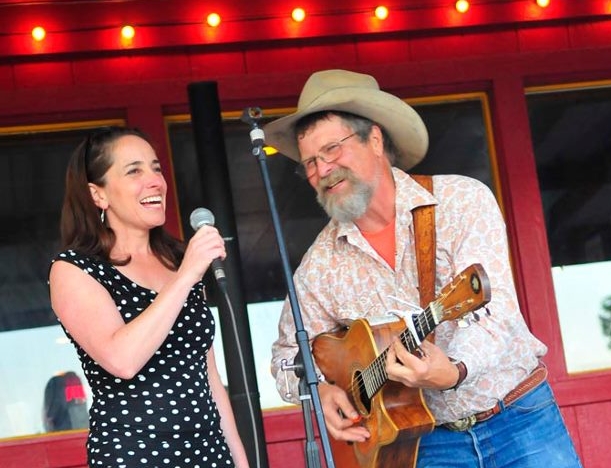
Photo by Eliza Wiley, Lakeside Helena with Sarah Elkins and Bruce Anfinson, Cowboy Poet
She was sitting on a bench in the corner of the room, watching people dancing and having fun. I could see her toe tapping, she seemed to be enjoying the music, but I couldn't really tell because her face didn't show any signs of a smile. I saw her the last time our band played at that venue, and remembered when she quietly came to me afterward to tell me how much she liked our band, and that if she knew how to dance, she would have. She was so shy.
I called out to her from the stage: "Come on out, dance with us! I can see you want to! Come on out and have some fun!" I motioned to my friends on the dance floor, smiling to encourage her.
She looked behind her, assuming I was talking to someone else. And then she looked straight at me with zero expression. I gave up. A song or two later, I noticed she had left her spot and walked further away from stage, watching from a safer distance.
I remember being shy, I remember being more self conscious than I am now. I like to say I don't regret, but there are definitely some moments in my past that I wish I could do over again. A lot of them involve sitting out a great song because I was self conscious about dancing. Opportunities flew right past me: To sing with great musicians, to dance, to swim in the ocean. The memories of that person, the girl who didn't raise her hand to volunteer on stage, the girl who said no to a cute boy because she didn't think she could dance, the one who was so concerned about how she looked or that she might mess up a note, those memories came back to me as I watched the woman in the audience look away from me. What a waste.
How did things change for me? With a little help from my friends. I was lucky enough to have friends to pull me out on the dance floor, to volunteer me to get on a stage, to tell me not to be scared. Now I'm that friend.
At some point in my life, I realized:
- It doesn't matter if you do something silly, as long as you own it. The audience likes to see you laugh, and if there are hecklers, they really don't matter.
- The majority of the people in the audience want to see you succeed, they want to see you having fun, and many are thinking about how brave you are for getting up there.
I tell my friends, my coaching clients, my children, that they must step up when an opportunity presents itself. If for just a moment you think "wow, that looks like fun, I wonder what it's like to...", take it. Leave that self conscious person behind and take the leap.
Living with regret is not living. When you don't have the energy or physical ability to dance, will you be sitting in the corner, thinking "what I'd give to dance right now. I love this song."
I hope not. I know I won't be that person.
I'll be the one holding the mic.