

Your Stories Don’t Define You
How You Tell Them Will
A podcast to unlock your stories and uncover meaningful insights.
386 Media Literacy and Division
In the age of the internet it is impossibly easy for us to see something shocking and outrageous, ending up with us emotionally and morally outraged. We want to speak up, to make our voices heard in the sea of noise if only for a moment. However, it is easy for us to make a mistake on who we follow or share posts from, it is very easy to be fooled by a wolf in sheep’s clothing, which is why it is vital to stop, take a moment to do some basic research, and make our own informed decision.
In today’s episode, Sarah Elkin’s has a solo show dedicated to her thoughts on media literacy, the division that has been amplified by social media, and how important it is that we not only do our own fact checking, but that we also convey our thoughts and stories with intention in order to accurately portray what we believe.
386 Media Literacy and Division

In the age of the internet it is impossibly easy for us to see something shocking and outrageous, ending up with us emotionally and morally outraged. We want to speak up, to make our voices heard in the sea of noise if only for a moment. However, it is easy for us to make a mistake on who we follow or share posts from, it is very easy to be fooled by a wolf in sheep’s clothing, which is why it is vital to stop, take a moment to do some basic research, and make our own informed decision.
In today’s episode, Sarah Elkin’s has a solo show dedicated to her thoughts on media literacy, the division that has been amplified by social media, and how important it is that we not only do our own fact checking, but that we also convey our thoughts and stories with intention in order to accurately portray what we believe.
Highlights
Sharing the right stories with intention, that are compelling and true.
What are you doing in your daily life that does more harm than good? How do you engage with the people and world around you?
You never really know who is listening to you, whether it is our phones and social media, or the people around us.
Quotes
“You don’t have to tell people who you are or what matters to you. They come to those conclusions through the stories they hear.”
“But if I’m too busy to check the source, maybe I shouldn’t have shared it at all. Everything we do has consequences and if we don’t consider the ‘what happens next?’ question, we damage relationships, our reputations, and miss incredible opportunities. We contribute to the noise of division.”
Dear Listeners it is now your turn,
I challenge you, to either stop scrolling, I know it’s hard. Or take inventory for a few days as you participate. Are your emotions like a rollercoaster as you scroll, feeling really good when you see something you agree with and getting angry, discouraged, or judgey when you see something you don’t? Before you hit that like button ask yourself what your intention is when engaging. Are you sure what you’re sharing is true? If you’re sharing someone else’s story, is this a stranger? Are you trusting their opinion over somebody in a similar situation who might be your neighbor or someone in your community? Ask yourself what exactly you’re signaling to people by engaging on the post, are you putting something out there that is insulting to people you care about? I am so discouraged and disgusted by the division and polarization, and if you are too, then stop contributing to it.
And, as always, thank you for listening.
About Sarah

"Uncovering the right stories for the right audiences so executives, leaders, public speakers, and job seekers can clearly and actively demonstrate their character, values, and vision."
In my work with coaching clients, I guide people to improve their communication using storytelling as the foundation of our work together. What I’ve realized over years of coaching and podcasting is that the majority of people don’t realize the impact of the stories they share - on their internal messages, and on the people they’re sharing them with.
My work with leaders and people who aspire to be leaders follows a similar path to the interviews on my podcast, uncovering pivotal moments in their lives and learning how to share them to connect more authentically with others, to make their presentations and speaking more engaging, to reveal patterns that have kept them stuck or moved them forward, and to improve their relationships at work and at home.
The audiobook, Your Stories Don’t Define You, How You Tell Them Will is now available!
Included with your purchase are two bonus tracks, songs recorded by Sarah's band, Spare Change, in her living room in Montana.
Be sure to check out the Storytelling For Professionals Course as well to make sure you nail that next interview!
316 Community In The Age of Social Media
Throughout our careers we will all need to make decisions to benefit ourselves and others by being a good leader and building up our teammates. In the age of social media and technology it is easy to focus on progress and monetization over the health of your community and your team. It is vital to your growth as a person and a business owner to choose community and growth for the betterment of your business, your community, and your team.
In today’s episode Sarah Elkins and the equally accomplished Eric Elkins discuss the importance of community and teamwork in our current age, how taking the time to listen to others and hold yourself and them accountable can lead to growth and change in the world around you. Eric also shares the skill of storytelling and brings awareness, compassion, and mindfulness to the conversation.
316 Community In The Age of Social Media
Want to join this year’s NLV Conference? Register here!

Throughout our careers we will all need to make decisions to benefit ourselves and others by being a good leader and building up our teammates. In the age of social media and technology it is easy to focus on progress and monetization over the health of your community and your team. It is vital to your growth as a person and a business owner to choose community and growth for the betterment of your business, your community, and your team.
In today’s episode Sarah Elkins and the equally accomplished Eric Elkins discuss the importance of community and teamwork in our current age, how taking the time to listen to others and hold yourself and them accountable can lead to growth and change in the world around you. Eric also shares the skill of storytelling and brings awareness, compassion, and mindfulness to the conversation.
Highlights
Sometimes you shouldn’t care what people think, especially if it’s something that makes you happy.
Oftentimes growing means change, don’t be afraid to spread your wings.
Community builds each other up, don’t be afraid to accept help and help others.
Turn conversations that are hard into something positive for you in the long run.
Value your team, without them you and your business can’t grow or make meaningful connections.
Quotes
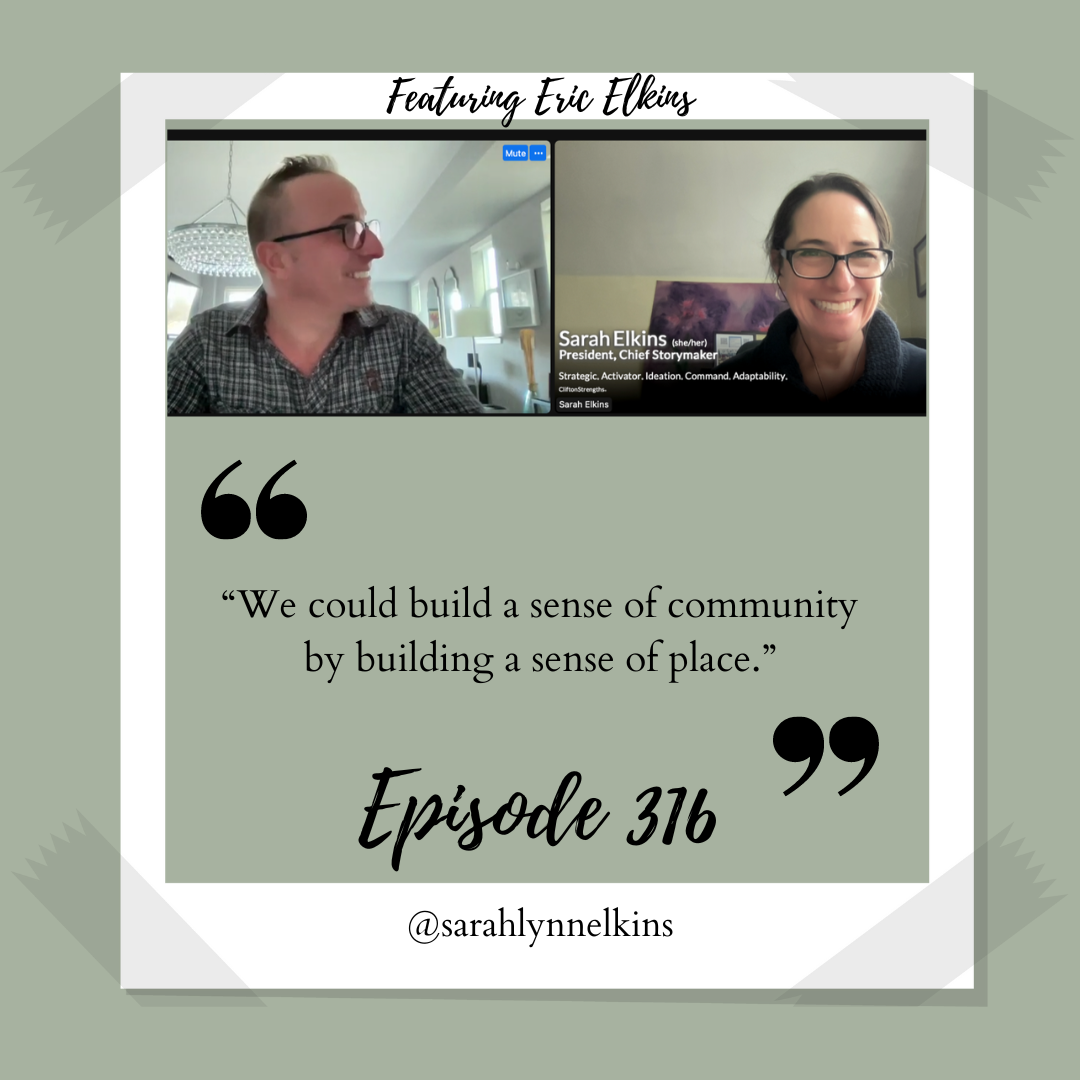
“We could build a sense of community by building a sense of place.”
“For me it’s always about connecting people so that they can be more successful and be happier and do what they need to do.”
“I often say when you get a negative comment or a negative review: Your response has two audiences and two functions, the first audience is the person who wrote the comment, the negative comment or the negative review, and the first thing you need to do there is deescalate and hopefully get that conversation offline or into a private venue so that you can work through the situation and solve the problem. But that second audience is everybody else who’s watching what you’re gonna do, and so that’s why it’s always important to respond, take responsibility, and then to actively in that response move that conversation elsewhere.”
“We all go to work. We all have to deal with the vagaries of the workplace, and the slog that is even a job that we love, and the one thing that keeps us coming back day after day is the connection we have to the people there.”
Dear Listeners it is now your turn,
It’s time to hold up that mirror in front of yourself, what behavior are you continuing in your management or your conversations within your community and the people who care about you that maybe you didn’t like when other people did those behaviors towards you. I know it’s hard to be a manager, especially if you’re new to that, so make sure that you’re paying attention to what you didn’t like in your experience with managers and not continuing those behaviors with your people. Listeners, I would love to hear your thoughts on this episode.
And, as always, thank you for listening.
About Eric

Eric Elkins is a strategist, author, professional speaker, and CEO of WideFoc.us Social Media (http://www.widefoc.us/), a Denver-based agency he founded in 2007. Using organic and paid social strategies along with full-service community management, his team drives tangible results for B2B tech/SaaS companies, B2C brands, the home services industry, nonprofits, and global corporations. For more than 25 years, Eric has helped companies grow their visibility and increase revenue. He writes the occasional novel, hosts Denver food faves at denverlicious.com, and loves to share his eating and travel adventures on Instagram as @ericelkins.
Be sure to check out Eric’s LinkedIn, Instagram, and Facebook! As well as his website Wide Focus and his food blog Denverlicious!
About Sarah
"Uncovering the right stories for the right audiences so executives, leaders, public speakers, and job seekers can clearly and actively demonstrate their character, values, and vision."
In my work with coaching clients, I guide people to improve their communication using storytelling as the foundation of our work together. What I’ve realized over years of coaching and podcasting is that the majority of people don’t realize the impact of the stories they share - on their internal messages, and on the people they’re sharing them with.
My work with leaders and people who aspire to be leaders follows a similar path to the interviews on my podcast, uncovering pivotal moments in their lives and learning how to share them to connect more authentically with others, to make their presentations and speaking more engaging, to reveal patterns that have kept them stuck or moved them forward, and to improve their relationships at work and at home.
The audiobook, Your Stories Don’t Define You, How You Tell Them Will is now available!
Included with your purchase are two bonus tracks, songs recorded by Sarah's band, Spare Change, in her living room in Montana.
Be sure to check out the Storytelling For Professionals Course as well to make sure you nail that next interview!
307 An Analogy For Happiness
In today’s environment that is so rife with the use of social media it can be both bewildering and disconcerting to not know what is or isn’t manufactured for content, as well as the perceived obligation to have to participate in social media. Although both overwhelming and exciting one must always remember to have their values at heart and to put forth what you want in the world while also keeping in mind how to support your friends and family online.
In this episode Sarah Elkins and AJ Kumar discuss how social media has impacted our perceptions of the world as well as our interpersonal relationships. AJ brings an insightful and warm perspective to the conversation, while also sharing his joy of learning and trying new things, and how these experiences have brought him to where he is today.
307 An Analogy For Happiness

In today’s environment that is so rife with the use of social media it can be both bewildering and disconcerting to not know what is or isn’t manufactured for content, as well as the perceived obligation to have to participate in social media. Although both overwhelming and exciting one must always remember to have their values at heart and to put forth what you want in the world while also keeping in mind how to support your friends and family online.
In this episode Sarah Elkins and AJ Kumar discuss how social media has impacted our perceptions of the world as well as our interpersonal relationships. AJ brings an insightful and warm perspective to the conversation, while also sharing his joy of learning and trying new things, and how these experiences have brought him to where he is today.
Highlights
We are all multifaceted.
You can’t just give up and stop learning.
Be cautious of the attention you invite into your life and how you return that attention.
Think about what story you want people to tell about you.
Quotes
“Earth is a school, life is a school, like you’re always learning something and you’re always trying to learn something from the past because if you don’t learn stuff from the past then you end up repeating that mistake until you learn that, and once you can learn that and extract something from it then you move forward.”
“It’s blurred, you can’t tell what’s real and what’s fake an d that’s a concern. People could use that negatively, it's hard to say, it’s like any tool, somebody can use it to build a house or knock someone over the head with it. I think that's the place we’re at now in society where how are you wielding this attention that you’re getting? Are you using it to harm people or are you using it to help people?”
“It’s all about understanding people’s problems, trying to be in their shoes the best you can, and then helping them solve it.”
Dear Listeners it is now your turn,
What will you take on as an adult to help you process information in a way that’s different than how you’re doing it now? AJ decided to pick up a rubix cube and was able to figure out all kinds of analogies for his work just by playing with a rubix cube. For me I like to go on a hike, I always find that since I have such cerebral work sometimes I need to just get outside and allow my brain a little time to focus on something outside of myself in nature. So what will you do, and how will you find your creativity within that puzzle or that hike or maybe it’s a snuggle with a pup. Whatever it is, find it, find your analogy for happiness at work and at home and I hope to hear from you.
And, as always, thank you for listening.

About AJ
Aj Kumar, the “Digital Maestro,” is the founder of The Limitless Company, a studio system for influencers. AJ and his team are on a mission to help entrepreneurs in the Creator Economy build for-profit human-healing brands. Aj has helped corporate brands like Salesforce, Mint, Intuit, and industry-leading personal brands including Neil Patel, Nikki Haskell, Nontoxicdad, and Kimberly Snyder.
Be sure to check out AJ’s LinkedIn, Instagram, and Facebook! As well as his websites Limitless and AJ Kumar!
About Sarah
"Uncovering the right stories for the right audiences so executives, leaders, public speakers, and job seekers can clearly and actively demonstrate their character, values, and vision."
In my work with coaching clients, I guide people to improve their communication using storytelling as the foundation of our work together. What I’ve realized over years of coaching and podcasting is that the majority of people don’t realize the impact of the stories they share - on their internal messages, and on the people they’re sharing them with.
My work with leaders and people who aspire to be leaders follows a similar path to the interviews on my podcast, uncovering pivotal moments in their lives and learning how to share them to connect more authentically with others, to make their presentations and speaking more engaging, to reveal patterns that have kept them stuck or moved them forward, and to improve their relationships at work and at home.
The audiobook, Your Stories Don’t Define You, How You Tell Them Will is now available!
Included with your purchase are two bonus tracks, songs recorded by Sarah's band, Spare Change, in her living room in Montana.
Be sure to check out the Storytelling For Professionals Course as well to make sure you nail that next interview!
Episode 117: Uncovering a Life Pivot Point, And Why It Matters
When she was 17, her public speaking course final was to perform at a local comedy club's open mic night. She wasn't nervous, though she thought she would be. Brynne stepped into the spotlight that night and never wanted to leave it. Even now, after decades of training and performance, she steps onto the stage and simply owns it.
We Can't Know at the Time, Our Stories That Will Inspire Others
Brynne Tillman and I met on #LinkedIn many years ago, just before she received the LinkedIn #Influencer title in 2016. I loved her content because it always included #humor, I could tell that Brynne took her work seriously - but never took herself too seriously.
During our conversation, we uncovered a life pivot point that she didn't realize was a big part of what shaped her future until she began to share it with me.

When she was 17, her public speaking course final was to perform at a local comedy club's open mic night. She wasn't nervous, though she thought she would be. Brynne stepped into the spotlight that night and never wanted to leave it. Even now, after decades of training and performance, she steps onto the stage and simply owns it.
That first evening at the comedy club, the manager pulled her and another student aside and invited them back the following week. After a few weeks working through her bit and performing at the open mic, she was invited to have her own time on stage - paid. She was officially a professional comic.
Similar to my conversation a few weeks ago with Ash Rao, Brynne and I touched on the topic of work ethic and being a good ambassador for yourself, no matter where you're working. In Brynne's case, being aware of her surroundings, and being driven to be good at whatever she does, was the key to her first opportunity to truly shine in a professional environment.
She remembers the day the big boss came down from his office to the call center she was working at in a Dun & Bradstreet office. He looked straight at her, then walked into her boss's office. She was sure that was the end of her career, sure she had said something her internal filter didn't catch, which happened a lot, and that she was being fired.
Instead, her boss and his boss called her into the office to ask her to create and facilitate training. They were so impressed with her skills of connecting with people and adding value, that they wanted her to find a way to basically clone herself through creating training for others.
Listen in on our conversation to hear more about Brynne and her entertaining, inspiring stories.
Connect with Brynne on LinkedIn, visit her website, and pick up her book, The LinkedIn Sales Playbook: A Tactical Guide to Social Selling.
Desperate for Real Connection
Confirmation? Another suicide in our small town.

We’re reeling from another teenage suicide in our little town. That’s the second in as many months, and they were friends. I saw a picture of the two high school juniors together, taken just a few days before the first decided to end her life.
Teens have always faced an especially rough emotional time, but what has changed in our communities to explain the huge rise in suicides and clinical depression? It’s not just teenagers, either.
There’s no simple answer; it’s a complex problem, and it will take complex strategies to change this dynamic. But there are reasons for the increase, and there are things we can do, as individuals and as communities, to make a difference every day.
We are forgetting how to connect in person, and we’re not teaching that to our children.
That means that when we are in face-to-face situations, we don’t know how to share important feelings and concerns.
It’s easier to share those concerns online, behind a screen and keyboard, and not have to be accountable for our words.
Sharing things online that you wouldn’t share in person makes it easier for you to pretend like you’ve addressed your loneliness and fears. But you haven’t, if you’re not dealing with them in real life, in person.
Here’s my observation: Though we feel connected to our contacts on social media and through our devices, we are missing key contact points. I have very close connections with people I’ve never met in person, I love them, and I believe in those relationships. We can get a lot out of our virtual connections, and I’m grateful for the incredible encouragement, kindness, and genuine care I’ve received over the years through those online friendships.
There are details, small, subtle details that come with a face-to-face conversation that are impossible to compare to our online discussions. There is a limit to what online relationships can provide in real life. Without a hug, a pat on the back, a handshake, we are missing the humanity in our relationships.
When we are face-to-face with another being, we are not only seeing the fine lines in their faces, their smiles, assessing whether they are being genuine. We are not only sensing their feelings toward us, the eye contact, and the body language.
There are many cues we receive subconsciously when we are face-to-face, including scent, micro-expressions, and more.
We are getting closer, every day, to having AI emulate almost all aspects of our human relationships. So what is the difference between us and machines, if we feel like our online relationships are enough for us?
People are desperate for real connections with real people, and most of us don’t even know it. Some people believe that their online relationships are enough, until they just aren’t. Our online relationships can only go so far, and can only make us feel alive and connected for a brief period of time.
Eventually, loneliness sets in.
As human beings, we are designed to touch, to sense with our fingers and skin. We are designed for real contact through touch of hands, hugs, sight, and scent. Ask anyone who has studied this aspect of our brain activity; read Happy Hour with Einstein by Melissa Hughes for a basic understanding of the impact of touch on our neural pathways.
Or just search online with keywords brain, touch, science.
Where we’re seeing this play out is in our children. Thanks to what they’re seeing on social media feeds, they are experiencing more polarization among us, and less real contact, fewer effective, interactive conversations.
When I was a teenager, I spent hours on the phone with friends, and… boys. We would whisper into our phones until the middle of the night when one parent or another would pick up and say: “GET OFF THE PHONE! IT’S 2AM!” Those were not face-to-face, but they were real connections, hearing a real voice on the other end of the line. Those late-night phone calls have been replaced with late-night texts.
Why is that a bad thing? Because we all know how difficult it can be to read and write tone into a message. We’ve experienced miscommunication face-to-face, imagine how far this can go in text messages!
The Disconnect Between Us and Our Human Nature
If you read articles or books about brain activity, human development, and about human connection, you’ve seen references to Harlow’s Monkeys, a study done on infant monkeys and the strong need they demonstrated for life-like touch as nourishment. It was a horrible experiment, devastating to anyone who has a heart that beats for love of other beings. It was also an important study that acknowledged the need for warm, physical contact among living creatures, particularly infants.
On my previous post, Desperate for Real Connection, my friend Donna-Luisa wrote about her relationship with her teenage children:
As a person who grew up without all the technological interfacing it seemed hard to understand and appreciate how ‘young people’ socialize. I decided to change the view from the outside looking in and step into their ‘imaginary world’ as I called it then. From the inside looking out I saw the changing times and understood my parenting perspective needed to change.
She’s right, communication has changed. I get frustrated when hear generalizations about generations, but there are some stark differences between the digital native generations and those that came before. My son eloquently argued his case that gaming designers are artists. He reminded me that at one time, digital art and digital design weren’t considered art, and that even film making was, at one time, dismissed as an art form.
We need to change how we teach and model our behavior, based on the differences in how our children communicate.
Digital natives communicate differently, and we must respect those differences. Just like every generation before us, each thinks they’re unique, and each older generation makes judgments about the younger ones.
But there are also similarities. The human need for physical touch and experiences in nature have not changed.
I miss talking to him on the phone, but I miss being near him more.
As parents, educators, and humans, tolerate the chipping away at availability of human contact and experiences in the natural world, we risk more than losing people to loneliness, depression and suicide, we risk losing our humanity.
I live in Montana, which is probably one of the best places to live in terms of access to nature. That’s why I’m often surprised to hear about people, particularly children and teens, who don’t walk on the mountain trails so accessible in our town. We have more open space and parks in our little town than we do buildings, and yet, when I asked our teenagers if they think their friends and peers spend enough time outside, they describe many of their friends as “gamers who don’t see sunlight for days at a time.”
Introvert, extrovert, or ambivert, our humanity depends on our relationships with others.
That includes physical proximity and interaction. If we don’t prioritize our relationships through listening, sharing our vulnerability, and yes, hugging, we will find our isolation and loneliness increasing. If you’re wondering about the impact of artificial intelligence on our humanity, that’s where you’ll see it, in increasing loneliness because of our reliance on technology for our human relationships.
Tell me this commercial isn’t frightening:
Verizon 5GB Plan TV Commercial, '5GB for $55'
Chances are people often pay for data they never use. Recognizing how expensive unlimited plans can be, Verizon is…ispot.tv
Not only is it dangerous to walk your dog along a waterway while staring deeply into your phone, your relationship with your dog is pathetic.
If you think I’m over-reacting, watch people walking around town. Go to a playground, the local library, the airport, restaurants, and watch people with their families, children, and colleagues. This is really scary, if you’re paying attention. I once had to yell at a father with his toddler, because he was watching his phone as his toddler nearly walked into a busy street.
Being online all the time poses real, physical risk; it also poses real risk in our relationships with each other. When parents and other adults are deeply engrossed in their digital lives, they are not modeling conversation and face-to-face interaction for children and other people around them.
Where will children and teens learn how to interact with people, if not from their parents and other adults in their lives?
There is hope. In an article by Neil Hughes, I was reminded that there are times that technology can be used to strengthen our face-to-face relationships.
My challenge to our digital native generations: Develop tools to leverage technology to improve our face-to-face, in-person interactions. I’ll bet we can find ways to gamify this. Like Pokemon Go, but with encouragement to actually talk to people and to “look up”.
What can we do about this? How do we change this trajectory? I have a few ideas, and I’d love to hear from you.
First things first, put down the device you’re reading this on, and go talk to your children/friends/partner. Focus on the conversation to listen, not to respond, and make sure you have a plan for more of this kind of interaction every single day.
Time in nature is healing and refreshing. Schedule outdoor adventures.
Next? Find ways to meet up with those people you connect with online. I’m challenging you to reach out of your comfort zone and remember how to connect face-to-face. If you are afraid that your real-life personality and image won’t match up to the expectations of your online friendships, you’re probably talking to the wrong people.
Take the risk, enjoy the benefits of either a true friendship, or the lessons learned from a mismatch.
Believing our online relationships are enough for us is like believing we can gain weight by smelling the desserts in the bakery case.
If you write on topics related to suicide, there are great resources available to make sure you are doing more good than harm. As a relatively uninformed professional on this topic, I use this website, ReportingSuicide.Org as a resource.
National Suicide Prevention Lifeline - Call 1–800–273–8255
Available 24 hours everyday
Stories Shared Create Safe Space
Nicole Herbig and her partner at REBORN are acutely aware of the different world they're experiencing as a result of growing up not only as digital natives, but at the cusp of another industrial revolution.
Demonstrate Caring Online, Make a Difference Offline
Nicole Herbig and her partner, Maggie Rose, at RE|BORN are acutely aware of the different world they're experiencing as a result of growing up not only as digital natives, but at the cusp of another industrial revolution.
Her story isn't unique in that many young people have experience with mental health issues in their families. But her story is unique in that she sees this online social world for the impacts it's having on her peers, and she's doing something about it.
In this episode, Nicole and I share stories of our experiences with that disconnection our community members are feeling as a result of trying to replace face-to-face relationships with online relationships. In our discussion, we come to the conclusion that when we are intentional and caring in our activities on social media, we can translate that creation of safe space into an in-person safe space.
Toward the end of our conversation, we shared stories about the role music plays in how we connect with our own feelings, and to others around us. I mentioned a song our older son shared with me in his early teen years, and if I hadn't had the realization I needed to be fully present when he shared it, I might have missed an important opportunity to better understand him at that time in his life:
As is usually the case, the story I shared triggered a memory for Nicole, one about how music helped her look past her own discomfort with her mother's mental illness, to reach out to her and work toward improving their relationship:
Nicole's story is one we're going to hear more and more in the coming decades, and it makes me hopeful that younger generations are seeing the digital disconnect and finding ways to leverage these powerful tools to address big issues in mental health.
I write a lot about the disconnect between us and our human nature, particularly related to our dependence on our virtual connections. To read one of these articles, click here.
If you write on topics related to suicide, there are great resources available to make sure you are doing more good than harm. As a relatively uninformed professional on this topic, I use this website, ReportingSuicide.Org as a resource.
National Suicide Prevention Lifeline - Call 1–800–273–8255
Available 24 hours everyday
Nicole Herbig is days away from completing her bachelor degree in counseling psychology at Pillar College in New Jersey - with a 4.0 GPA. She's also full of creative energy and ambition, working to help address mental health issues in a way only a digital native can - using the constantly adaptive tools of technology at her fingertips. Learn more about Nicole and connect with her on LinkedIn, and visit the RE|BORN in its infancy, as she and her partner, Maggie Rose, continue to develop the mission and vision of this innovative project.