

Episode 148: Your Stories Don't Define You. How You Tell Them Will
This week’s episode of the podcast is a sneak peek of the audiobook, Your Stories Don’t Define You, How You Tell Them Will, to be released in mid-November. For a limited time, the ebook is just $0.99!
As a special bonus for listeners, the book will include two songs recorded by my band, Spare Change, in my living room in Montana. Keep an eye out for announcements through LinkedIn and via my Elkins Consulting Facebook & Instagram pages, or visit my website to learn more.
Sneak Peek of the Audiobook to be Released November 2020!
Hi, I’m Sarah Elkins, your host, and Chief Storymaker at Elkins Consulting.

In my work with coaching clients, I guide people to improve their communication using storytelling as the foundation of our work together. What I’ve realized over years of coaching and podcasting is that the majority of people don’t realize the impact of the stories they share - on their internal messages, and on the people they’re sharing them with.
My work with leaders and people who aspire to be leaders follows a similar path to the interviews on my podcast, uncovering pivotal moments in their lives and learning how to share them to connect more authentically with others, to make their presentations and speaking more engaging, to reveal patterns that have kept them stuck or moved them forward, and to improve their relationships at work and at home.
This week’s episode of the podcast is a sneak peek of the audiobook, Your Stories Don’t Define You, How You Tell Them Will, to be released in mid-November. For a limited time, the ebook is just $0.99!
As a special bonus for listeners, the book will include two songs recorded by my band, Spare Change, in my living room in Montana. Keep an eye out for announcements through LinkedIn and via my Elkins Consulting Facebook & Instagram pages, or visit my website to learn more.
Episode 135: Obstacles Can Be the Key to Building Resilience and Self Love
It's not unusual to have a "Series of Unfortunate Events" in our lives, those multiple years of trauma, grief, and struggle, that can either make us bitter, or help us develop resilience in a positive way, to become even more compassionate toward others.
Kerrian Fournier went through two of those phases, once in her early career, and again years later.
What is the Lesson? Your Life's Stories Create Your Identity
It's not unusual to have a "Series of Unfortunate Events" in our lives, those multiple years of trauma, grief, and struggle, that can either make us bitter, or help us develop resilience in a positive way, to become even more compassionate toward others.

Kerrian Fournier went through two of those phases, once in her early career, and again years later.
I often wonder what people see as their source of resilience, and Kerrian's is most definitely the motivation and determination to live a full life, and to demonstrate qualities of resilience, persistence, compassion, and courage for her highly intelligent daughter.
To learn more about Kerrian, visit her outstanding website, and connect with her on LinkedIn.
---
Sarah Elkins delights in guiding individuals and teams to improve communication, using storytelling as the foundation of her work. She is a Gallup certified Strengths coach and uses that tool to coach her clients to improve their communication in all relationships, and to find more satisfaction at work and at home.
Her book, Your Stories Don't Define You, How You Tell Them Will is available on bookshop.org (supporting independent booksellers), and on Amazon. The audiobook will be available in fall 2020.
Episode 108: Real Change Requires the Right "Gear", Creating the Right Environment, and Celebrating Small Wins
I’ve been thinking a lot about motivation, habit, and successful, sustainable changes in both. On The Hidden Brain, an NPR radio show, I heard a researcher talking about the fact that successfully developing strong habits like everyday workouts and healthy eating isn’t a result of better self-control or motivation, it comes from developing the habits themselves.
It’s Not Self-Control that Makes Change Stick, It’s Developing Habits

Quarry Trail, Mt. Helena, Montana - January 2020
I’ve been thinking a lot about motivation, habit, and successful, sustainable changes in both. On The Hidden Brain, an NPR radio show, I heard a researcher talking about the fact that successfully developing strong habits like everyday workouts and healthy eating isn’t a result of better self-control or motivation, it comes from developing the habits themselves.
As a person who developed a habit of nearly-daily hiking year-round on the mountain behind near my home, I started to wonder how it happened. I’ve never considered myself particularly outdoorsy. I was born in Washington DC, a city not known for healthy habits and a natural environment, and lived in LA for my early formative years. We moved to Colorado Springs when I was in junior high school, and I started to explore the Garden of the Gods, a beautiful natural park with HUGE red rocks when I got a car and driver’s license.
On any warm afternoon after school my junior and senior years, particularly after stressful days, I could be found bouldering on those rocks by myself, barefoot.
And as an adult, when I moved from Washington DC to Montana, I was determined to spend more time outside with our infant son. We moved in April, and all summer long the baby would be in a backpack on my back, hiking in the hills nearby, or fly fishing the streams just over the mountain from our little town. – But I still didn’t consider myself “outdoorsy”, probably because the women I connected with over the years were far MORE outdoorsy and hard core than I was. Those women would backpack into wilderness areas by themselves or in small groups for a few days at a time, carrying 30-40 pound packs and cooking on a campfire. And they were outdoorsy year-round, where I considered myself a “fair-weather” hiker and angler, only exploring the trails and rivers when I didn’t have to bundle up and wear warm gloves.
That version of hiking worked for me until recently. You see, we adopted a big chocolate lab mix a couple of years ago, and he is very different from our previous dogs: He won’t “do his thing” on a tether or leash in our yard or driveway – he requires a walk of a minimum of about 4 blocks.
We adopted him in March, and the weather had started to improve by then, so taking him on daily walks up the mountain nearby wasn’t too much of a chore. As a matter of fact, it became a welcome part of the mid-morning after I left my full time job to be self-employed that July. I found myself returning to my home office with more energy and inspiration, even if I left the house feeling obligated for the walk.
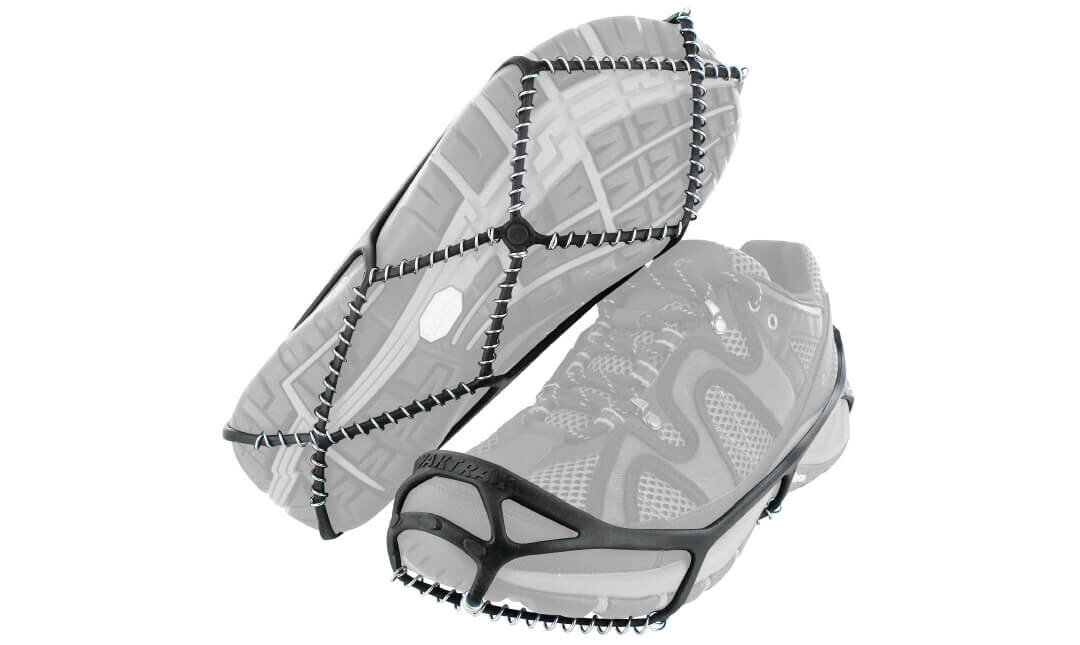
Yak Tracks
And then it got cold. REALLY COLD. And icy. And sometimes blowing snow. And the dog STILL required his long, daily walks. I don’t enjoy our walks in the neighborhood on the sidewalks nearly as much as I enjoy getting onto the mountain only two blocks away, so I purchased Yak Tracks, rubber & wire attachments for my shoes that would help with traction on ice and packed snow. In early winter those worked pretty well, but when the ice on the trails started to get thicker and more slippery, the lightweight Tracks just weren’t effective enough for me to feel safe walking up the mountain.
I found myself avoiding my walks, asking one of our boys or my husband to take the dog to the park nearby to throw the frisbee instead – which was an alternative that worked to get the dog to do his thing.
It took me a few weeks of those intermittent walks to realize I missed doing it more regularly. I’d dive into my work, lose track of time through distractions, and suddenly it was the afternoon and I felt all used up. Little motivation and almost no inspiration. I needed that time in nature to recharge and get out of my head.

As you can imagine, we have a great selection of outdoors stores here in Montana, and two are within walking distance of our house, so I walked into one that I love, and walked out with heavy-duty ice grippers – spikes that attach to my hiking boots that are super-effective at improving traction on ice. (If you visit my blog, you’ll be treated to pictures and even a video of how these things work.)
They sat in their box for months because I was intimidated by them. I didn’t even open the box until the beginning of the following winter. I’d put on the less effective ones for periodic walks, and was able to get back into my routine soon after – because it was spring and I didn’t have to worry about slipping anymore.
Winter arrived early last year, our first significant snowfall was in late September, which is highly unusual where I live. It warmed up a bit, snow melted, and then WHAM – we were hit with another significant snowfall. Those storms combined to create seriously slippery conditions on my mountain trails.

Summit, Mt. Helena, Montana - January 2020
I was determined to try out the heavy-duty spikes, took them out of the box, and put them on my hiking boots. With my trusty dog, Toblerone beside me on his leash, we walked up the two blocks of the alley to the trail and started our ascent.
“What the heck was I afraid of?! These are AWESOME!”
When we got back to the house I hung those spikes up on a hook next to the back door where I would see them every morning as I made coffee. And every day I’d smile, knowing I had the gear to make my hike more pleasant – even under the worst conditions. It could be blowing snow and in single digit temperatures and I would bundle up in multiple layers, a warm hat and gloves, and my awesome spikes.
I’d get to the top of a hill, and even to the summit a couple of times each week, look around at the fantastic views, smile, and feel like a total badass. This was a feeling worth repeating. Often.
Here’s what I’ve realized about developing sustainable, emotional and physical habits:
You have to have the right gear,
you have to create the right environment, and
you have to take every opportunity to celebrate small wins.

My hiking “gear” to keep me accountable - Toblerone “Toby”
By “gear”, I’m not just talking about physical gear like those spikes I described. I mean you have to surround yourself with the things and people you need to be successful. If you want to eat a more healthy diet, make sure you have the food in your home, and tools you need to make habits stick. If you want to get physically more fit, make sure you invest in the gear you need, don’t go cheap on this – comfortable workout clothes, good shoes, easy to use equipment or a great gym to do that. AND for your “people” gear, make sure you’re surrounding yourself with other people who want to be healthy, people who can be your accountability partners, supporters, and encouragers.
When I say create the right environment I mean this: If you buy a fancy Pelaton and put it in your basement or an unused guestroom – out of sight – you’re unlikely to create a habit around that gear. I had to put those spikes in a place I’d see them every day in order to inspire me to put them on. If you sit in an office that doesn’t inspire you, you’re not in an environment to create and sustain good, productive work habits. If you surround yourself with people who do not inspire you, who create an environment that’s tense and bitter, you’re highly unlikely to make sustainable change.
And last, when you reach a high point – lose 5 pounds, make the choice NOT to buy the potato chips when you’re at the grocery store, get to the top of the hill, or the summit – no matter how many times each week you DO THOSE THINGS, celebrate yourself. Take a moment to congratulate yourself on your good choice. Take that moment to be grateful for yourself and your hard work to make that memory strong and sticky, to keep you company for the next challenge.
Join me and an extraordinary group of professionals at the 2020, 4th annual No Longer Virtual conference on March 12 & 13th in Chicago. When I say “find your tribe”, this group is what I’m talking about. The common characteristics of people who attend are curiosity, compassion, and an entrepreneurial mindset.

The agenda is full of relevant, engaging sessions, and you’ll be surrounded by some of the most wicked-smart, generous, creative, supportive professionals around. Limited to 50 participants, you’ll have the opportunity to truly connect and build strong relationships. And the best part? You’ll avoid the “after-conference hangover” by remaining in close contact with your network after the event.
Here’s a peek at the agenda:
• Supercharge your LinkedIn experience, hosted by Shelly Elsliger & Zach Messler
• Turning ideas into action by clarifying your why, prioritizing, action planning & increasing accountability, hosted by Kris Macc & Craig Thomason
• Non-sales workshop to engage your audience and grow your revenue, hosted by Hannah Bratterud and Arlene Mendoza
• Achieving win-win relationships to improve your outcomes, with a field trip to the Art Institute of Chicago, hosted by Chris Spurvey & Megan Miller
• Nurturing your emotional health to improve outcomes, hosted by Renee Smith & Kevin Strauss
DISCOUNT CODE:
Since early registration ended, here’s a $100 discount offer from the full price NLVFRIEND, and if you make arrangements with me to register two or more guests, I’ll offer a discount code for $125 off each of your registrations.
There are 13 spots left as of January 12, 2020!
I hope to see you at #nlvchicago2020, investing in yourself, taking the steps necessary to take action toward your dreams, and building and nurturing your network that can help you get there.
Episode 104: Truly Effective Leadership Begins with Self-Reflection
Rajkumari Neogy loved her job, but couldn’t shake the feeling of being excluded. As a leader in the organization, it was difficult to pinpoint where that feeling of dissatisfaction and exclusion was coming from because she had a great boss and an engaged team, but something just wasn’t right.
Leadership Development Requires Stories of Self-Reflection
Rajkumari Neogy loved her job, but couldn’t shake the feeling of being excluded. As a leader in the organization, it was difficult to pinpoint where that feeling of dissatisfaction and exclusion was coming from because she had a great boss and an engaged team, but something just wasn’t right.
So many of us feel disconnected from the communities we’re expected to feel close to, the community at work, at church or synagogue, even with our own families. Many of us feel like we’re out here on our own, like we simply don’t belong to any one community, like we just don’t fit in anywhere.
When Rajkumari left her job, her ultimate goal was to learn more about why those feelings were so persistent, to study the neurobiology behind those feelings of disconnection and exclusion, even when there was no evidence to support those feelings.
During our conversation about resilience and the impact of genetics on trauma, Rajkumari mentioned two scientists well-regarded in the field of epigenetics, Rachel Yehuda and Moshe Szyf.
From an interview with Dr. Yehuda: “Rachel Yehuda is a pioneer in understanding how the effects of stress and trauma can transmit biologically, beyond cataclysmic events, to the next generation.”(1)
Also mentioned was a book by Sarah Peyton, Your Resonant Self, which you can find here.
Our conversation spanned from that feeling of exclusion and where it comes from, to the strategies we can use to address trauma in our bodies and minds. Rajkumari is committed to self-reflection to continue to grow and improve as a coach, to and bring others along for that journey.
(1) https://onbeing.org/programs/rachel-yehuda-how-trauma-and-resilience-cross-generations-nov2017/
Episode 103: Good Career Advice Might Not Be What You Think
When Eddie Wilders graduated from high school, all he knew was that he wanted to go to college. He didn’t know which college, or what programs he would be interested in, but he knew he wanted to be the first in his family to get a degree and do something different.
Career Guidance Stories, Reviews, and Regrets
When Eddie Wilders graduated from high school, all he knew was that he wanted to go to college. He didn’t know which college, or what programs he would be interested in, but he knew he wanted to be the first in his family to get a degree and do something different.
Eddie’s guidance counselor in high school was anything but, friendly and open, there for support, but did little to actually guide and help her students with important decisions.
He didn’t have any more success with that kind of guidance in college. When he was about to graduate with his Communications degree, rather than giving him some concrete ideas for jobs to apply for, his counselor said: “You can do just about anything with that degree!” And left it at that.
Eddie and I met in the comments section of a post on LinkedIn, asking about career advice. I responded to his comment on the post that I received plenty of decent career advice, but looking back now, none of it applied to me. All the advice I received was general, not specific to my tendency toward passionately learning something for a while, and then getting bored, self-sabotaging, and then switching jobs.
His questions and concerns were geared toward how he could guide his young daughters, since he didn’t receive useful guidance, and I immediately reached out to ask him about his experience and to record it for this episode.
Our conversation spanned from dressing appropriately for the job you want and for the environment you find yourself standing, to taking a trial and error approach in career decisions from early on. Eddie didn’t feel like he had the luxury of the trial and error system because all he knew was the experiences of his parents: Find a good job, get really good at it, and stick with it because it’s a good job and it pays.
Looking back now, he knows he wants his daughters to feel confident in trying different professional environments until they find one that feels right.
It’s always a pleasure to speak with someone with an important message, and Eddie shares one I’m sure most people can relate to, getting stuck in something because of the expectations and experiences of others.
Connect with Eddie on LinkedIn, and let him know what resonated with you about this episode!
Episode 102: Finding Soul-Shifting Moments
This episode’s theme is career transformation. My guest, Lorraine Flower, had a moment in her late 30s, when she was quickly and effectively moving up the corporate ladder, really on the upswing of her career, when she realized her soul wasn’t being fed.
Listen Closely to Your Heart When Your Story Shifts
This episode’s theme is career transformation. My guest, Lorraine Flower, had a moment in her late 30s, when she was quickly and effectively moving up the corporate ladder, really on the upswing of her career, when she realized her soul wasn’t being fed. She took what she called a sabbatical from her job, with the intention of spending time to learn what would feed her soul, and when she was offered an incredible opportunity with a different firm just a few months later, she came within a couple of days of starting – and then walked away from it.
Connect with Lorraine on LinkedIn, and visit her website to learn more about how she helps leaders remember to feed their souls by helping them identify and develop the soul of their companies.
Episode 101: Impulsive But Not Stupid
What is one thing you’ve been saying about yourself for decades? What are the stories you share that give you and your listeners the perceptions that match that thing you’ve been saying about yourself, confirming those characteristics in a positive or negative way?
Stories We Tell Have an Impact On Our Perceptions of Ourselves
“Just to make sure I understand this: If I sign the lease before the other two women in the house, I have the option of bringing a small pet. If I don’t choose to have one, I still have one of only two leases with that clause, which means if I don’t bring a small pet, that will be one fewer pet in the house. Is that right?”
“Yes, that’s right.”
“Excellent. How much is the deposit again?”
It was the end of the spring semester and I was signing a lease to share a four bedroom house with three other women starting fall semester at Colorado State University in Fort Collins. A few minutes later, I was on my way home to my parent’s house in Colorado Springs to spend the summer working and saving money for the next school year.
It was a fun summer working in a fancy restaurant, mostly lunch service, with a ridiculously fun crew, and the weeks flew by quickly. Just a few days before I was scheduled to move into the house in Fort Collins, I got a phone call from the landlord.
Her father bought the big house for her to live in and manage for the time she was going to be in school. As a student in the pre-veterinary program, they knew she’d be spending at least 4-6 years there and made a very wise investment by buying a house for her instead of renting. If I have any regrets in life, it’s not finding a way to buy a small house there while I was in school. Just a few years later, Fort Collins became a bedroom community for the Denver area, and still retains its lovely, small-town feel, and the property values have sky-rocketed there.
I answered her call to hear an abrupt, challenging tone:
“I’ve decided you can’t have a small pet in the house after all.”
“But that was in the lease I signed, Jessica.”
“I know, but I changed my mind.”
“Um… that’s not legal. Besides, what changed your mind?”
“I was only going to bring one of my cats from home in Albuquerque but I decided I want to bring both, and my dad said we couldn’t have more than two cats in the house.”
I’m not normally unreasonable, and I certainly wasn’t a particularly spiteful 20 year old, but her challenging, abrupt, aggressive tone really put me off. If she had just explained the situation and apologized for trying to change a legal document, I’m sure I would have been fine with it. But she wasn’t. And I was, well, 20, and pretty impulsive.
“What if I already got a kitten?”
“Can you take it back?” Again in a challenging and aggressive tone.
“What? Take it BACK? Are you serious? No! I can’t just TAKE IT BACK.”
“Okay then. We’ll just have to hide him when my dad comes to visit.”
Seconds after hanging up the phone I grabbed the newspaper off the kitchen table and combed the classifieds for free kittens. Two hours later I was driving home with my sister, with a kitten on my lap in my ’74 gold VW Super Beetle, stopping to pick up a cat box, cat litter, cat food, and a couple of toys for a kitten I couldn’t afford, didn’t really want, and hadn’t considered naming yet.
I can’t even imagine what my parents were thinking when I brought that kitten home. We were a dog family, through & through, and hadn’t had a cat since I was five years old. I didn’t even like cats.
But Clawed became an important part of my life, the only stable, reliable thing I experienced for at least six years, until I met my husband. He was all the things a cat can be: Mischievous, snuggly (on his terms), playful, and loving. And he was mine, completely mine. He tolerated other people, but I was HIS. I loved that cat for 9 years through multiple moves, the final one from Washington DC to Montana, where he died just a few months later. He brought me comfort in times of uncertainty, and gave me memories that have become legendary stories in my family. He was a beautiful accident to come out of a spiteful, impulsive decision.
I’ve been describing myself as impulsive for as long as I can remember, and most people who know me well would agree. And while I can be impulsive sometimes, I realize now when I look back, that most of the time my behavior was not as spontaneous as it appeared at the time.
It wasn’t until I started getting deeply into my StrengthsFinder results that I saw myself and those quick decisions as less impulsive and more strategic. As I mentioned in an earlier episode, my top strengths are Strategic and Activator, and it took me at least four months to see where strategic showed up in my daily life.
That’s one of the cool things about that particular assessment: It opens your eyes to the possibility that something you considered a weakness before can be shifted to be seen from a different perspective, even as a strength.

Summit looking south east, Mt. Helena, Helena, Montana
In that earlier episode, I mentioned that my strategic shows up in my hamster-brain thinking process as I’m getting ready to do something. The example I used was that in the seconds it took me to bundle up for a hike on the mountain behind my house, I had a plan for the route I would take that day, complete with an explanation for every part of my plan: I’d take a steep trail up to get my heart rate up and warm my core, I’d take the two-block route to the trail that would allow for the dog to poop where it could easily be picked up and disposed of, and I’d be sure not to take the steep trail back because my knees were a little achy.
It was that “ah ha” moment on the mountain that I could finally see that strategic showed up a LOT in my life, like when I am in the car, and before I even click my seatbelt on, I know exactly the route I will take to run errands, and the reasons for the route.
And in the time between that discovery and today, I’ve started to see how strategic was showing up in my past, impulsive-looking decisions.
Getting Clawed was absolutely impulsive, there’s no sugar-coating that decision, when my Activator went crazy and Strategic took a back seat.
But the time (seemingly out of nowhere) I asked my husband to marry me after 8 months dating wasn’t nearly as impulsive as it seemed. And the time, two days after we moved from Washington DC to Montana, I drove our 218,000 mile Honda Accord into the Subaru dealer parking lot with a failing transmission and drove out less than two hours later in a Subaru Outback Sport. And the time I walked through an 1890 Victorian home for a few minutes, called Bob to come look at it, and made an offer at 4:00 that afternoon. And the time I talked to Neil Hughes in late October about maybe starting a podcast, and launching it on December 26, 2017 with a handful of episodes in the hopper for a weekly publication. Was I thinking long term about any of those things? Absolutely not.

22 Anniversary, Bob and Sarah at the Missouri River, 2019
And yet, here I am, married for more than 22 years (and still like him an awful lot, but that’s another story), driving our third Subaru since purchasing that first one in 1999, all from the same awesome dealership, living in a charming, “project house” for nearly 20 years with loads of extraordinary memories of raising two wonderful boys, hosting guests, parties, and music in it, and here we are at episode 101 of that crazy idea of a weekly podcast I had nearly two years ago.
So. This is what Strategic-Activator looks like in me. None of those decisions were actually impulsive in the sense that they were exclusively spontaneous. Now – to someone with Deliberative or Intellection in their top strengths (like my husband), they certainly look that way, but that’s because a) they’re not in my head with me, where a ridiculously detailed but very fast internal dialog has happened before I take a step, and b) I haven’t taken them along for that ride.
Before asking my husband to marry me, my hamster brain had spent considerable effort (but not time, necessarily) thinking about things like: I haven’t ever wanted to spend this much time with one person, especially a guy, he treats me like I matter, like I’m smart and insightful, beautiful and sexy, reliable and practical (mostly), he brings me an espresso in bed every morning we’re together, which looks a lot like “love” and “cherish” to me, he’s kind, challenges me, is crazy-smart, warm, and tolerates my crazy – and my family’s crazy, with patience and is even mildly entertained by it. Those all felt like real things to me at the time, they still do, and asking him to marry me just felt right.
Buying that first Subaru wasn’t an instant decision either. And I had seen enough houses in the area we wanted to live, that I knew the deal-breakers for me. Of course, I didn’t REALLY understand what he meant when Bob said: “You know this is a project house, right?” But we haven’t ever regretted those decisions, nearly 20 years later. They were both good, reasonable decisions.
And when I took on that podcast project? I knew I had the support and resources to make it work long before I recorded the first episode. So no, it wasn’t even part of my imagination to consider I’d still be doing this, 101 episodes later. But then, at 20 years old, I thought the only thing I’d ever do for more than 20 years was breathe… and have a cat for a while.
I told a story at a live storytelling event a few years ago, explaining the thought process before getting my one and only tattoo at 44 years old. It’s called I’m Impulsive, Not Stupid.
I’ve been telling myself for most of my life that I’m impulsive, maybe somewhat smart, but definitely lucky for how most of those impulsive decisions turned out well. I told myself I simply trusted my instincts. And yet, as I become more intentional with my strengths, I’m able to see those decisions from a completely different perspective. It has shifted my confidence in a big way, and as a communication coach, has offered me incredible insights into others, particularly those with similar - and opposite - strengths from mine.
Being more aware of how my strengths work has also improved my communication with my husband, family, and close friends. When I’m working through an important decision, I now take those involved for the ride on that hamster wheel in my brain, so they can hear the reasoning behind where I’m leaning in that decision. And even more important, they can see the flaws and/or beauty of the reasoning to help me make those decisions more thoughtful and reliable.
If I surrounded myself only with people who thought like me, I’d miss out on making better decisions, and on recognizing and demonstrating that I value the strengths in the people around me, which is always good for relationships.
What is one thing you’ve been saying about yourself for decades? What are the stories you share that give you and your listeners the perceptions that match that thing you’ve been saying about yourself, confirming those characteristics in a positive or negative way?
Consider where those characteristics might not be what you’ve been telling yourself all these years, and maybe, just maybe you’ll see yourself in a more true, positive light.