

How Storytelling Shapes Your Internal Messages

I had the opportunity to ask Leili McKinley, founder and CEO of Identitype LLC a few questions about her pivotal moments in life, and how she was able to identify those moments, and years later was able to apply them to difficult situations.
She surprised me with her analogy of her skill in creating a corset as the foundation for a wedding gown designed during her time at Parson's School of Design in NYC. As she builds experiences, she sees those experiences as the corset-building, or foundation-building of her behavior, persistence, and success.
Visit Leili's website and LinkedIn profile for more information about the IdentitypeTM system she created (in her words):
... to help you be the leader you were born to be, build a brand, and grow your business (ME, Inc.) because you’re passionate about what you do, and because you want to create more income for yourself and the people you love.
Podcast: Is Imposter Syndrome Defining Your Internal Stories?
In other words, when you're outwardly successful, but often feel like a fraud, like at some point everyone will know about the "real" you.
Sarah Elkins | Your Stories Don't Define You | episode 2
Imposter syndrome, according to Cambridge dictionary online, is "the feeling that your achievements are not real, or that you do not deserve praise or success."

Sharing a story at Tell Us Something, Helena, Montana, April 2017
In other words, when you're outwardly successful, but often feel like a fraud, like at some point everyone will know about the "real" you.
There have been major studies about this phenomena, and great articles have been written to describe outwardly, wildly successful people who suffer from it. The article says that a person with imposter syndrome attaches almost exclusively external factors to their success, e.g. I was in the right place at the right time, I was fortunate to..., the opportunity landed in my lap, etc. While they attribute their failures internally, e.g. I'm not smart enough, I wasn't paying enough attention, etc.
Then there are those who turn it completely around, the non-imposter syndrome professionals who attribute their success almost entirely to their own intelligence, beauty, savvy, etc., and their failures are all externally driven, e.g. he didn't want me to succeed, I was in the wrong place at the wrong time, if only ---- had happened, etc. There's a Harvard Business Review article about overcoming imposter syndrome, placing the internal messages right up front in dealing with those minimizing thoughts.

I think there's a lot more to this. People who don't acknowledge the external contributing factors to their success, who describe themselves as "self made", are missing a major component of humility and humanity. No one is self-made, literally. But way beyond that, we have to consider genetics, family economic status, public utilities (if you're a manufacturer, guaranteed you use public roads to distribute your goods), education (even in the poorest communities, there are some fantastic, motivated educators), and access to mentors. Some people are driven by spite, so even a negative influence contributed to your success.
There are also those factors that contribute to failure: Do you acknowledge the internal factors? If you cannot take responsibility for those things you didn't succeed with, you're missing great opportunities for growth and connection with others. Blaming outside, external forces for failure means you do not acknowledge those moments when you were truly human. Where does that leave you?
Your internal messages come from all of your experiences, from your very early interactions, through your young adulthood. It's no wonder those messages are hard to fight; we're hard-wired to keep those messages, once they're placed in our heads. They've created pathways in our brain. It can be impossible to change them if you aren't aware of them, or where they came from.
I was walking through the open space of a friend's dorm with her, and two VERY tall basketball players stopped to say hello. One of them asked me out, and I said no thanks.
He put his huge hands on my hips and easily lifted me to set me down on top of a vending machine. I was in a sundress, the vending machine was very tall, and there was no way I could jump down.
I blushed deep pink and asked him to help me down. He laughed:
I'll help you down if you say you'll go out with me.
I shook my head no, and stared directly at his friend, the one I knew to be a nice guy.
Dude. That's not cool. Get her down from there.
He didn't, so his friend helped me down and apologized. When he put me down, I looked up (WAY up) at the culprit and said:
I. AM. NOT. A. TOY. Don't EVER do that again - to anyone.
They walked away, and I could hear the nice guy giving the other one a hard time. I was furious.
That wasn't the first time someone picked me up without my permission. As a matter of fact, it had happened many times. In elementary school, everyone wanted to give me piggy-back rides. In high school, I was asked to play one of the very young daughters in Fiddler on the Roof, though I had auditioned for a speaking, singing role.
Why? Because I'm small. I was lucky to pass 5' my freshman year of college; highly unusual for a girl to grow that late in life, but I did, and thank goodness. All I wanted was to outgrow my mother! But it's not just my height. When I graduated from college, I still weighed under 100 pounds. I couldn't find women's shoes in size 4.5 or 5, making professional outfits very difficult to complete.
I know this can sound really awesome, and it is in most ways; I am generally the most comfortable person on an airplane. Being small also means looking young, at least it does for me. The last time I was ID'd at a bar I was 41 years old. But when I was a professional in my late 20s and early 30s, looking young did not help me at all in getting others to take me seriously. In one meeting I was facilitating, a women in her 50s was dismissive toward me until I found an opportunity to share my age with the group. She looked at me, startled, and suddenly began to pay attention to me.
When a good friend recently heard about a trip I was taking, we were visiting about my expectations, and my concerns about it. I said: "It feels weird, Callie, like I'm just little Sarah from Montana, what do I have to contribute to this group?" I wasn't entirely serious; I know my value and I know I can make a difference in any situation. But that little voice spoke up, and it had to come from somewhere, right? She looked at me, a little shocked, and said: "Sarah. NO ONE thinks of you as little Sarah. NO ONE."

It took me a while to process that conversation; I had to dig into why I had that self-limiting voice still speaking to me. That's when I realized it has a lot to do with my size, and the way I was perceived because of it. When I meet someone and I'm sitting down, they are always visibly surprised to see how petite I am when I stand up. Clearly the way I'm presenting myself is much taller than my actual height.
Before my 20th high school reunion, I had dreams that I was in my old school, wandering through the halls saying hello to people. The weird thing was that I was much taller in my dream. I woke up a little disappointed, until I realized that's how I saw myself now, not as a physically taller person, but taller in stature.
A friend recently described himself as big and goofy, and I asked him where that came from, because that's not at all how I see him. He told me a story about having moved in 5th grade, and having to establish himself somehow in the new school. He found great success in being goofy; the other students responded to that silly, self-deprecating behavior, and he was able to make friends. Or, at least he could make his classmates laugh with him, rather than at him.
It got me thinking about how these childhood and young adulthood perceptions and words we used to describe ourselves - and others used to describe us - impact our current potential and success. It also got me thinking - again - about imposter syndrome and how to deal with it.
Up until recently, I thought I suffered from imposter syndrome. Now I'm thinking those internal messages are more an identity issue, a confidence issue. I attribute my success equally to hard work, experience, and introspection, and to the support network I have, the fortune of being born where and who I am, and to the relatively low-drama household in which I was raised. What I realized is that I'm not alone in feeling like a kid, like I'm just pretending to be a grown-up, and doing grown-up things. The other thing I realized is that I like that about myself, and those who relate to that sensation. It keeps us youthful, curious, adventurous, and optimistic.
What stories are you still telling yourself that are simply no longer true? Are those stories yours, or do they belong to someone else? Are you holding onto certain perceptions because they worked for you at some point? Is it time to let them go?
What are your thoughts about the difference between imposter syndrome, and self confidence?
Micromanagers Inspire You... to Quit

Cheryl Snapp Conner | Your Stories Don't Define You | Episode 1
What stories from your past became pivotal moments as you look back at them?
I had the opportunity to visit with Cheryl Snapp Conner about a difficult boss she encountered early in her career. That experience drove her to try something completely surprising to her - she left the company to start her own business.
Listen to the podcast to hear the lessons she learned in the situation, and to sit in on the conversation about how this story has impacted how Cheryl sees herself today.
Want to learn more about Cheryl and her stories? Visit her company website: Snapp Conner PR, or follow her on LinkedIn.

Where is Your Tribe?
They created and nurtured a tribe like few get to experience.
Tragedy hits; who do you reach out to? Who will reach out to you? You might be surprised.
Our dear friends lost their son in a car accident and our community is mourning the loss of this beautiful soul. Their lives, and the lives of so many this young man's energy and love impacted, are forever changed. But that's not the point of this story, because his family and those closest to him will tell it themselves.
It's Their Story
People who have experienced tragedy will tell you that those who they believed would be there for them often disappear, while people they weren't particularly close to were the ones who showed up.
There are many reasons for this, and I've written a lot about that theme over the years. But the biggest reason I can share is that people are uncomfortable with grief. That discomfort comes from knowing how unpredictable life can be - that it could be them, and it comes from not knowing what to say or do, and not being able to make things better.
But those who show up make the difference. Though it's disappointing when those you thought would be there aren't, the extraordinary beauty of those who DO show up shines a light like nothing else can.
The only light I've been able to see, the only comfort I've been able to find as my friends absorb this new reality is that they are surrounded by the love and light of their community.
Over the years I've known them, they've shared themselves, their love, creativity, and vibrant appreciation for life with everyone they come in contact with, anywhere. My friends transformed friends into family at every opportunity by nourishing people at their dining room tables, through their art, and over miles and miles of outdoor adventures. They created their tribe for just this moment, this time when they need them.
This tribe will not disappear at the scent, sound, and thick fog of grief. This tribe will show up, at all hours, at any moment and in any location to be there for our friends. We will grieve together, and know when and how to leave room for the grief of the parents and sibling, which is unlike any other grief.
This tribe will never - ever - utter the words: "I know how you feel." Because they know, without a doubt, that they can't know.
It Could Be Your Story
Do you have a tribe? Have you cultivated with generosity, kindness, and love a community you know will show up when you need them?
Just like a business network, if you wait until you need them when you are unemployed or underemployed, you will be lost for much, much longer than you would have been had you maintained and nurtured those connections.
We may feel very connected to those we know online, but if we're not spending time in real life with real people, we're not building the kind of tribe I'm talking about here.
Build your tribe before you need them. Reach out to those you feel connected to and nurture those relationships. Spend time face-to-face, schedule dates of walks, lunches, and silliness.
Make time now, because you may not have tomorrow.
*This post is dedicated to the memory of the sparkly, deeply intelligent, beautifully loving man lost on December 13, 2017, Kyle Boundy, and to his family and friends who will be forever changed for having experienced his love.*

Mid-Life Crisis? Dazed & Confused? You're Not Alone.
Are you going through a time of uncertainty? Are you feeling off-balance and lost? No one can solve your problems for you, but reaching out to encouraging, supportive, engaged friends will definitely help.
I recently read a sad article about a ridiculous number of women my age who are going through a sort of mid-life crisis. The part that caught my attention first was this:
"Hey," I said, happy to have caught her on a break from her job, "do you know anyone having a midlife crisis I could talk to?"
The phone was silent for a second.
Finally, she said, "I'm trying to think of any woman I know who's not."
When I read that exchange, I realized that women in my age range are having very similar experiences to current young adults just leaving high school and college.
Our world is so different from what I experienced as I left high school. Career paths were pretty traditional then, though there were some who took different journeys. Most of my friends didn’t think about the next step after high school because the next step was college; most of us never thought about NOT going on for a four year degree. I was surrounded by my middle class friends in suburban Colorado neighborhoods, but even my friends outside of that community knew the traditional path and generally followed it.
Those traditional paths still exist, but they’re an awful lot like where Kodak was about 30 years ago; they’re not real anymore.
Some people are seeing this as an exciting opportunity, a chance to do whatever seems right at any given moment. Others are experiencing a kind of agoraphobia, a sense of overwhelming loss and confusion. For them, it’s like being really hungry and going to a restaurant with too many menu options. They get so overwhelmed that they can’t make a decision and walk away starving.
Women who are going through this crisis are facing similarly overwhelming options, but instead of seeing this time as full of opportunity, they’re seeing it as failure, or worse, their lives completely shattered.
I have to keep reminding myself that not everyone likes to be in that “in-between” space, where I live most of the time. People who fit the equation comfort = happiness are overwhelmed by this time in their lives, while others who have consistently shifted gears to find the next adventure see this time as exciting and full of opportunity.
It’s hard to know what to do to help friends going through this phase of self-discovery and change; after all, their world is unbalanced and full of uncertainty. I’ve written about strategies for helping a person who is grieving, and they apply here, too. Remember that your friends are grieving. They’re grieving the loss of what they thought they wanted in life, the loss of their certainty, and potentially the loss of the foundation of their marriage and parents as their health deteriorates.
A good coach can help define the questions that need to be addressed, and will help clarify what the answers mean in terms of action steps and opportunities. Coaching is well worth the investment, and in combination with a counselor, can turn things around significantly. Not every counselor or coach is the same, so if you find one you don’t work well with, keep looking. Don’t stick with one you don’t feel excited to share with, but don’t give up on coaching or counseling if you have one negative or ineffective experience!
Listening is a huge part of allowing a person to grieve. If you are a good listener, that may be your primary role in helping your friends.
Being a positive force of encouragement and support is absolutely the best thing you can do for people. Make sure you have a small group that meets regularly to talk about the challenges and questions you’re all facing. More importantly, make sure the energy in that group remains positive. Each person in your group must have the ability and comfort level to intervene when a meeting turns into a rant session. A complaint-filled hour will only drag you down; when anyone in the group senses that things are going south in a conversation, they must know how to carefully switch gears and talk about actions people can take to move forward.
Are you going through a time of uncertainty? Are you feeling off-balance and lost? No one can solve your problems for you, but reaching out to encouraging, supportive, engaged friends will definitely help. I have what I call my N.A.G. group, Nudge – Advise – Guide, and we meet once each month to help us stay accountable to ourselves with our goals, to encourage and advise us when we have crazy ideas, and to guide us to make the best choices.
“If you regret any part of your past, think about your future, and make changes and efforts now, so you don’t look back again with regret.”
How you perceive this time in your life is YOUR CHOICE. You can wallow in sadness over the loss of what you thought you had, what you thought you wanted, or you can step up and live out the dreams you’ve dismissed while you were developing yourself to be who you are right now.
Dream big, take action, and be a good N.A.G. for others.
Get Out There!
I called out to her from the stage: "Come on! I can tell you want to let loose and dance! Come on out and have some fun!"
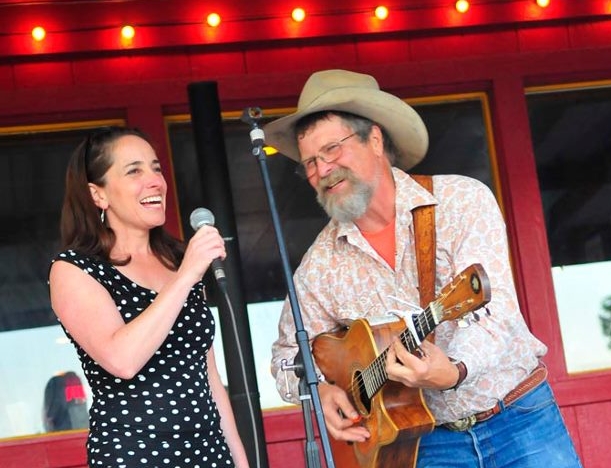
Photo by Eliza Wiley, Lakeside Helena with Sarah Elkins and Bruce Anfinson, Cowboy Poet
She was sitting on a bench in the corner of the room, watching people dancing and having fun. I could see her toe tapping, she seemed to be enjoying the music, but I couldn't really tell because her face didn't show any signs of a smile. I saw her the last time our band played at that venue, and remembered when she quietly came to me afterward to tell me how much she liked our band, and that if she knew how to dance, she would have. She was so shy.
I called out to her from the stage: "Come on out, dance with us! I can see you want to! Come on out and have some fun!" I motioned to my friends on the dance floor, smiling to encourage her.
She looked behind her, assuming I was talking to someone else. And then she looked straight at me with zero expression. I gave up. A song or two later, I noticed she had left her spot and walked further away from stage, watching from a safer distance.
I remember being shy, I remember being more self conscious than I am now. I like to say I don't regret, but there are definitely some moments in my past that I wish I could do over again. A lot of them involve sitting out a great song because I was self conscious about dancing. Opportunities flew right past me: To sing with great musicians, to dance, to swim in the ocean. The memories of that person, the girl who didn't raise her hand to volunteer on stage, the girl who said no to a cute boy because she didn't think she could dance, the one who was so concerned about how she looked or that she might mess up a note, those memories came back to me as I watched the woman in the audience look away from me. What a waste.
How did things change for me? With a little help from my friends. I was lucky enough to have friends to pull me out on the dance floor, to volunteer me to get on a stage, to tell me not to be scared. Now I'm that friend.
At some point in my life, I realized:
- It doesn't matter if you do something silly, as long as you own it. The audience likes to see you laugh, and if there are hecklers, they really don't matter.
- The majority of the people in the audience want to see you succeed, they want to see you having fun, and many are thinking about how brave you are for getting up there.
I tell my friends, my coaching clients, my children, that they must step up when an opportunity presents itself. If for just a moment you think "wow, that looks like fun, I wonder what it's like to...", take it. Leave that self conscious person behind and take the leap.
Living with regret is not living. When you don't have the energy or physical ability to dance, will you be sitting in the corner, thinking "what I'd give to dance right now. I love this song."
I hope not. I know I won't be that person.
I'll be the one holding the mic.
Don't regret! Join me at No Longer Virtual in Denver on February 22 and 23, 2018. Early registration opens Friday, September 1, 2017. Don't miss this opportunity!

Nervous? If you're not, you're not doing it right.
I was more nervous than I think I have ever been. My legs were shaking so hard, I thought they might actually collapse beneath me.
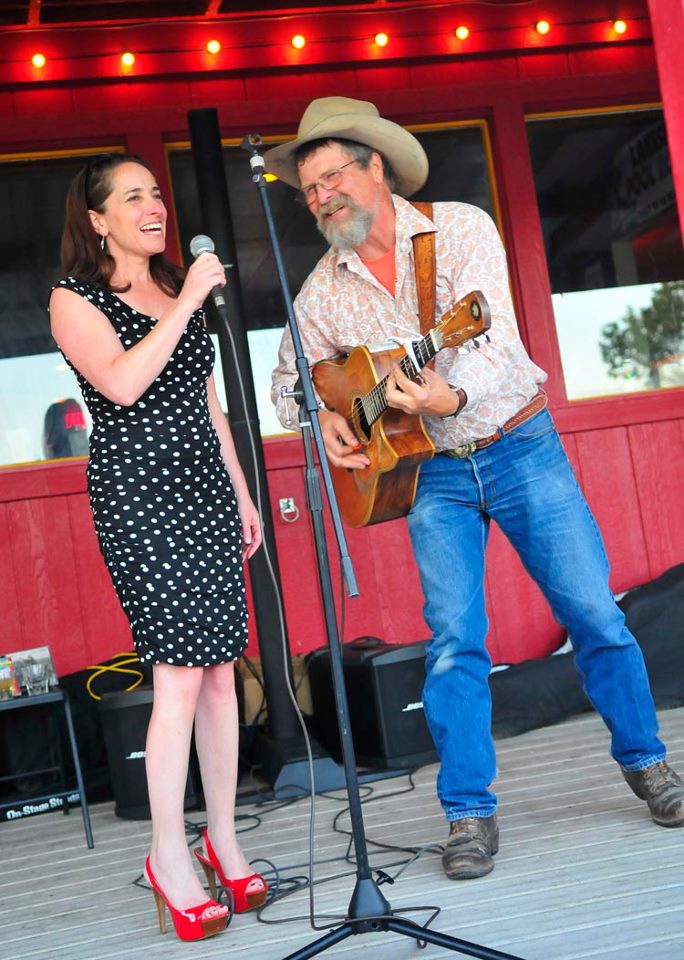
Being nervous means what you're doing matters to you.
This post was inspired by a post by my friend Zach Messler, called "Overcome your fear of public speaking. Here's what I do." If you aren't a bit nervous about a speech or performance, you're probably not engaged or excited about what you're about to do.
It was 9:45 am and the ceremony was scheduled to begin at 10. I knew they would be running late because they were bringing in WWII veterans, most of them disabled, all of them 88+ years old, plus their families from all over the US and Canada. The First Special Service Force, sometimes referred to as the Devil's Brigade, had received the Congressional Medal of Honor, finally, earlier that year. The metal was being presented to Fort Harrison for display, as the home of the First Special Service Force in the beginning of WWII.
As the public affairs person for the city, I had been involved from the beginning of the plan for the weekend of activities, to include this ceremony at Fort Harrison on Friday morning, as well as a re-enactment of the parade on Saturday, of soldiers that marched down our main street just before they left Montana to head to Europe. When asked if I would sing the US and Canadian Nation Anthems for the parade, I was honored and accepted. My friend agreed to come to Helena to sing with me, so we could perform the songs in harmony.
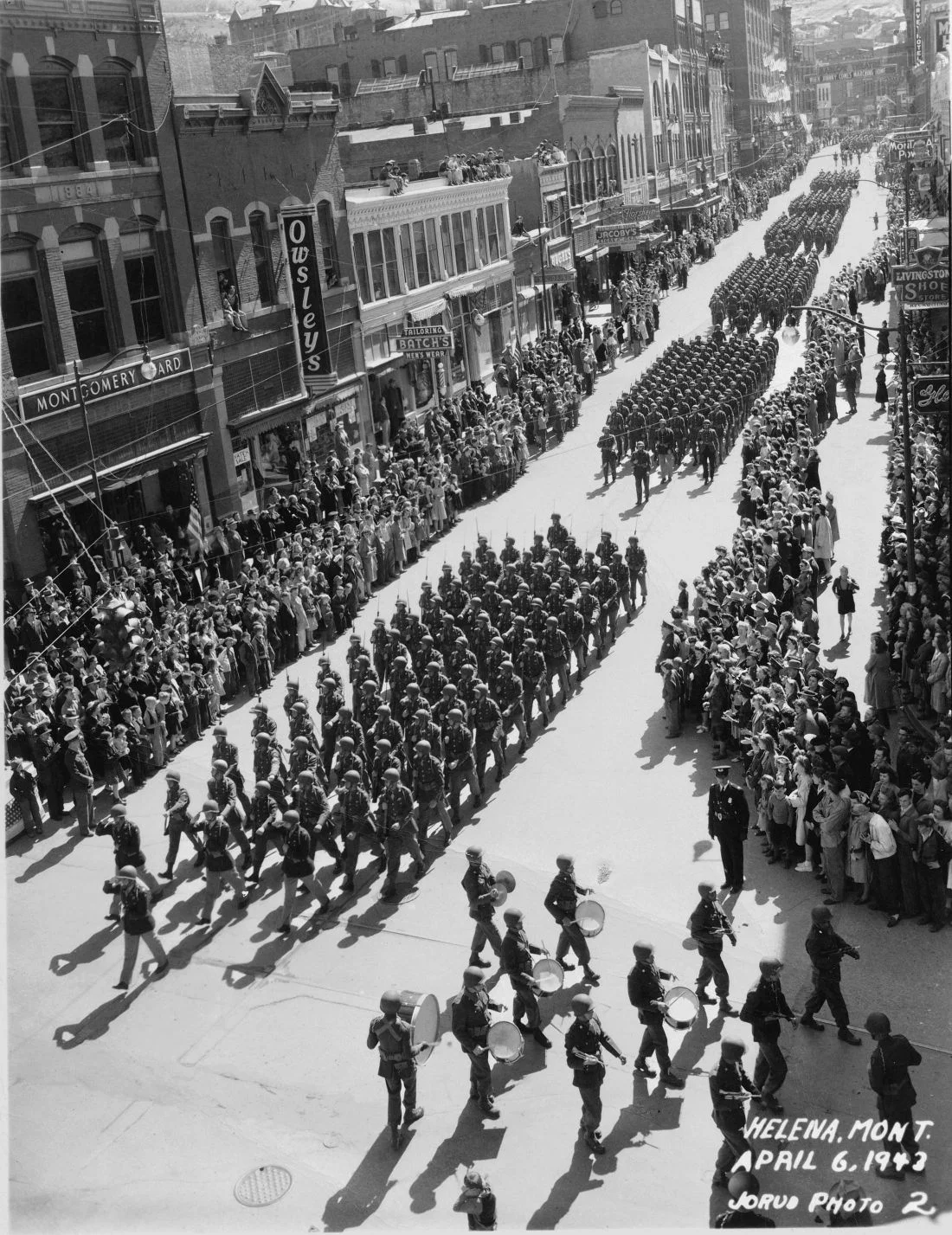
I assumed they had found someone to perform the two anthems for the ceremony the day before the parade, so when I arrived that morning, I was surprised to hear they were planning to... use a recording.
It seemed insulting to me, so I impulsively offered to sing both anthems. Solo. Unaccompanied.
When I began the Star Spangled Banner, standing at the podium in front of more than 200 guests and a handful of WWII heroes, I was more nervous than I think I have ever been. My legs were shaking so hard, I thought they might actually collapse beneath me. I gripped the side of the podium with my left hand, hit the high note at the end, paused, and sang the Canadian National Anthem for the first time in my life. When I left the stage after the ceremony, a Canadian woman asked me: "Are you sure you're not Canadian?"
I've often been asked:
How do you get over the nerves during a performance?
- Change your internal message: "I'm so excited about this!" Instead of "I'm so nervous!"
- Breathe with intention. In other words, don't start speaking or singing until you have taken a few deep breaths to calm yourself. When you feel yourself getting shaky again, pause. When you're planning your presentation - mark your script at places where a pause would be natural.
- Insist on a microphone stand or a lapel mic. Holding a microphone will exacerbate your nerves, trust me. If you must hold a microphone, start by holding it with both hands. If you know ahead of time you'll be holding the mic, wear something heavy on your mic-holding wrist, like a large watch or bracelet. The weight will help with the shaking.
- Breathe into your diaphragm, relax your knees slightly, and tighten the muscles in your lower abdomen. Feel your knees wobbling and your heart racing? Don't try to stop the shaking, that just makes it worse. Make sure your feet are planted, your knees just slightly bent, and squeeze those muscles in your rear end - hard. This provides structure and a more solid foundation for your voice. That squeeze will help make the vibrato in your voice less noticeable.
- As part of your preparation, choose your shoes first, then build your outfit. Make sure you select shoes that make you feel confident and attractive. When you feel yourself start to shake, glance at your feet, solid in position, then look back up and continue. Again, plan your pauses so you have opportunities to collect yourself.
Zach Messler is a master of keeping an audience engaged, and he makes it look so easy! Give yourself credit for putting yourself out there - it's scary, and it's not something everyone has the courage to do. Practice these techniques while practicing Zach's and you'll improve every time you speak.
*cover photo courtesy of @elizawileyphotographer, parade photo courtesy of the Helena Independent Record