

Your Stories Don’t Define You
How You Tell Them Will
A podcast to unlock your stories and uncover meaningful insights.
375 Practicing What You Preach
It’s important in life, whether you are running your own business or in your daily life, to practice what you preach. Not only do you avoid being seen as hypocritical but often the best person to give you advice is you. Consult with other coaches and counselors, ask the opinions of those you love and value, do whatever you need to in order to put yourself on the path to fulfillment and success.
In today’s episode Sarah Elkins and Mike Trugman discuss practicing their own advice, as well as the importance of doing what you will say you will in order to put yourself in a better environment that will help you grow and thrive.
375 Practicing What You Preach

It’s important in life, whether you are running your own business or in your daily life, to practice what you preach. Not only do you avoid being seen as hypocritical but often the best person to give you advice is you. Consult with other coaches and counselors, ask the opinions of those you love and value, do whatever you need to in order to put yourself on the path to fulfillment and success.
In today’s episode Sarah Elkins and Mike Trugman discuss practicing their own advice, as well as the importance of doing what you will say you will in order to put yourself in a better environment that will help you grow and thrive.
Highlights
How do you approach your own self learning and self development?
What do you need to do more of to bring yourself more fulfillment?
Are you in a place that lets you grow and thrive? Or do you need to find somewhere new to grow?
Quotes
“We think we’re really sneaky, or really good at hiding these aspects of ourselves but there is no separate ‘I’m playful over here’ ‘I’m not playful over here.’ you are who you are.”
“In some capacity we have helped people with public speaking, each of us.”
“We’ve been conditioned for the most part in our society that to be successful you need to be relentlessly hard on yourself, and give up a lot of aspects of your life. And I love to work with people who are doing the courageous work of: What if I were really kind to myself? What could life look like if I was kinder and gentler to myself? And almost in a way, allowed my success to unfold, rather than something I need to grasp and control and attain. And if I lived that way, how would that make my personal relationships and the rest of my life better?”
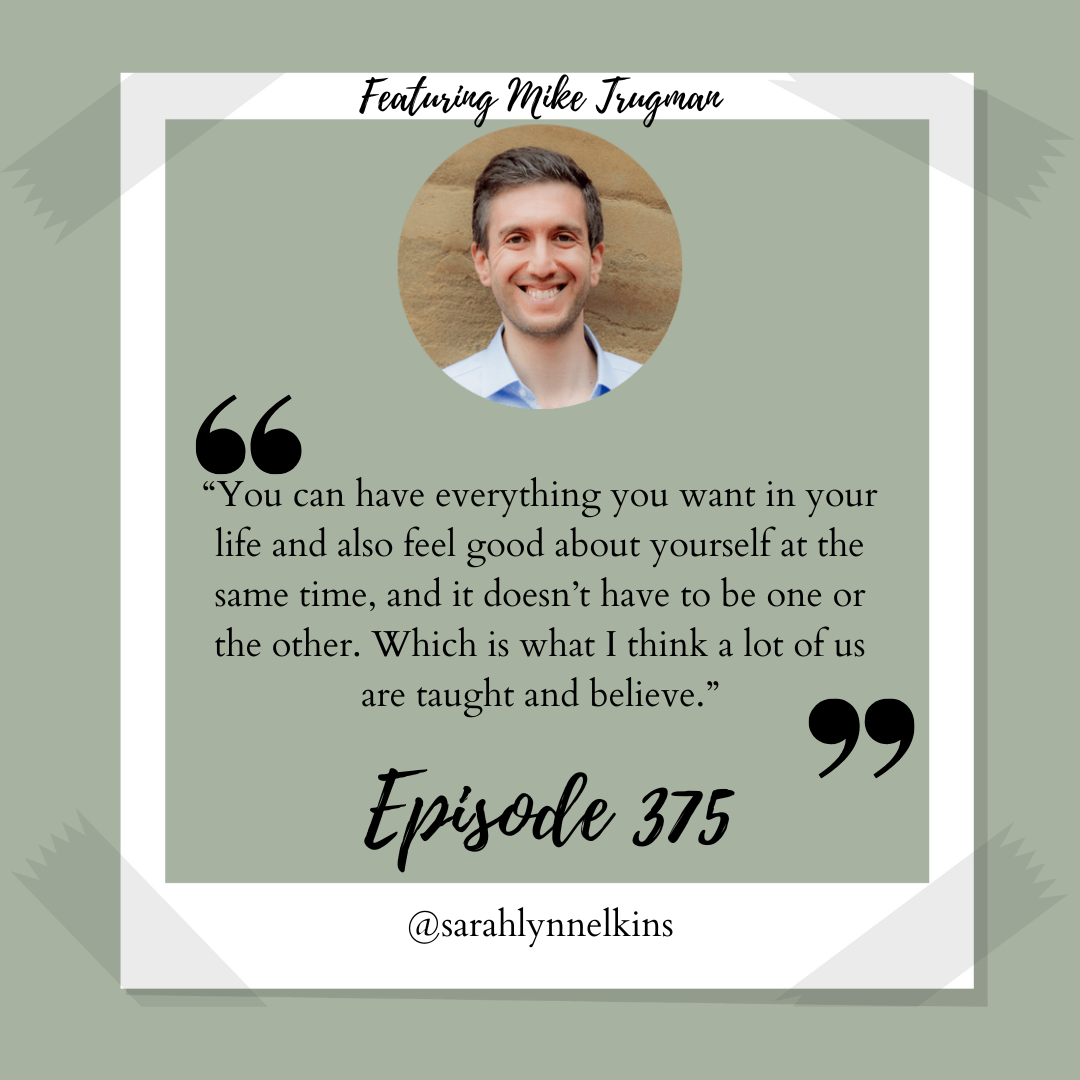
“You can have everything you want in your life and also feel good about yourself at the same time, and it doesn’t have to be one or the other. Which is what I think a lot of us are taught and believe.”
Dear Listeners it is now your turn,
I would love for you to think about a time when something went sideways for you. I know we all have episodes that went a little sideways. But when was a time where things really went sideways for you and someone showed up to be your guide? It might’ve been in a negative way, it might’ve been somebody who did something so bad that you chose a different path in spite or to spite this person. But more than likely, you hit a point where things went so sideways that only somebody who loves you could help guide you out of that. Think about that moment, write it down, collect that story because as Mike said; it’s not all about I did this and now I’m here, it’s what obstacles did you overcome to get here? Because that’s the story that inspires.
And, as always, thank you for listening.
About Mike
Mike Trugman is a Professional Life and Career Coach who helps his clients move from fear to thriving with purpose, passion and fulfillment. He hosts a top 3% podcast, Mike's Search for Meaning, dedicated to mastering what it means to be human. As someone who used to sweat and shake at the prospect of speaking up in a small meeting, he knows that we can all achieve beyond our wildest dreams with consistency and hard work.
Before coaching and podcast hosting, Mike's background was in public accounting. He has over 10 years of public accounting experience, with a focus on financial services (hedge fund and private equity) clients.
Mike currently lives in the greater New York City area with his wife and son. He loves reading, learning, cooking, spending lots of time outdoors, watching his beloved but usually struggling Knicks and Jets, and connecting with his friends and family.
Be sure to check out Mike’s LinkedIn and Instagram! As well as his website Mike Trugman Coaching, and Calendly to schedule an appointment!
About Sarah
"Uncovering the right stories for the right audiences so executives, leaders, public speakers, and job seekers can clearly and actively demonstrate their character, values, and vision."
In my work with coaching clients, I guide people to improve their communication using storytelling as the foundation of our work together. What I’ve realized over years of coaching and podcasting is that the majority of people don’t realize the impact of the stories they share - on their internal messages, and on the people they’re sharing them with.
My work with leaders and people who aspire to be leaders follows a similar path to the interviews on my podcast, uncovering pivotal moments in their lives and learning how to share them to connect more authentically with others, to make their presentations and speaking more engaging, to reveal patterns that have kept them stuck or moved them forward, and to improve their relationships at work and at home.
The audiobook, Your Stories Don’t Define You, How You Tell Them Will is now available!
Included with your purchase are two bonus tracks, songs recorded by Sarah's band, Spare Change, in her living room in Montana.
Be sure to check out the Storytelling For Professionals Course as well to make sure you nail that next interview!
372 The Art of Storytelling: Connection Over Persuasion, One Relationship At A Time
Time makes a folktale of the storyteller, and yet even hundreds if not thousands of years later, the stories that mattered -that we connect with- endure. To tell a story effectively means you need to connect with the person who is listening to you.
In today’s episode Sarah Elkins and Jeff Ikler discuss the importance of genuine connection over persuasion in the art of storytelling, and how it is far more meaningful to build a bridge between one another, rather than forcing them to choose one side of the river.
372 The Art of Storytelling: Connection Over Persuasion, One Relationship At A Time

Time makes a folktale of the storyteller, and yet even hundreds if not thousands of years later, the stories that mattered -that we connect with- endure. To tell a story effectively means you need to connect with the person who is listening to you.
In today’s episode Sarah Elkins and Jeff Ikler discuss the importance of genuine connection over persuasion in the art of storytelling, and how it is far more meaningful to build a bridge between one another, rather than forcing them to choose one side of the river.
Highlights
What is something you can do to further your goals that relies on your strengths and your toolsets?
Who inspired you recently to continue your work?
What stories are you carrying with you? And what do you have that reminds you of that story?
Quotes
“Everybody was being vulnerable, they were telling deeply personal stories and it was like they were letting us in before we had really been introduced.”
“If you persuade, fine, but it’s more important to connect.”
“And I am privileged to have sat at that dining room table.”
“I loved feeding you at that dining room table.”
Dear Listeners it is now your turn,
What stories can you tell to make a meaningful connection? What objects or unknown facts about yourself are you willing to share to strengthen the bonds of fellowship between you and another? Try to tell your next stories, not with the intent to persuade, but with the intent to make a meaningful connection with the person in front of you.”
And, as always, thank you for listening.
About Jeff

Jeff Ikler is Director of Quetico Career and Leadership Coaching, a firm dedicated to helping individuals overcome career issues and develop sustained changes in their leadership practices and organizations. He received his certificate in coaching from the Coach Training Institute. He is a certified innovation facilitator using the SIT (Systematic Inventive Thinking) process. Jeff holds a Master’s in the Teaching of History along with a Bachelor’s in History from the University of Illinois. He taught high school history in Maywood and Batavia, Illinois, for seven years. He is a former Executive Vice President at Pearson Learning where he directed the development of text- and technology-based products for all disciplines. Jeff is a co-author of Shifting: How School Leaders Can Create a Culture of Change. He is the host the “Getting Unstuck – Cultivating Curiosity” podcast. Supporting the agency of others is the river that has run through his entire career.
Be sure to check out JEff’s LinkedIn as well as Quetico Coaching and Consulting!
About Sarah
"Uncovering the right stories for the right audiences so executives, leaders, public speakers, and job seekers can clearly and actively demonstrate their character, values, and vision."
In my work with coaching clients, I guide people to improve their communication using storytelling as the foundation of our work together. What I’ve realized over years of coaching and podcasting is that the majority of people don’t realize the impact of the stories they share - on their internal messages, and on the people they’re sharing them with.
My work with leaders and people who aspire to be leaders follows a similar path to the interviews on my podcast, uncovering pivotal moments in their lives and learning how to share them to connect more authentically with others, to make their presentations and speaking more engaging, to reveal patterns that have kept them stuck or moved them forward, and to improve their relationships at work and at home.
The audiobook, Your Stories Don’t Define You, How You Tell Them Will is now available!
Included with your purchase are two bonus tracks, songs recorded by Sarah's band, Spare Change, in her living room in Montana.
Be sure to check out the Storytelling For Professionals Course as well to make sure you nail that next interview!
Bicentennial Episode! An Accidental Podcaster Reaches Her 200th Episode
Hundreds of stories, people from all over the world, and life-changing conversations all have to lead to this special 200th episode of the "Your Stories Don’t Define You, How You Tell Them Will" podcast.
Sarah Elkins and her good friend, Neil Hughes, look back to the beginning of the podcast’s creation and the unexpected moments and lessons that emerged.
Sarah Elkins and Neil Hughes:
Origin Stories of Podcasts and Friendship

Hundreds of stories, people from all over the world, and life-changing conversations all have to lead to this special 200th episode of the "Your Stories Don’t Define You, How You Tell Them Will" podcast.
Sarah Elkins and her good friend, Neil Hughes, look back to the beginning of the podcast’s creation and the unexpected moments and lessons that emerged.
Tune in to hear more about the happy accidents and people that contribute to something bigger than yourself.
“If you’re open, the universe will nudge you in the right direction.”

*podcast show notes contributed by Tracy Ackeret
About Neil:

Neil Hughes is a tech columnist, best-selling author, LinkedIn top voice, freelance writer, ghostwriter, tech blogger, podcast host, and podcast producer.
Visit Neil’s website and follow him on LinkedIn!
*podcast show notes contributed by Tracy Ackeret
ABOUT SARAH:

"Uncovering the right stories for the right audiences so executives, leaders, public speakers, and job seekers can clearly and actively demonstrate their character, values, and vision."
In my work with coaching clients, I guide people to improve their communication using storytelling as the foundation of our work together. What I’ve realized over years of coaching and podcasting is that the majority of people don’t realize the impact of the stories they share - on their internal messages, and on the people they’re sharing them with.
My work with leaders and people who aspire to be leaders follows a similar path to the interviews on my podcast, uncovering pivotal moments in their lives and learning how to share them to connect more authentically with others, to make their presentations and speaking more engaging, to reveal patterns that have kept them stuck or moved them forward, and to improve their relationships at work and at home.
The audiobook, Your Stories Don’t Define You, How You Tell Them Will is now available!
Included with your purchase are two bonus tracks, songs recorded by Sarah's band, Spare Change, in her living room in Montana.
Episode 102: Finding Soul-Shifting Moments
This episode’s theme is career transformation. My guest, Lorraine Flower, had a moment in her late 30s, when she was quickly and effectively moving up the corporate ladder, really on the upswing of her career, when she realized her soul wasn’t being fed.
Listen Closely to Your Heart When Your Story Shifts
This episode’s theme is career transformation. My guest, Lorraine Flower, had a moment in her late 30s, when she was quickly and effectively moving up the corporate ladder, really on the upswing of her career, when she realized her soul wasn’t being fed. She took what she called a sabbatical from her job, with the intention of spending time to learn what would feed her soul, and when she was offered an incredible opportunity with a different firm just a few months later, she came within a couple of days of starting – and then walked away from it.
Connect with Lorraine on LinkedIn, and visit her website to learn more about how she helps leaders remember to feed their souls by helping them identify and develop the soul of their companies.
Episode 94: Using Personality Assessments as Tools for Self-Reflection & Self-Improvement
Joy Gabriel was an awkward kid. She struggled to understand social context and constructs, and had a hard time building relationships with other kids. Her time with adults was usually okay, and as an only child, she benefited from the focus of her parents on her development, academically and in relationships.
If They’re Accurate, Assessments Can Help You See Where You’re Getting in Your Own Way

Joy Gabriel Olson
Joy Gabriel was an awkward kid. She struggled to understand social context and constructs, and had a hard time building relationships with other kids. Her time with adults was usually okay, and as an only child, she benefited from the focus of her parents on her development, academically and in relationships.
Because she has always been cerebral, she spent a lot of time by herself, nose in a book, and gazing out windows and at artwork as she processed whatever she happened to be reading, philosophy, scientific theories, and at one point, anything Anime.
Though she has always seemed pretty comfortable in her skin, at least to outsiders, she often wondered whether there was something wrong with her. To address her worries, Joy had a way of taking on the characteristics of characters in her books and favorite movies and tv shows that she admired and respected, in our conversation she called them the “influencers I was imitating.”
As she worked through her late teens and early 20s, trying on different jobs, identities, and relationships, she discovered the Enneagram. Joy is one of those intensely self-reflective, curious people who loves to find and apply tools for more self-discovery and to use to help others, and the Enneagram was a game-changer for her. After participating in the training and becoming a trainer herself in that assessment, she realized her calling was to be a coach, and that she wanted to dig into another assessment to add to her toolkit. Now she’s fully certified in DiSC as well.
Our conversation was full of great insights about how the Enneagram, DiSC, and Strengthsfinder assessments provide interesting ways to present the complexities of personality, and methods to apply the results to improve communication and relationships.
Now, as a life coach, she’s putting her gifts to use, focusing her insightful applications of assessments to help “the imploders, the self-sabotagers, and the people-pleasers out there. Whatever you do in life, I want it to be your call— not someone else’s!”
Connect with Joy on LinkedIn, and check out her website, Read Your Own Mind, and Fighting Fair blog to learn more.
Episode 62: Missed Opportunities in Leadership
…and Opportunities Taken
I’ve had a handful of good managers in my career. I consider them good when a manager trusts me to get my work done, cares about me, doesn’t micro-manage, and does their best to advocate for me and provide the resources I need to do my job.
What’s missing here?
Mentorship.
Early in my career, I was offered an incredible opportunity to be a branch administrator in Washington DC as the branch transitioned to a new owner, a company based in Vancouver, Canada. It was probably beyond my experience and skills, but the branch manager interviewed me (in a coffee shop, one of the best interviews of my life), hired me on the spot, and generally trusted that I could figure out my role and be successful. In other words, he trusted his instinct that I could make him look good to the new owners.
I did.
He didn’t micromanage me. He gave me full authority to make decisions, while making sure I knew I could talk to him and ask for guidance at any time. Over the course of about 10 weeks, I negotiated a lease for new, raw office space, 3x larger than the space we were in, worked with an architect to design the interior (layout/offices, paint, carpet, etc.), negotiated data and phone system installation, and even purchased artwork.
When the time came, I organized, coordinated, and managed the move of our employees and the contents of our tiny office space into our new location in about 24 hours, losing only about 4 hours of productivity for those employees. I was 24. It felt like a huge accomplishment, especially because I had never done anything like that before.
After I set up and trained staff in A/R, A/P, payroll, benefits, and basic processes and procedures of the new company, I settled into my position… and promptly got bored. Six months after the move, my boss saw the minor mistakes I was making, called me into his office, and asked me about them. I honestly didn’t know how to answer him, so I got defensive. He figured it out before I did, thank goodness, and within a few weeks, he hired a new branch administrator and transitioned me into a junior consultant role.
I enjoyed every client site I worked on, moved around enough to keep me interested and constantly learning, and was appreciated and valued by our clients. But I still hadn’t figured out exactly what my unique skill sets were, so I simply moved between tasks, learned a lot about everything I touched, and moved on again.
I look back now and think:
Thank goodness I had a boss who basically understood me, so I could learn and grow in that position. What incredible opportunities I had, despite my age and lack of experience!
I also think:
What if my boss had a tool back then so he could coach me, mentor me, to guide me in the direction of applying my unique strengths to a specific role? I made him look good because he gave me the tools and challenges I needed to succeed, but how much better could I have made him look if he had the ability to see into my future and guide me to my best self, using my natural talents?
I’m not one to look back with regret; I look back because I love to learn lessons from my experiences, and apply them to help others. So when I look back at that time, I am grateful for what Melvin Sassoon did so early in my career. He trusted me and saw skills in me that I didn’t know were there. I also look back and think about what we both could have done differently to have different, even better outcomes.
What if you had a tool that would transform your relationship with your employees from manager to mentor or coach?
What if you had a language to speak that would help your employees understand their role and value in your company, and would help them understand their own strengths and how to apply them to be more productive and happier at work?
You can even begin with selfish intentions: When your employees are successful, productive, effective and happy, they can make YOU look REALLY good.
The end result is that you will find more satisfaction in your relationships at work, even if you don’t start with that intention. It would be almost impossible for you not to improve on your success, leaning into that style of management.
Here’s the good news:
There are tools to help you mentor and coach your employees to bring their best selves, their greatest talents to work. The difference in the tools is simply how you manage to apply them to improve communication.
I could have focused my attention on a number of assessments and tools to help me in my communication coaching; StrengthsFinders is simply my tool of choice because I find the concept to be so positive and easily applied to the workplace.
Whatever assessment you use - whatever tool you use to help uncover the natural talents of your employees, take the time to coach them to apply those talents to their role in your organization. Think about your own career, and how it could have benefited from having a manager who truly understood your strengths, and could have helped guide you to lean into them and use them in every aspect of your life.
Those strengths don’t always show up in positive ways, especially in relationships with people who have very similar strengths, and those who are on the opposite end of the spectrum. It’s as if you’re speaking different languages when interacting with people with different strengths.
When you coach with a tool like StrengthsFinders, you can help your employee understand every aspect of their talents, and how those can be negatively perceived by the people around them. In time, that employee will start to be more self-reflective, and will be able to adjust how they present their strengths to others, basically finding ways to get out of their own way (their heads), and move past obstacles. And when they truly understand their natural talents, their career will gravitate to roles that they will find great success and satisfaction.
At that early stage in my career, if my boss had access to a tool like StrengthsFinders, and understood how to use it, it’s likely he would have steered me in the direction of sales for the company. I love people, and I love to share information and tools that help people improve their daily lives. My natural, unique talents would have made me an excellent sales person in that industry, with just a bit of training and guidance.
Who really knows what might have happened?
I could fill my days with alternative futures based on those “what if” questions. What matters at this point is that I now understand how my natural strengths have helped make me successful in the past, and how they’ve created obstacles when I haven’t known how I was being perceived by the people around me. I also know how I can apply them to improve my future, and the lives of the people I have the honor of working with.
If you had a tool to help transform your relationship with your employees from manager to coach, would you use it?
Think about it this way:
When you coach your employees, rather than manage them, when you understand their strengths and what motivates them, your relationship improves. If you can coach your employees by helping them apply their strengths to their role, and encourage them by acknowledging their work, they can make you look really good.
And when you micromanage your employees, undermine their confidence and trust, withhold information, and allow whatever insecurities you have to impact your behavior, knowing you’re somehow threatened by their competence, you make it absolutely impossible for them to make you look good. You make it absolutely impossible for them to do their job well, and to make you look good.
Whatever tool you use, make sure you understand your employee’s strengths and what motivates them, and help them apply their strengths so they succeed. Because when your employees are empowered to learn, grow, and improve, they’ll make YOU look GOOD.
Are you enjoying listening to episodes of this podcast? Are you wondering how you can help me sustain this project, to support and encourage the sharing of important stories?

Here are a few ideas!
1) Leave a rating and comment on your favorite podcast service like iTunes or Stitcher
2) Share a link to the show and tell people why you like it
3) Become a sponsor (for as little as $2/month) by going to Patreon
Can You Bring Your Whole Self to Work?
Stories About Finding Your Fit
An introvert. That's how Jeff sees himself, despite being a successful salesman, and that's part of the reason his first career path led him to a biology degree and a research position.
He realized at some point that spending all day every day in a lab, mostly by himself, didn't bring him as much satisfaction and stimulation as he thought it would. His colleague found her outlet as a bartender on weekends, and he realized he wanted to do something similar to bring some social activity into his life. Thanks to a few introductions from friends, he found himself training and then working as a DJ on weekends.
Not only did he enjoy the opportunity to get out on weekends, he liked the extra cash he earned. On top of that, he realized that despite his introverted tendencies, he was really good at engaging an audience and getting people to step out of their comfort zones.
After a few years of his Dr. Jekyll and Mr. Hyde life of research scientist by day, wild DJ at night, he started to feel that sense of dissatisfaction again. He realized he felt split, like he was living two completely different, separate lives, and he wanted to be able to bring his whole self to his whole life. That's when he started to explore other options in his field, and found a great fit as a salesman.
How many of us have started down a career path with interest and passion, only to realize the choices we made might not really satisfy all aspects of our character?
The question, then, is how to transition into something that's a good fit?
Jeff Bissen shares his story here, in the hopes that others will see themselves in his story, and make the necessary changes so they, too, can find satisfaction by finding a fit that allows them to bring their whole selves to work.
Are you enjoying listening to episodes of this podcast? Are you wondering how you can help me sustain this project, to support and encourage the sharing of important stories?
Here are a few ideas!
1) Leave a rating and comment on your favorite podcast service like iTunes or Stitcher
2) Share a link to the show and tell people why you like it
3) Become a sponsor (for as little as $2/month) by going to Patreon