
Your Stories Don’t Define You
How You Tell Them Will
A podcast to unlock your stories and uncover meaningful insights.
430: Every Emotion Comes from Needs, Met and Unmet - featuring Morgane Borzée
"... we talk about feelings, but... At the end, every feeling has an underlying need. If it's a pleasant feeling, it's a met need. If it's an unpleasant feeling, it's an unmet need. And needs drive our behavior."
This conversation with Morgane Borzée filled in so many gaps in my understanding of what I've heard referred to as trauma-informed coaching, teaching, and counseling.
I thought I understood the connection between emotional intelligence and behavior, but I was missing a key component:
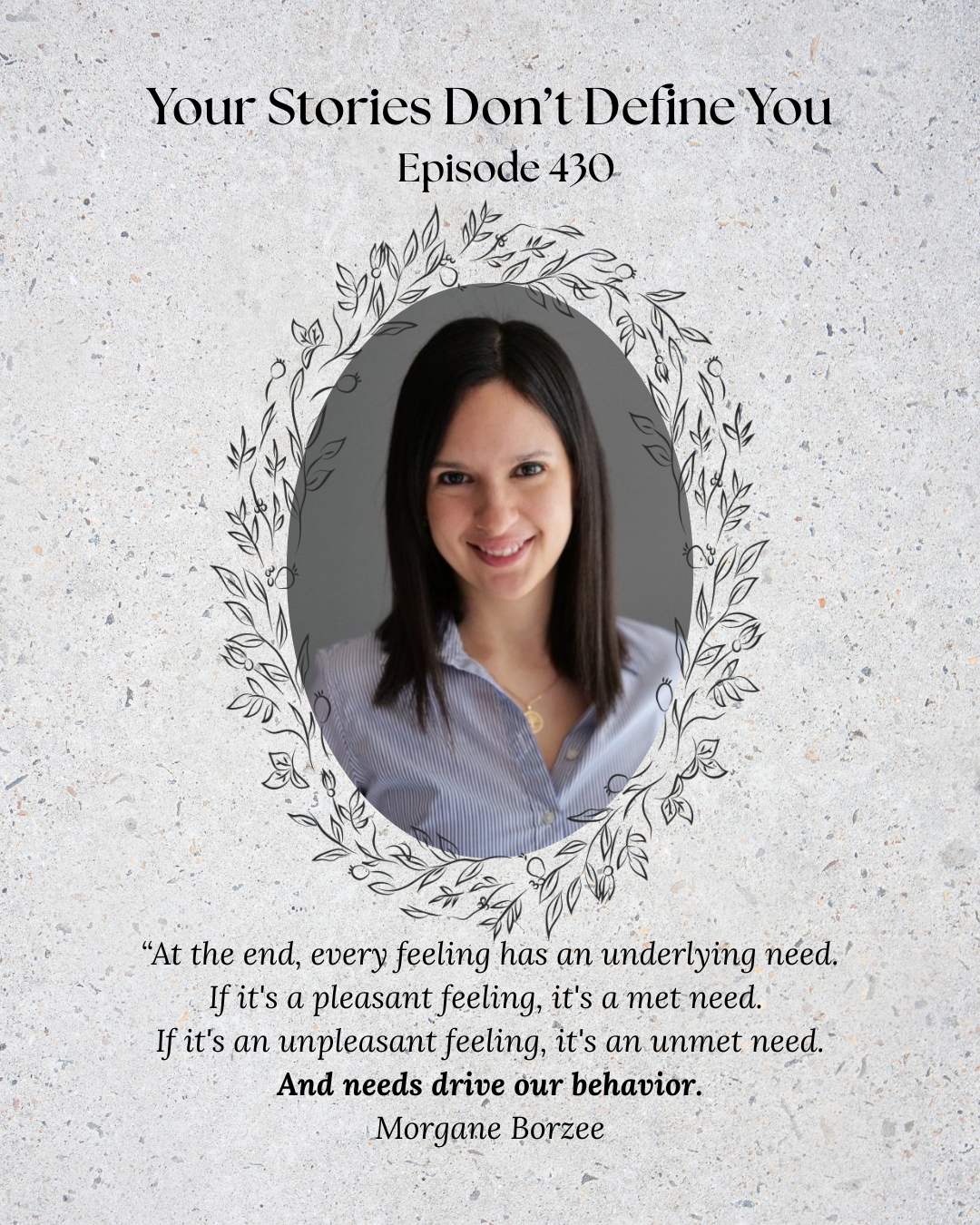
"... we talk about feelings, but... At the end, every feeling has an underlying need. If it's a pleasant feeling, it's a met need. If it's an unpleasant feeling, it's an unmet need. And needs drive our behavior."
This conversation with Morgane Borzée filled in so many gaps in my understanding of what I've heard referred to as trauma-informed coaching, teaching, and counseling.
If you're anything like me, you associated the word trauma with something dramatic, like abuse or neglect, death, major accidents, war, natural disasters, etc. Many of us don't feel comfortable using the word trauma to describe experiences in our lives that don't seem to compare with what we know others have experienced.
But trauma in childhood can be something as innocuous as an underlying current of the repression of anger, financial stress and anxiety, sibling rivalry. And each person experiences it differently. Ask your siblings or cousins about growing up and they'll remember completely different episodes as traumatic - or not.
Morgane suffered from severe anxiety as a young adult, and was referred to a therapist that she didn't realize was a trauma specialist. She thought she might be in the wrong place until she heard from the therapist that her anxiety might be coming from repression of anger. And she might be repressing anger because that's how she responded to her fear of the anger she saw expressed in her childhood home, among her family.
"... for years, I was shortcutting anger with anxiety. So whenever a situation would make me angry, I didn't feel angry, I felt anxious."
Her experience with the therapist not only gave her the tools she needed to start truly addressing the anxiety at that deeper level. It gave her the inspiration she then used to create an incredible platform to make what she was learning more accessible and approachable for others.
She took what she learned in academic, research-based, deeply intellectual settings, and translated into everyday language and characters that the rest of us can apply, learn from, and make real change in our lives and those of the people we influence.
Highlights
The word trauma feels big, feels significant, and it is, but it's also relative. Each person experiences it differently.
Needs met and unmet are what drive our emotions and behavior.
Listeners, now it's your turn. During our call, I started writing notes about my own needs and how they affect my behavior when they're not met: My need for respect and how that might show up in emotional responses and anger.
What are yours?
A need for basic food staples in your house? If somebody gets upset when you run out of peanut butter or eggs, it may be a need in terms of food security that wasn't. What is a pattern of conflict or frustration that you've experienced yourself or experienced with somebody else that might be related to this issue? When your needs are met, you have a particular emotional response, and when they're not met, you have another emotional response. I'm curious to hear what came up for you, what patterns you've uncovered, and maybe what you're going to do about it.
From Morgane:
I’m the founder of Equanima. I created it after years of struggling with anxiety and realizing how powerful emotional intelligence can be when you actually understand what’s happening inside you.
As a designer, I saw a gap between complex psychological concepts and what people can realistically use in daily life. Equanima exists to bridge that gap by turning emotional intelligence into clear, practical, and visual tools that help people understand their patterns, regulate under pressure, and live more aligned lives.
Visit my website to learn more, and be sure to connect and/or follow me on LinkedIn and Instagram.
About Sarah

Sarah is a Montana based workplace communication trainer, TEDx speaker, DisruptHR speaker, public speaking coach, professional storyteller, musician, and podcast host. Her workshops and coaching packages with teams and their leaders are known to address and reduce miscommunication – the most common cause of tension and stress in the workplace. Using the team’s results from the StrengthsFinder assessment, she guides teams in learning to speak each other’s “language”, learning to value each other’s strengths and connecting with each other through enhanced self-reflection and effective listening.
Sarah’s nearly 20 years working in government agencies inspired her to complete her MBA and to achieve her StrengthsFinder certification to improve work environments for others, guiding teams toward increased satisfaction, productivity, and happiness.
Visit her website to purchase her book, Your Stories Don't Define You in paperback or audiobook.
426: Ending the Cycle of Family Trauma Featuring Sharon Weinstein
426: Ending the Cycle of Family Trauma Featuring Sharon Weinstein
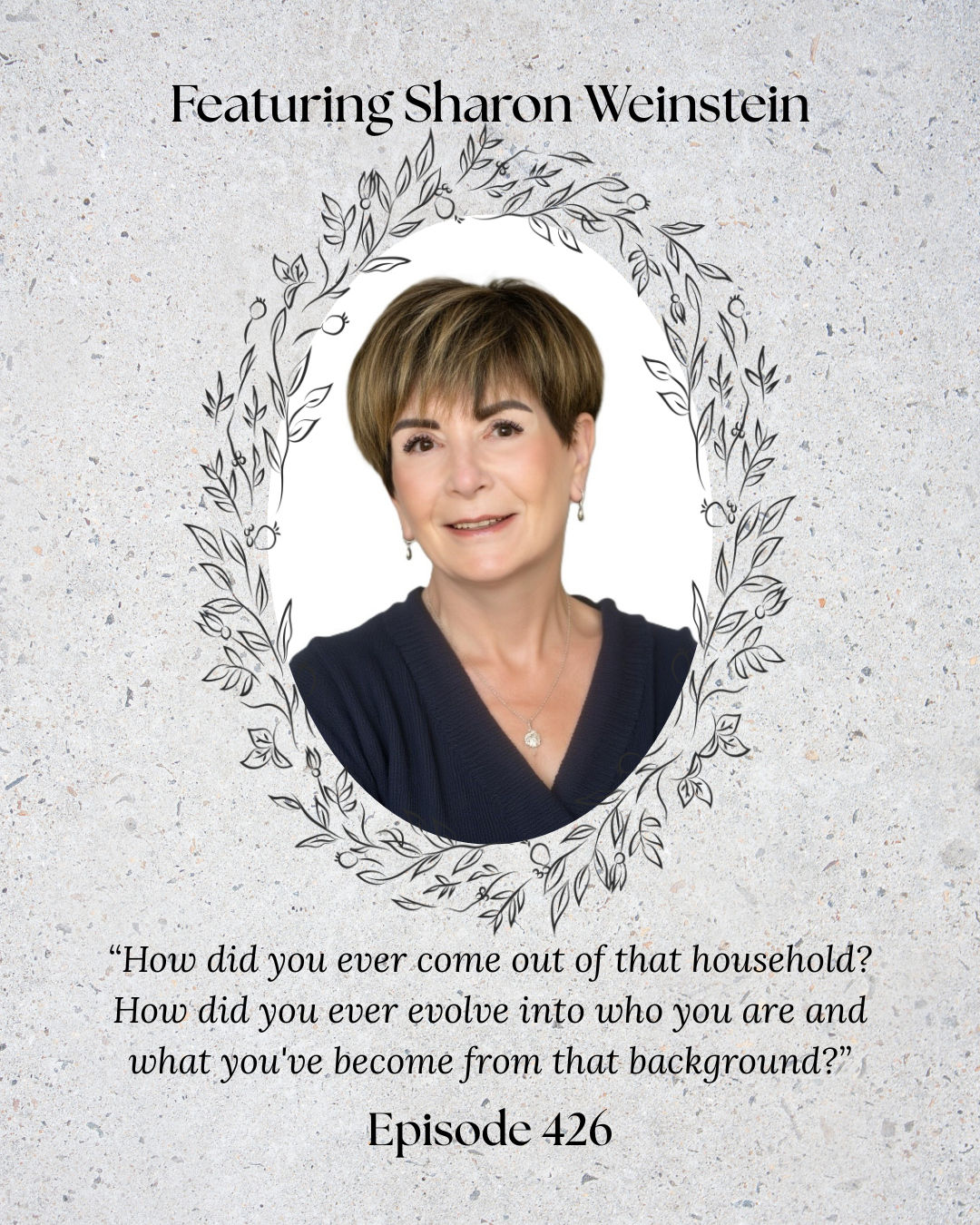
"How did you ever come out of that household? How did you ever evolve into who you are and what you've become from that background?"
We met in Washington DC at the final competition for the People's Choice speaker for the next TEDxUStreetWomen event scheduled on November 3, 2025. And when she won the coveted spot, all of us were thrilled. She earned it.
In this episode we discussed her TEDx talk, "Think Differently to be Unstoppable", the use of the 4W framework to reframe personal trauma into recovery and growth. She shared insightful, powerful stories of how she modeled what she wanted to see in her children and family to end the cycle of family trauma.
We also discussed her new book, Harmony by Design, replacing the concept of balance with a work and life integration.
If you're curious to hear the story of that 18-month competition, listen to episode 421 featuring Kuti Mack.
Highlights:
4W Framework
Where am I? Assess your current reality, take inventory with honesty and clarity.
What if...? Brainstorm different approaches and potential outcomes.
What WOWs? Identify ideal outcomes given current resources. What is the best case scenario?
What works? Find sustainable, repeatable solutions. Take small steps.
Sharon's soccer story, choosing to start an adult women's league without any experience, so her children could see her trying something uncomfortable and new, and so she could be more aware of what her children were experiencing.
Quote:
"...And sometimes the biggest question that I get from them is, 'how did you ever come out of that household? How did you ever evolve into who you are and what you've become from that background?' They say it to me all the time. 'Are you sure you weren't adopted?'"
Watch Sharon's recently published TEDx!
About Sharon:
A global nursing leader, TEDx speaker, and advocate for personal transformation who empowers others to rethink what's possible and turn adversity into strength. A Certified Speaking Professional (CSP), she's an award-winning healthcare innovator and author. Founder of SMW Group and the #FromCrisistoCapacity framework, she develops nurse leaders and strengthens teams and organizations through resilience, stress reduction, and human performance.
Visit, follow, and connect:
LinkedIn, Facebook, Instagram, YouTube, website.
---
About Sarah
Sarah is a Montana based workplace communication trainer, TEDx speaker, DisruptHR speaker, public speaking coach, professional storyteller, musician, and podcast host. Her workshops and coaching packages with teams and their leaders are known to address and reduce miscommunication – the most common cause of tension and stress in the workplace. Using the team’s results from the StrengthsFinder assessment, she guides teams in learning to speak each other’s “language”, learning to value each other’s strengths and connecting with each other through enhanced self-reflection and effective listening.
Sarah’s nearly 20 years working in government agencies inspired her to complete her MBA and to achieve her StrengthsFinder certification to improve work environments for others, guiding teams toward increased satisfaction, productivity, and happiness.
Visit her website to purchase her book, Your Stories Don't Define You in paperback or audiobook.

244: How Does Storytelling Make You More Relatable and Inspiring?
In this episode Sarah Elkins and her guest, Greg McDonough, an accomplished entrepeneur and finance consultant, discuss the importance of telling one's story in a meaningful and relevant way so that it resonates with the audience in a way that can be both compelling and inspiring.
The Meaningfulness of Relevant Stories

In this episode Sarah Elkins and her guest, Greg McDonough, an accomplished entrepeneur and finance consultant, discuss the importance of telling one's story in a meaningful and relevant way so that it resonates with the audience in a way that can be both compelling and inspiring.
Highlights from the episode:
Your strengths are your stories.
Sharing somthing meaningful so that it is relevant.
People want to see that these stories are possible and achievable.
Quotes
It's not about your story, it's about how your audience receives it.
Be conscious of where you are in the moment and how the moment is going to reflect in your stories going forward.
Referenced in this podcast:
The Impactful Leadership podcast episode featuring Sarah Elkins
The Entrepreneurs' Organization website
From Greg's LinkedIn profile:

My passion is to help my clients balance the amount of sleep they have with the amount they EAT (earnings after-tax). We manage their risk-taking so they can sleep better at night while also managing their business to produce the after-tax cash flow they need. It is a tricky combination but through a team approach, we are able to achieve these goals together.
Connect with Greg on LinkedIn, subscribe to The Impactful Leadership podcast, and check out his website!
*Show notes contributed by Chinook Bromlie-Estey
About Sarah:
"Uncovering the right stories for the right audiences so executives, leaders, public speakers, and job seekers can clearly and actively demonstrate their character, values, and vision."
In my work with coaching clients, I guide people to improve their communication using storytelling as the foundation of our work together. What I’ve realized over years of coaching and podcasting is that the majority of people don’t realize the impact of the stories they share - on their internal messages, and on the people they’re sharing them with.

227: Identify Key Moments in Your Life to Share and Inspire Others
What does finding yourself look like? What are the key moments in our life that define who we are? Join in as Sarah and her special guest and New York Times bestselling author, Lindsey Pollak, discuss the transformative stages in our lives, and how Lindsey is inspiring others by sharing stories of dealing with her own anxiety.
Lindsey Pollak's Stories of Self-Discovery

What does finding yourself look like? What are the key moments in our life that define who we are? Join in as Sarah and her special guest and New York Times bestselling author, Lindsey Pollak, discuss the transformative stages in our lives, and how Lindsey is inspiring others by sharing stories of dealing with her own anxiety.
“When we’re in our twenties and early thirties, we’re constantly trying to be something else. We’re constantly looking at others to say, “Oh I want to be like that.” And fighting our natural instincts of who we are.”
*podcast show notes contributed by Tracy Ackeret
About Lindsey:
Lindsey Pollak is a New York Times bestselling author and one of the world’s leading career and workplace experts. She was named to the 2020 Thinkers50 Radar List, which honors the top global management thinkers whose work is shaping the future of how organizations are managed and led. Lindsey’s latest book is a response to the COVID-19 crisis: Recalculating: Navigate Your Career Through the Changing World of Work was published by HarperCollins on March 23, 2021.
Her other books include The Remix: How to Lead and Succeed in the Multigenerational Workplace, Becoming the Boss: New Rules for the Next Generation of Leaders, and Getting from College to Career: Your Essential Guide to Succeeding in the Real World. Lindsey’s speaking audiences and consulting clients have included more than 250 corporations, law firms, conferences, and universities. Her advice and opinions have appeared in such media outlets as The TODAY Show, The New York Times, The Wall Street Journal, CNN, and NPR.
Connect with Lindsey on LinkedIn and check out her website to learn more and purchase her best selling books!
Sarah’s Discovering Clarity One Bite at a Time course
is now available!
ABOUT SARAH:

"Uncovering the right stories for the right audiences so executives, leaders, public speakers, and job seekers can clearly and actively demonstrate their character, values, and vision."
In my work with coaching clients, I guide people to improve their communication using storytelling as the foundation of our work together. What I’ve realized over years of coaching and podcasting is that the majority of people don’t realize the impact of the stories they share - on their internal messages, and on the people they’re sharing them with.
My work with leaders and people who aspire to be leaders follows a similar path to the interviews on my podcast, uncovering pivotal moments in their lives and learning how to share them to connect more authentically with others, to make their presentations and speaking more engaging, to reveal patterns that have kept them stuck or moved them forward, and to improve their relationships at work and at home.
The audiobook, Your Stories Don’t Define You, How You Tell Them Will is now available!
Included with your purchase are two bonus tracks, songs recorded by Sarah's band, Spare Change, in her living room in Montana.
204: Inner Voice Have You Spinning? Fire Your Narrator!
How do we overcome that powerful voice in our head that keeps us from succeeding and sharing our accomplishments?
Sarah Elkins and Valerie Gordon tackle the topics from their previous conversation, as well as new topics such as questioning the loud voice inside your head and rewriting your own story. This engaging conversation dives into the deeper meaning behind the “narrator” we experience, how do we seize those thoughts and put them into action?
Valerie Gordon Knows a Thing or Two About Stories

How do we overcome that powerful voice in our head that keeps us from succeeding and sharing our accomplishments?
Sarah Elkins and Valerie Gordon tackle the topics from their previous conversation, as well as new topics such as questioning the loud voice inside your head and rewriting your own story. This engaging conversation dives into the deeper meaning behind the “narrator” we experience, how do we seize those thoughts and put them into action?
“Another type of narrator’s thoughts that’s going to get in your way of future success, where did that story start? And how do we rewrite it?”
*podcast show notes contributed by Tracy Ackeret
About Valerie:

Valerie Gordon knows how to harness the power of a story to meet a wide range of business needs. A 10-time Emmy-winning television producer with two decades producing stories for CBS News, HBO, and ESPN, she knows what makes a story meaningful and memorable. Through Commander-in-She LLC, the career and communications strategy firm she founded in 2017, Valerie helps clients take command of the power in their own stories.
Valerie works with corporations and speaks at conferences to engage employees, guide teams, and grow future leaders. She offers keynotes, workshops, virtual training, and individual coaching, providing the communication skills necessary to help clients ascend the leadership ladder, manage relationships and critical conversations, build their personal brand and create next chapter success.
Her new book, “Fire Your Narrator! A Storyteller’s Guide to Getting Out of Your Head and Into Your Life” is about the stories we tell ourselves and the impact those internal stories have on our external success.
Visit Valerie’s website and follow her on LinkedIn!
*podcast show notes contributed by Tracy Ackeret
ABOUT SARAH:
"Uncovering the right stories for the right audiences so executives, leaders, public speakers, and job seekers can clearly and actively demonstrate their character, values, and vision."

In my work with coaching clients, I guide people to improve their communication using storytelling as the foundation of our work together. What I’ve realized over years of coaching and podcasting is that the majority of people don’t realize the impact of the stories they share - on their internal messages, and on the people they’re sharing them with.
My work with leaders and people who aspire to be leaders follows a similar path to the interviews on my podcast, uncovering pivotal moments in their lives and learning how to share them to connect more authentically with others, to make their presentations and speaking more engaging, to reveal patterns that have kept them stuck or moved them forward, and to improve their relationships at work and at home.
The audiobook, Your Stories Don’t Define You, How You Tell Them Will is now available!
Included with your purchase are two bonus tracks, songs recorded by Sarah's band, Spare Change, in her living room in Montana.
203: Is It Truly Possible For People To Change? Featuring Lester Young
At the age of 19, Lester Young was convicted of murder. Today, he has transformed his life and utilizes his gifts to fulfill his purpose.
Enjoy this riveting discussion between Sarah Elkins and Lester Young, Executive Director for Path2Redemption, as they delve into how mistakes of the past don’t define who you are today. From learning “how to plant the seed” and cultivate your unique gifts, to giving back to others and changing their perceptions of you, this is an episode that will truly inspire your inner want for growth.
A Convicted Murder Believes in True Redemption

At the age of 19, Lester Young was convicted of murder. Today, he has transformed his life and utilizes his gifts to fulfill his purpose.
Enjoy this riveting discussion between Sarah Elkins and Lester Young, Executive Director for Path2Redemption, as they delve into how mistakes of the past don’t define who you are today. From learning “how to plant the seed” and cultivate your unique gifts, to giving back to others and changing their perceptions of you, this is an episode that will truly inspire your inner want for growth.
“I’m not tied to my story. I’m showing you the evolution, the transformation that I went through.”
Books Discussed:
James Allen’s As A Man Thinketh
Bob Burg’s The Go-Giver
Lester Young’s The Five Stages of Incarceration
Lester Young’s The Five Stages of Growth
*podcast show notes contributed by Tracy Ackeret
About Lester:
Lester Young, Jr is a native of Hilton Head Island, South Carolina. At the age of 19, Lester was given a life sentence (with the possibility of parole after serving 20 years). Entering prison without education was indeed a struggle, but he did not allow this to stop him from educating himself as well as others. With the support of family and friends, Lester was able to obtain his G.E.D and later enroll in Business Management Courses, via mail, as a student at Ashworth College. Lester began drawing attention and was constantly rewarded for his interest in helping others. With permission and no hesitation from the warden, Lester along with the prison chaplain began meeting to create templates, outlines, programs, and classes to instruct and mentor fellow inmates. This is where the idea of him establishing his own non-profit organization “Path2Redemption” got its start. After his release, on May 15, 2014 (22 years and 5 months) the outlines of his programs are still being taught in prison. Mr. Young is the author of two books The Five Stages of Incarceration and The Five Stages of Growth. Lester is also a proud father of a 6-year-old daughter.
Visit Lester’s website and follow him on LinkedIn to learn more!
*podcast show notes contributed by Tracy Ackeret
ABOUT SARAH:
"Uncovering the right stories for the right audiences so executives, leaders, public speakers, and job seekers can clearly and actively demonstrate their character, values, and vision."
In my work with coaching clients, I guide people to improve their communication using storytelling as the foundation of our work together. What I’ve realized over years of coaching and podcasting is that the majority of people don’t realize the impact of the stories they share - on their internal messages, and on the people they’re sharing them with.
My work with leaders and people who aspire to be leaders follows a similar path to the interviews on my podcast, uncovering pivotal moments in their lives and learning how to share them to connect more authentically with others, to make their presentations and speaking more engaging, to reveal patterns that have kept them stuck or moved them forward, and to improve their relationships at work and at home.
The audiobook, Your Stories Don’t Define You, How You Tell Them Will is now available!
Included with your purchase are two bonus tracks, songs recorded by Sarah's band, Spare Change, in her living room in Montana.
202: Becoming a Scientist: Why Do Stories Matter?
Indulge in this engaging conversation with Sarah Elkins and Scott Hanton, Editorial Director for Lab Manager Magazine and former Industrial Chemist and business leader for 30 years. They explore the beginning of his interest in becoming a chemist, as a young 13-year-old listening to a random man share his work stories, a moment that would instill a life-long passion for him.
Scott Hanton Has Firsthand Experience in the Power of Stories In His Journey to Becoming a Chemist
What do you want to be remembered for when you leave this world?

Indulge in this engaging conversation with Sarah Elkins and Scott Hanton, Editorial Director for Lab Manager Magazine and former Industrial Chemist and business leader for 30 years. They explore the beginning of his interest in becoming a chemist, as a young 13-year-old listening to a random man share his work stories, a moment that would instill a life-long passion for him. This was Scott’s “lollipop memont”, and was only the start - flash forward to Scott’s career today as he and Sarah discuss how managers treat their employees, as well as how our work and stories change others' perceptions of us.
Don't miss this great TED talk, where Drew Dudley talks about "lollipop moments" in the context of everyday leadership. This was a game-changer for Scott.
*podcast show notes contributed by Tracy Ackeret
About Scott:
Scott attended Michigan State University and received his Bachelor’s of Science in Chemistry, before earning his PhD in Physical Chemistry from the University of Wisconsin-Madison. Scott was an industrial chemist and business leader for 30 years. His titles included General Manager, Laboratory Operations Manager, and Chief Scientist for Intertek Allentown. Scott also held the roles of research scientist, laboratory supervisor, and section manager. Currently, Scott is the Editorial Director for Lab Manager Magazine.Due to these positions, Scott has developed expertise in analytical characterization, people leadership, and business management. Scott is an active member of ACS, ASMS, and ALMA.
Visit Scott’s page on Lab Manager Magazine and follow him on LinkedIn.
*podcast show notes contributed by Tracy Ackeret
ABOUT SARAH:
"Uncovering the right stories for the right audiences so executives, leaders, public speakers, and job seekers can clearly and actively demonstrate their character, values, and vision."
In my work with coaching clients, I guide people to improve their communication using storytelling as the foundation of our work together. What I’ve realized over years of coaching and podcasting is that the majority of people don’t realize the impact of the stories they share - on their internal messages, and on the people they’re sharing them with.
My work with leaders and people who aspire to be leaders follows a similar path to the interviews on my podcast, uncovering pivotal moments in their lives and learning how to share them to connect more authentically with others, to make their presentations and speaking more engaging, to reveal patterns that have kept them stuck or moved them forward, and to improve their relationships at work and at home.
The audiobook, Your Stories Don’t Define You, How You Tell Them Will is now available!
Included with your purchase are two bonus tracks, songs recorded by Sarah's band, Spare Change, in her living room in Montana.