Your Stories Don’t Define You
How You Tell Them Will
A podcast to unlock your stories and uncover meaningful insights.
Episode 87: Share Stories and OWN Your Talents
Al Swanson has always been an outdoorsy guy, so much that his first plan out of high school was to study turf management. Yes, turf management. His interest began with a manager who was on the cutting edge of sustainable, ecologically healthy golf course management. That manager was way ahead of his time, and Al knew it.
Don’t tell people what you’re good at. Demonstrate it with a story!
Al Swanson in his studio in Helena, Montana
Al Swanson has always been an outdoorsy guy, so much that his first plan out of high school was to study turf management. Yes, turf management. His interest began with a manager who was on the cutting edge of sustainable, ecologically healthy golf course management. That manager was way ahead of his time, and Al knew it. That experience is part of what inspired him to continue his work as a sustainable craftsman.
A back injury prevented him from taking his degree to work, so to speak, and after a few learning opportunities, he came back to his roots (so to speak), in woodworking with sustainably harvested trees.
Al Swanson’s Shop, Helena, Montana

Delicious beer from Lewis & Clark Brewing Company
We spoke at his shop in Helena, Montana, while sipping some local beers with the extraordinary scent of cedar and pine all around us.
There are two reasons I asked Al to be a guest on the podcast. One was that during our last conversation, he told me a story about running into some people at a brewery in Phillipsburg, Montana, and having a moment of celebrity status - and owning it. I was intrigued with his idea about being comfortable with that feeling and choosing to be exactly what your admirers expect you to be. It’s not about being a know-it-all, or any kind of superiority. It’s about owning what you’re awesome at, knowing you’re still growing and learning, and acknowledging and appreciating it when people recognize your magic.
Al is well known for his fly fishing accessories, but he developed his reputation for fine art and craftsmanship in his furniture business. That’s how I met him; I coveted an absolutely stunning piece he had donated to an auction for our Prickly Pear Land Trust annual event, the Harvest Moon Banquet.
Fly boxes custom made for Patagonia
The other reason I asked Al to chat with me was that his work is truly extraordinary, and I wanted to learn more about his motivation behind what he does. We share the theory that when we provide a service or product, it’s the details that make your work unique. Similar to my conversation with Rocky Connell, the artisan bread maker at Park Avenue Bakery, we spoke about the energy we put into everything we do.
In Al’s case, a huge part of receiving a piece built by him is how he packages the gift. It’s all about the experience, not just the beautiful artistry in the piece itself. Al includes cedar, hand shaved into fragrant, curly, fine strips in the box. When that box is opened, the receiver is instantly transported to the shop where the piece was made, with a sense of belonging and longing for the forest where the wood was harvested.
One of the great stories he shared was about how he was inspired to create fly fishing accessories, many are available thanks to his relationship with Orvis. Because of Al’s generous spirit, he fixed a broken landing net (used to carefully scoop up a fish after catching it) that was meaningful to a young man who happened to walk into the A.L. Swanson gallery in downtown Helena. That young man was about to join the leadership team at Orvis.
After Conference Hangover
In less than ten seconds, my boss had me nearly deflated. Within two weeks, I may as well have not gone to that conference at all.
So excited to begin implementing ideas, I actually arrived early to work the morning I returned from the conference. That's a big deal for me; I love to sleep and rarely choose to get up an earlier than I have to. But that morning was different. That week would be different. My JOB would be different. I was on fire.
The conference had been full of great topics, from sales to leadership, from marketing to financial analysis. My favorite sessions were the keynote and breakout session on marketing in our industry, hosted by the keynote speaker. He reminded me why I loved that class when I was going through my undergraduate business program. His excitement for the planning process, implementation, and follow up analysis was contagious; I couldn't wait to get back to work and start my own project!
That Monday, I sat down at my desk and penciled in time on my busy calendar to work on a formal marketing plan. Allowing myself 30 minutes to get started by looking at available online templates, I found myself selecting a simple but solid format and downloading it to my desktop. My boss walked in as I was saving it; he was surprised to see me already settled into my day, a bit earlier than usual. In an uneasy, suspicious, fake-happy tone:
What are you so happily working on first thing this morning?
"You know that break-out session I went to at the conference last week? The one on marketing plans and implementation? I'm working on a marketing plan for us, to formalize some of what I've been doing, and to make it easier to budget and analyze the success of what we're doing here. I've been so busy since I started, trying to build business, I completely forgot how important this tool can be!"
Why do we need a marketing plan? You should be pounding the pavement. Didn't we have this conversation, that you need to spend less time onsite and more time selling?
In less than ten seconds, my boss had me nearly deflated. I didn't give up, though, I just knew I was on the right track. Every time I had 15 minutes alone in the office, I worked on that marketing plan. I knew I needed the document to help me stay on track and see results in my efforts at that job. In my optimistic mind, when I presented the finished product to my boss, he'd appreciate it -- he'd realized why we needed it. I'll save the results of that work for another blog post; let's just say it wasn't pretty.
I tried to keep my enthusiasm that week and the next. Interactions with staff included some discussion of things I learned and ideas I wanted to share; some were motivated to work on them. Most just nodded and smiled, assuming the ideas would go away and they could get back to their routines without having to work too hard.
Within two weeks, I may as well have not gone to that conference at all.
Have you been to conferences that got you all excited, only to return to your routine and lose momentum within days or weeks? Why is that? Is it the conference itself, setting up unreasonable expectations? Is it your colleagues who didn't attend, who aren't motivated to step things up and improve?
How do we fix this?
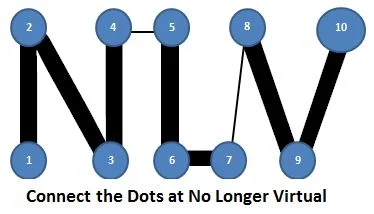
I have an idea about that and I'm implementing it at the No Longer Virtual conference in February. Because the participation is limited to 50 people, every person will have the opportunity to meet the facilitators and other participants and truly connect. Think about the value of that roomful of advocates for you, your career, and your business. Participants will keep in contact via the No Longer Virtual Facebook group and via LinkedIn, solidifying not only the learning and motivation from the event itself, but the relationships that were built in those 48 hours.
Think about the opportunity. Think about the value. Can you afford to miss this?
Watch my enthusiastic interview about NLV with Chris Spurvey here:
Do You Value Yourself? How Much?
What is your budget for inspiration, encouragement, and solid strategy for improvement? I want to know, because I want to help.
Do you value yourself? Do you value your professional and personal development? How much?
What is your budget for inspiration, encouragement, and solid strategy for improvement? I want to know, because I want to help.
"Hope is not a strategy."
Wiser words have rarely been spoken, and thanks to Trent Selbrede, those words are burned into my mind and have dramatically changed the way I write and think. Instead of writing hope, hopeful, or hopefully, I write intend, plan, and will.
"Fear is a liar."
This sentence is next in line in my current thought process, thanks to Trish Goff. When I find myself falling into my gerbil-like mind with circular thinking about what could go wrong, that is the sentence that I will into my consciousness.
If someone else had planned something like the No Longer Virtual conference, I would invest quite a lot to attend. As a matter of fact, I AM investing quite a lot to attend, and here's why:
The people facilitating these interactive sessions are some of the most competent, motivated, inspiring and inspired people I've had the pleasure to meet; I've only met one of them face-to-face. The people already registered are some of the smartest, most self-aware, kind, ambitious and motivated people I've met, and I've only met one of them face-to-face.
I know that to maximize my learning from these incredible people I must meet them face-to-face. It is worth the investment I'm making to have this experience because I know that -
what I put into it is exactly what I'll get out of it.
And I intend (not hope) to make this a life-changing experience.
I know that I need to continue to learn strategies to leverage my online network in my offline life. This agenda is full of topics I know will help me move my business and my life forward, and I know it will be worth the investment.