
Your Stories Don’t Define You
How You Tell Them Will
A podcast to unlock your stories and uncover meaningful insights.
430: Every Emotion Comes from Needs, Met and Unmet - featuring Morgane Borzée
"... we talk about feelings, but... At the end, every feeling has an underlying need. If it's a pleasant feeling, it's a met need. If it's an unpleasant feeling, it's an unmet need. And needs drive our behavior."
This conversation with Morgane Borzée filled in so many gaps in my understanding of what I've heard referred to as trauma-informed coaching, teaching, and counseling.
I thought I understood the connection between emotional intelligence and behavior, but I was missing a key component:
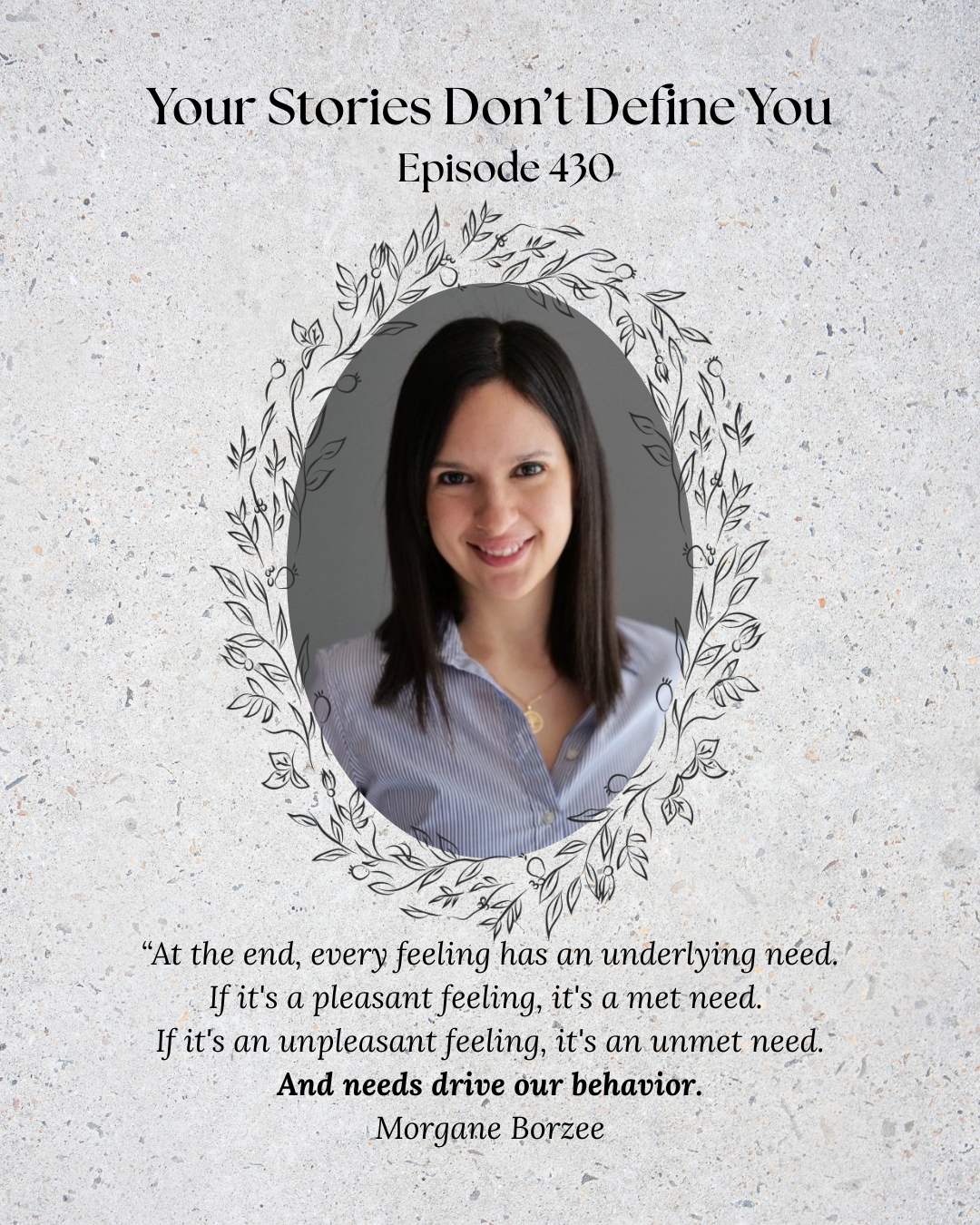
"... we talk about feelings, but... At the end, every feeling has an underlying need. If it's a pleasant feeling, it's a met need. If it's an unpleasant feeling, it's an unmet need. And needs drive our behavior."
This conversation with Morgane Borzée filled in so many gaps in my understanding of what I've heard referred to as trauma-informed coaching, teaching, and counseling.
If you're anything like me, you associated the word trauma with something dramatic, like abuse or neglect, death, major accidents, war, natural disasters, etc. Many of us don't feel comfortable using the word trauma to describe experiences in our lives that don't seem to compare with what we know others have experienced.
But trauma in childhood can be something as innocuous as an underlying current of the repression of anger, financial stress and anxiety, sibling rivalry. And each person experiences it differently. Ask your siblings or cousins about growing up and they'll remember completely different episodes as traumatic - or not.
Morgane suffered from severe anxiety as a young adult, and was referred to a therapist that she didn't realize was a trauma specialist. She thought she might be in the wrong place until she heard from the therapist that her anxiety might be coming from repression of anger. And she might be repressing anger because that's how she responded to her fear of the anger she saw expressed in her childhood home, among her family.
"... for years, I was shortcutting anger with anxiety. So whenever a situation would make me angry, I didn't feel angry, I felt anxious."
Her experience with the therapist not only gave her the tools she needed to start truly addressing the anxiety at that deeper level. It gave her the inspiration she then used to create an incredible platform to make what she was learning more accessible and approachable for others.
She took what she learned in academic, research-based, deeply intellectual settings, and translated into everyday language and characters that the rest of us can apply, learn from, and make real change in our lives and those of the people we influence.
Highlights
The word trauma feels big, feels significant, and it is, but it's also relative. Each person experiences it differently.
Needs met and unmet are what drive our emotions and behavior.
Listeners, now it's your turn. During our call, I started writing notes about my own needs and how they affect my behavior when they're not met: My need for respect and how that might show up in emotional responses and anger.
What are yours?
A need for basic food staples in your house? If somebody gets upset when you run out of peanut butter or eggs, it may be a need in terms of food security that wasn't. What is a pattern of conflict or frustration that you've experienced yourself or experienced with somebody else that might be related to this issue? When your needs are met, you have a particular emotional response, and when they're not met, you have another emotional response. I'm curious to hear what came up for you, what patterns you've uncovered, and maybe what you're going to do about it.
From Morgane:
I’m the founder of Equanima. I created it after years of struggling with anxiety and realizing how powerful emotional intelligence can be when you actually understand what’s happening inside you.
As a designer, I saw a gap between complex psychological concepts and what people can realistically use in daily life. Equanima exists to bridge that gap by turning emotional intelligence into clear, practical, and visual tools that help people understand their patterns, regulate under pressure, and live more aligned lives.
Visit my website to learn more, and be sure to connect and/or follow me on LinkedIn and Instagram.
About Sarah

Sarah is a Montana based workplace communication trainer, TEDx speaker, DisruptHR speaker, public speaking coach, professional storyteller, musician, and podcast host. Her workshops and coaching packages with teams and their leaders are known to address and reduce miscommunication – the most common cause of tension and stress in the workplace. Using the team’s results from the StrengthsFinder assessment, she guides teams in learning to speak each other’s “language”, learning to value each other’s strengths and connecting with each other through enhanced self-reflection and effective listening.
Sarah’s nearly 20 years working in government agencies inspired her to complete her MBA and to achieve her StrengthsFinder certification to improve work environments for others, guiding teams toward increased satisfaction, productivity, and happiness.
Visit her website to purchase her book, Your Stories Don't Define You in paperback or audiobook.
310 Painting A Picture Of Yourself You Can Be Proud Of
Stories. We all have them and we all share them at some point or another, those stories may make your listener laugh or they may make them cry, what is equally important in storytelling is how you tell stories about other people in your life, how you talk about others says just as much about you as your own personal stories. By exploring the world around you and experiencing the diversity and unique qualities that every place and every person has to offer, you will feel even more alive and grateful for the stories you have to share.
In this episode Sarah Elkins and Peter Davis discuss the many facets of life, storytelling, and how uplifting others can lead one to a fulfilling life path. Peter brings intelligence and empathy to the conversation with thought provoking quandaries and heartfelt personal stories that are sure to leave you with some introspective questions to think about.
310 Painting A Picture Of Yourself You Can Be Proud Of

Stories. We all have them and we all share them at some point or another, those stories may make your listener laugh or they may make them cry, what is equally important in storytelling is how you tell stories about other people in your life, how you talk about others says just as much about you as your own personal stories. By exploring the world around you and experiencing the diversity and unique qualities that every place and every person has to offer, you will feel even more alive and grateful for the stories you have to share.
In this episode Sarah Elkins and Peter Davis discuss the many facets of life, storytelling, and how uplifting others can lead one to a fulfilling life path. Peter brings intelligence and empathy to the conversation with thought provoking quandaries and heartfelt personal stories that are sure to leave you with some introspective questions to think about.
Highlights
Do things that make you feel alive.
Diversity and change are the fruit of life, accept it whenever it decides to show itself.
Don’t forget to let yourself dream, yes working towards success is important but don’t forget to let yourself enjoy the little things.
Are the stories you are still holding on to years later useful to the narrative of the person you are now?
Quotes
“I learned very quickly in Chicago that being good at something, they don’t care. Everyone’s good at something. You got to be great, you got to stand out, you really have to have something to offer, and you have to be tough, you have to be able to take criticism. Lots of it.”
“You’re on an L Train going downtown like everybody for work, you’re going to see people at every station of life. And they are all reading a great book.”
“The years go by, you’re propping up a story that is no longer useful and the psychic energy required to maintain that infrastructure must be exhausting.”
“You’re going to have to find a way to differentiate yourself in a way that is compelling, powerful, and accurate. And authentic.”
Dear Listeners it is now your turn,
Whatever you’re doing I hope that you can start to answer that question: I see a day when.
I have no doubt that whatever you put together you can then use to really inform how you present yourself to the world around you. Because the stories you tell say a lot about who you are, and the stories you tell about others in your community say even more about who you are. So share your stories and share them well.
And, as always, thank you for listening.
About Peter

Peter Davis helps leaders of small to medium-sized B2B service companies, non-profit organizations, and institutions of higher learning craft and tell stories that attract their most natural audiences; people that actually want to buy from you, work for you, invest in you, fund you or volunteer for you. Performed consistently, a compelling story has the power to improve personal, organizational and brand performance.
Be sure to check out Peter’s LinkedIn, Facebook, and Instagram! As well as his website Heroes Quest Consulting and the video Business Is Theater!
About Sarah
"Uncovering the right stories for the right audiences so executives, leaders, public speakers, and job seekers can clearly and actively demonstrate their character, values, and vision."
In my work with coaching clients, I guide people to improve their communication using storytelling as the foundation of our work together. What I’ve realized over years of coaching and podcasting is that the majority of people don’t realize the impact of the stories they share - on their internal messages, and on the people they’re sharing them with.
My work with leaders and people who aspire to be leaders follows a similar path to the interviews on my podcast, uncovering pivotal moments in their lives and learning how to share them to connect more authentically with others, to make their presentations and speaking more engaging, to reveal patterns that have kept them stuck or moved them forward, and to improve their relationships at work and at home.
The audiobook, Your Stories Don’t Define You, How You Tell Them Will is now available!
Included with your purchase are two bonus tracks, songs recorded by Sarah's band, Spare Change, in her living room in Montana.
Be sure to check out the Storytelling For Professionals Course as well to make sure you nail that next interview!
253 The Impact We Bring
How do you impact others? How do you think you are perceived by those people? These questions are explored in today’s episode with incredible insight and the emotional intelligence of people who have also asked themselves these questions and decided that they wanted to leave a positive legacy.
In this episode Sarah Elkins and Neetal Parekh discuss the importance of our impact on those around us, from the home to the workplace and even to our digital footprint. Viewed through the lens of self reflection and acceptance of how -or if- we impact the people around us, this episode is sure to bring awareness to our impact on others as well as the impact they have on ourselves.

How do you impact others? How do you think you are perceived by those people? These questions are explored in today’s episode with incredible insight and the emotional intelligence of people who have also asked themselves these questions and decided that they wanted to leave a positive legacy.
In this episode Sarah Elkins and Neetal Parekh discuss the importance of our impact on those around us, from the home to the workplace and even to our digital footprint. Viewed through the lens of self reflection and acceptance of how -or if- we impact the people around us, this episode is sure to bring awareness to our impact on others as well as the impact they have on ourselves.
Highlights
Warmth brings people out of their shells.
Your impact on others can change them so make it a good one.
Acknowledge the people who’ve changed you.
We don’t know how we’re being perceived until someone speaks up.
The more you do something the less awkward it will be and the more you will learn.
Quotes
“You have to learn to surrender. You’ll never know the thousands of people listening, you’ll never be able to know all of them because we have no way to know. But all of these people that are listening to your voice or hearing something you said and it may impact how they go about their day or go about their life.”
“As a creator you would never know if and how it impacted people.”
“When we really own that strength, it actually draws people that make it happen.”
About Neetal Parekh

Neetal Parekh is an attorney and founder/CEO of Innov8social, which builds content, tools, and programs to make social entrepreneurship more accessible, actionable, and transformative. She is a passionate advocate for social impact ecosystem-building who believes that this field empowers us to creatively re-imagine how businesses and individuals can create meaningful impact and lasting value. Neetal is the author of Amazon bestselling book, 51 Questions on Social Entrepreneurship, host of The Impact Podcast by Innov8social, and convener of Impactathon®. She is currently working on a series of children's books to introduce a problem solving mindset to young learners.
Connect with Neetal on LinkedIn, Facebook, and Instagram! And be sure to check out her websites Innov8 Social, Impactathon, and be sure to go to 51 Questions to get her amazing book!
About Sarah Elkins
"Uncovering the right stories for the right audiences so executives, leaders, public speakers, and job seekers can clearly and actively demonstrate their character, values, and vision."
In my work with coaching clients, I guide people to improve their communication using storytelling as the foundation of our work together. What I’ve realized over years of coaching and podcasting is that the majority of people don’t realize the impact of the stories they share - on their internal messages, and on the people they’re sharing them with.
My work with leaders and people who aspire to be leaders follows a similar path to the interviews on my podcast, uncovering pivotal moments in their lives and learning how to share them to connect more authentically with others, to make their presentations and speaking more engaging, to reveal patterns that have kept them stuck or moved them forward, and to improve their relationships at work and at home.
The audiobook, Your Stories Don’t Define You, How You Tell Them Will is now available!
Included with your purchase are two bonus tracks, songs recorded by Sarah's band, Spare Change, in her living room in Montana.
Interested in NLV? Sign up here!
Show Notes by Chinook Bromlie
247: Our Biggest Obstacle Is Sometimes Ourselves
Many times in life we do everything within our power to achieve our goal, whether that be a new job, to bring pride to others or ourselves, and to finally get over that hurdle our mental health has been lately. It’s easy to forget how far you’ve come when you see how far you still have left to go, but that doesn’t mean you can’t celebrate your accomplishments now.
Our Biggest Obstacle Is Sometimes Ourselves, Featuring Megan Miller of Aprovechar Language Solutions

Many times in life we do everything within our power to achieve our goal, whether that be a new job, to bring pride to others or ourselves, and to finally get over that hurdle our mental health has been lately. It’s easy to forget how far you’ve come when you see how far you still have left to go, but that doesn’t mean you can’t celebrate your accomplishments now.
In this episode Sarah Elkins and her good friend Megan Miller discuss the importance of allowing yourself to change and to celebrate every victory, no matter how small, because those victories are proof of your success.
Highlights
Sharing personal, vulnerable stories without any intention doesn’t help you.
Sometimes you don’t notice how much things change until you step back or get an outside perspective.
Celebrate the wins.
You get out what you put in.
Quotes
It’s soul, it’s about how you do it and why you do it.
The advice we give a lot of the time is advice we need to hear at that point in time.
Mentioned in this Podcast
About Megan

Megan Miller is the CEO of Aprovechar Language Solutions, LLC, a company which acts as a bridge between English and Spanish language learners. Her personalized and small group programs take a habit-based approach, and whether it’s in class or a Book Club – you know you’ll have fun!
She also helps IT companies in Latin America and Europe tell their stories for a U.S.-based audience through translation and localization projects. Megan has a Bachelor’s in Spanish Language, Literature, and Culture and is a certified to Teach English as a Foreign Language.
Check out her Instagram and LinkedIn! As well as her website, Approvechar Language Solutions!
About Sarah
"Uncovering the right stories for the right audiences so executives, leaders, public speakers, and job seekers can clearly and actively demonstrate their character, values, and vision."
In my work with coaching clients, I guide people to improve their communication using storytelling as the foundation of our work together. What I’ve realized over years of coaching and podcasting is that the majority of people don’t realize the impact of the stories they share - on their internal messages, and on the people they’re sharing them with.
My work with leaders and people who aspire to be leaders follows a similar path to the interviews on my podcast, uncovering pivotal moments in their lives and learning how to share them to connect more authentically with others, to make their presentations and speaking more engaging, to reveal patterns that have kept them stuck or moved them forward, and to improve their relationships at work and at home.
The audiobook, Your Stories Don’t Define You, How You Tell Them Will is now available!
Included with your purchase are two bonus tracks, songs recorded by Sarah's band, Spare Change, in her living room in Montana.
Show notes by Chinook Bromlie
246: How Your Authentic Self Changes With Time
As we journey through life, conflict and confrontation of the self is inevitable, but it is how we face these challenges that reveal our most authentic selves.
Episode 246: How Your Authentic Self Changes With Time

As we journey through life, conflict and confrontation of the self is inevitable, but it is how we face these challenges that reveal our most authentic selves.
In this episode, Sarah Elkins and her guest Lisa Lackey discuss this idea, as well as what authenticity means to them and how it is something that can change with time.
Highlights
Authenticity is fluid and ever changing.
We can't be everything all at once.
Face challenges and pursue your dreams.
Quotes
Authenticity is malleable, it is not this rigid thing. You have to allow space for transformation, and if you have this rigid idea of your authentic self then there is no room for transformation
We can't be everything all at once, we can be what we want to be but we can't do it all at the same time.
I didn't know where I belonged, and I still don't know where I belong, and I have to constantly give myself permission to be able to sit in that and be okay with that. I ask myself, "what do I need?" and "what do I need to make myself feel like I fit in?" and "Is it okay to not fit in?"
About Lisa Lackey from her LinkedIn profile:

After a successful career in the entertainment industry beginning in my home country of Australia and spanning over 20 years here in the U.S, along with a life changing volunteer opportunity in Ghana, West Africa, I am excited to continue my work in this new and purposeful career focusing on social impact. Based in Los Angeles, I strive to be a vehicle for change, and I look forward to many more opportunities to align myself with the those who are rethinking how we can alleviate poverty especially as it pertains to the empowerment of women, and youth, locally and internationally.
About Sarah Elkins
"Uncovering the right stories for the right audiences so executives, leaders, public speakers, and job seekers can clearly and actively demonstrate their character, values, and vision."
In my work with coaching clients, I guide people to improve their communication using storytelling as the foundation of our work together. What I’ve realized over years of coaching and podcasting is that the majority of people don’t realize the impact of the stories they share - on their internal messages, and on the people they’re sharing them with.
My work with leaders and people who aspire to be leaders follows a similar path to the interviews on my podcast, uncovering pivotal moments in their lives and learning how to share them to connect more authentically with others, to make their presentations and speaking more engaging, to reveal patterns that have kept them stuck or moved them forward, and to improve their relationships at work and at home.
The audiobook, Your Stories Don’t Define You, How You Tell Them Will is now available!
Included with your purchase are two bonus tracks, songs recorded by Sarah's band, Spare Change, in her living room in Montana.
Show Notes by Chinook Bromlie
245: Our Authenticity Depends on Our Values, Not Our Comfort Zones
Throughout our lives we learn many lessons about ourselves and others, how we move on and grow from these lessons is how we become better versions of ourselves even if at the time it seems painful. By sharing what we’ve learned and our interests in a constructive and compassionate way, without sounding condescending or judgmental we can achieve our best selves.
Our Authenticity Depends on Our Values, Not Our Comfort Zones

Throughout our lives we learn many lessons about ourselves and others, how we move on and grow from these lessons is how we become better versions of ourselves even if at the time it seems painful. By sharing what we’ve learned and our interests in a constructive and compassionate way, without sounding condescending or judgmental we can achieve our best selves.
In this episode Sarah Elkins and Ben Albert talk about the importance of life lessons and sharing our interests with others in a way that doesn’t sound conceited, as well as balancing our work and life in a healthy way, and through doing so learn how to reflect on ourselves in order to benefit others and ourselves by being empathetic and vulnerable.
Highlights
Being conscious of how you speak and rewording things that can seem negative.
Being proud of being your whole self
There is continuity in steps that feel disconnected
Work and life are parts of the same thing, alignment of the two is essential for a healthy life
Quotes
“To me it doesn’t matter who gets the trophy, so long as the solution is found.” - Ben Albert
“ ‘Should’ doesn’t demonstrate care, it demonstrates judgment.” Sarah Elkins
About Ben Albert

Ben is the owner of Balbert Marketing LLC. He is also the curator of The “Real Business Connections Network,” where he hosts 5 podcasts, “Rochester Business Connections,” “Learn Speak Teach,” “Ben’s Bites,” “Five Minute Fridays,” and “Real Hits.” Once an underdog, now a successful entrepreneur, Ben is passionate about helping other underdogs achieve their dreams.
When Covid hit, Ben was furloughed from work. He found himself down and out, staring at an empty handle of Jim Beam whiskey. He was unemployed, depressed, and felt unworthy.
Hesitantly, he opened his Macbook and started reaching out to strangers on Linkedin. This spearheaded his entrepreneurial journey.
The rest is history.
Now Ben hosts a network of 5 podcasts called “Real Business Connections,” runs a massively successful marketing firm, Balbert Marketing, and has replaced his established sales income in just over a year. Ben found his way.
Once an underdog, now a successful entrepreneur, Ben is passionate about helping other underdogs find their way and achieve their dreams.
Ben is on a mission to move the needle on one million careers, one conversation at a time.
You can contact Ben via his Facebook, Instagram, Linkedin, and at Balbert Marketing! Or schedule a consultation with him Here! You can also listen to his podcast Real Business Connections on Apple or Spotify!
About Sarah Elkins
"Uncovering the right stories for the right audiences so executives, leaders, public speakers, and job seekers can clearly and actively demonstrate their character, values, and vision."
In my work with coaching clients, I guide people to improve their communication using storytelling as the foundation of our work together. What I’ve realized over years of coaching and podcasting is that the majority of people don’t realize the impact of the stories they share - on their internal messages, and on the people they’re sharing them with.
My work with leaders and people who aspire to be leaders follows a similar path to the interviews on my podcast, uncovering pivotal moments in their lives and learning how to share them to connect more authentically with others, to make their presentations and speaking more engaging, to reveal patterns that have kept them stuck or moved them forward, and to improve their relationships at work and at home.
The audiobook, Your Stories Don’t Define You, How You Tell Them Will is now available!
Included with your purchase are two bonus tracks, songs recorded by Sarah's band, Spare Change, in her living room in Montana.
243: While Your Mindset Shifts Over Time, Your Purpose May Not
Sometimes in life we will all have moments where we think to ourselves, “Is this really who I want to be? Is this how I want my story to impact others?” and we either wonder or plan for the next steps in becoming the person we want to be.
In this episode Sarah Elkins and her guest Tony Michaelides, an accomplished Author and former Music Industry Executive, discuss the importance of being authentic in your stories and how they influence your audience in a way that is for the better, instead of being outrageous and telling your stories for the perceived “glory” of having a legacy.
While Your Mindset Shifts Over Time, Your Purpose May Not

Sometimes in life we will all have moments where we think to ourselves, “Is this really who I want to be? Is this how I want my story to impact others?” and we either wonder or plan for the next steps in becoming the person we want to be.
In this episode Sarah Elkins and her guest Tony Michaelides, an accomplished Author and former Music Industry Executive, discuss the importance of being authentic in your stories and how they influence your audience in a way that is for the better, instead of being outrageous and telling your stories for the perceived “glory” of having a legacy.

Highlights
It's okay to be lousy when you first try something.
In order to pursue your dreams you have to be willing to be uncomfortable in order to learn what you need to do.
How many people can you benefit by being your authentic self?
The influence of being insistent on personal growth.
Show appreciation for the road life has lead you on.
Quotes
Be true to yourself, don't find yourself being lead down a road of uncertainty.
There comes a time in your life when you stand back and say "what about me?" and that's not being selfish towards others, that's just putting yourself in the mix.
We can be heroes if just for today.
Featured in this podcast:
Moments that Rock Podcast
About Tony Michaelides (from his website):
Having spent thirty plus years in the music industry and working with some of the world’s leading artists I could see that big changes were about to happen. It was clearly time for me to make a change too so after being labelled an “Alien of Extraordinary Ability” for services to the music and arts I was awarded a green card, packed my bags and headed out to America for the next part of my journey. As I began writing my first book it dawned on me that I had learned a lot from both the artists I had worked with together with the people I like to call ‘music industry insiders.’ I started to take ‘The Lessons Learned from Rock and Roll’ out on to the road and to numerous events internationally. As I was writing my second book, ‘Moments That Rock’ I decided to keep the lessons separate and to release them as a series of E Books and Audio books. My ‘Moments That Rock’ became a storytelling podcast and a new dawn beckoned. If I can no longer do what I did then why not talk about it? The Lessons Learned from Rock and Roll is not exclusive and can be applied to anyone. It opens people’s eyes in to what it takes to be a real Rock Star.
ABOUT SARAH:

"Uncovering the right stories for the right audiences so executives, leaders, public speakers, and job seekers can clearly and actively demonstrate their character, values, and vision."
In my work with coaching clients, I guide people to improve their communication using storytelling as the foundation of our work together. What I’ve realized over years of coaching and podcasting is that the majority of people don’t realize the impact of the stories they share - on their internal messages, and on the people they’re sharing them with.
My work with leaders and people who aspire to be leaders follows a similar path to the interviews on my podcast, uncovering pivotal moments in their lives and learning how to share them to connect more authentically with others, to make their presentations and speaking more engaging, to reveal patterns that have kept them stuck or moved them forward, and to improve their relationships at work and at home.
The audiobook, Your Stories Don’t Define You, How You Tell Them Will is now available!
Included with your purchase are two bonus tracks, songs recorded by Sarah's band, Spare Change, in her living room in Montana.
Show notes by Chinook Bromlie - Estey