Your Stories Don’t Define You
How You Tell Them Will
A podcast to unlock your stories and uncover meaningful insights.
429 Lynn Harris - Comedy, Creativity, and Community
In today’s episode Sarah Elkins and Lynn Harris discuss the importance of comedy and creativity in the heart and soul of a community and how overcoming the doubts and assumptions of others can not only strengthen yourself but as well as the people around you.
429 Lynn Harris - Comedy, Creativity, and Community
In today’s episode Sarah Elkins and Lynn Harris discuss the importance of comedy and creativity in the heart and soul of a community and how overcoming the doubts and assumptions of others can not only strengthen yourself but as well as the people around you.
Highlights
How we defy the expectations and assumptions of others.
If we can’t talk about a problem we can’t even begin to fix it.
The power of community and contributing to it and encouraging others to contribute.
Quotes
“As with all industries and all context; Girls would have to work twice as hard to get half the applause and half the credit.”
“That’s something we’ve learned about community, is that it’s not just us. It’s -especially a creative community of any kind- there’s skill building you can kind of do on your own, and some cases not all, but then what do you do with those skills? Making stuff in other words. So we really encourage our members to actually make things and actually do the thing and do the thing together.”
Dear Listeners it is now your turn,
What I love about this conversation is that accessibility to humor, and we all need this probably now more than ever in our lifetime. We need to find humor, we need to laugh together, and it is one thing that can connect us very similar to music and story. And I can tell you that in just a recent experience where I was talking to somebody on the opposite side of the political spectrum to me, I was reading a book by John Scalzi; When The Moon Hits Your Eye, and I asked him if I could read out loud that had made me laugh so hard I was almost crying, and it was one way that I connected with this person next to me. So I’m asking you listeners, what will you do to find humor today?
And, as always, thank you for listening.
About Lynn
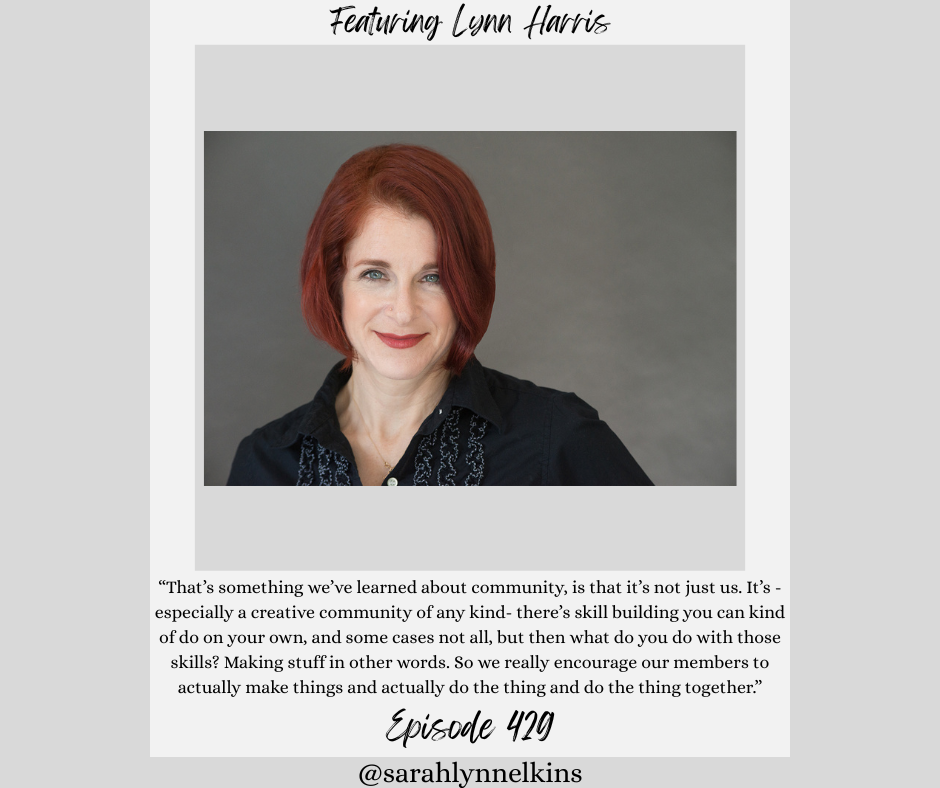
Lynn Harris is a culture-shifting producer, award-winning journalist, and author/co-author of six books. Her comedy and campaigns for social justice and gender equity have changed laws and conversations from Capitol Hill to NASCAR. She is founder and CEO of GOLD Comedy—the comedy school, professional network, and content studio where women and non-binary creators grow their comedy careers, build powerful communities, and make funny stuff. Harris co-created Breakup Girl (acquired by Oxygen), one of the first multiplatform internet success stories, and co-hosted, with Ginna Green, The Forward’s A Bintel Brief: The Podcast. Lynn served as the first VP of communications at global human rights group Breakthrough, where her blend of humor and advocacy powered some of the team’s most effective U.S. campaigns. She has also worked as a Tonya Harding lookalike, which is a long story.
GOLD Comedy is the online comedy school, professional network, and content studio where women, non-binary creators, and other “others" build their comedy careers, join a powerful community, and make funny stuff that gets seen on all kinds of stages and screens. Unlimited classes, community, shows, and more, all online. Join from anywhere, anytime!
Be sure to check out Lynn’s Facebook, her personal Instagram as well as Gold Comedy’s Instagram, and LinkedIn! As well as Gold Comedy and Gold Comedy Club!
About Sarah
Sarah is a Montana based workplace communication trainer, TEDx speaker, DisruptHR speaker, public speaking coach, professional storyteller, musician, and podcast host. Her workshops and coaching packages with teams and their leaders are known to address and reduce miscommunication – the most common cause of tension and stress in the workplace. Using the team’s results from the StrengthsFinder assessment, she guides teams in learning to speak each other’s “language”, learning to value each other’s strengths and connecting with each other through enhanced self-reflection and effective listening.
Sarah’s nearly 20 years working in government agencies inspired her to complete her MBA and to achieve her StrengthsFinder certification to improve work environments for others, guiding teams toward increased satisfaction, productivity, and happiness.
Visit her website to purchase her book, Your Stories Don't Define You in paperback or audiobook.
283 Cultivating Your Ideal Environment
Creativity and problem solving often go hand in hand usually in very unexpected ways, however when given the chance to bend and try things in new and unexpected ways without judging yourself or your abilities you may just find that these two vital skills can shape your strength and identity going forward.
In today’s episode Sarah Elkins and Dr. Cyndi Burnett discuss the importance of creativity and education and how these two things can shape our identities and images of authenticity going forward.
283 Cultivating Your Ideal Environment
Creativity and problem solving often go hand in hand usually in very unexpected ways, however when given the chance to bend and try things in new and unexpected ways without judging yourself or your abilities you may just find that these two vital skills can shape your strength and identity going forward.
In today’s episode Sarah Elkins and Dr. Cyndi Burnett discuss the importance of creativity and education and how these two things can shape our identities and images of authenticity going forward.
Highlights
Sometimes you need to do things differently than you normally would in order to connect with your audience.
You have to work with people who are different from you, you do not want to be stuck in an echochamber.
Everyone is creative in their own way.
Quotes
“That’s what teaching is, it’s all problem solving. So if you think about creativity as problem solving and not just arts and crafts and who has a nice door, then you’ll understand that all of you in this classroom are creative, otherwise you wouldn’t survive as a teacher.”
“Sometimes it’s hard to stop and say; okay hey we made it through this week, let’s celebrate that! Just finding those small things that we can celebrate in both our personal and professional lives can really help with the overall wellbeing that we’re moving forward through something.”
“I give them a baby plant with a letter that says; This plant represents your wellbeing. If you can’t keep it alive you’re not doing something for yourself. And so if it dies you need to really stop and reflect on what you’re doing wrong that you can’t even keep this plant alive, ‘cause it only takes a little bit of watering once a week. If you can’t do that you’re not taking care of yourself.”
Dear Listeners it is now your turn,
What if you took this challenge from Cyndi and the next time you found yourself judging yourself for something you do or don’t do or something you’re afraid to do or something you have an idea about and you “Should” all over yourself about, I should be happy, or I should be okay with this without implementing this new idea I have. The next time you do that, really question where that came from and just as importantly, if not more importantly, find somebody who will support your idea or who will challenge you to think about your idea and how you can actually implement it. Find the people in your life, your community, that when you say “I have this crazy idea,” they say, “Awesome, how can I help?”
And, as always, thank you for listening.
About Cyndi

Dr. Cyndi Burnett is the Director of Possibilities for Creativity and Education, and the co-founder of the Creative Thinking Network for Educators. Her mission is to empower educators to infuse creative thinking into the classroom. She taught deliberate creativity and creative problem solving for 20 years at the Center for Applied Imagination at SUNY Buffalo State University. She is also the co-host of the Fueling Creativity in Education podcast.
Connect with Cyndi on her LinkedIn, Instagram, and Facebook!
Be sure to check out her podcast Fueling Creativity in Education! As well as her websites Creativity and Education, and Creative Thinking Network!
About Sarah
"Uncovering the right stories for the right audiences so executives, leaders, public speakers, and job seekers can clearly and actively demonstrate their character, values, and vision."
In my work with coaching clients, I guide people to improve their communication using storytelling as the foundation of our work together. What I’ve realized over years of coaching and podcasting is that the majority of people don’t realize the impact of the stories they share - on their internal messages, and on the people they’re sharing them with.
My work with leaders and people who aspire to be leaders follows a similar path to the interviews on my podcast, uncovering pivotal moments in their lives and learning how to share them to connect more authentically with others, to make their presentations and speaking more engaging, to reveal patterns that have kept them stuck or moved them forward, and to improve their relationships at work and at home.
The audiobook, Your Stories Don’t Define You, How You Tell Them Will is now available!
Included with your purchase are two bonus tracks, songs recorded by Sarah's band, Spare Change, in her living room in Montana.
Be sure to check out the Job Interview Storytelling Course as well to make sure you nail that next interview!
Stories Shared Create Safe Space
Nicole Herbig and her partner at REBORN are acutely aware of the different world they're experiencing as a result of growing up not only as digital natives, but at the cusp of another industrial revolution.
Demonstrate Caring Online, Make a Difference Offline
Nicole Herbig and her partner, Maggie Rose, at RE|BORN are acutely aware of the different world they're experiencing as a result of growing up not only as digital natives, but at the cusp of another industrial revolution.
Her story isn't unique in that many young people have experience with mental health issues in their families. But her story is unique in that she sees this online social world for the impacts it's having on her peers, and she's doing something about it.
In this episode, Nicole and I share stories of our experiences with that disconnection our community members are feeling as a result of trying to replace face-to-face relationships with online relationships. In our discussion, we come to the conclusion that when we are intentional and caring in our activities on social media, we can translate that creation of safe space into an in-person safe space.
Toward the end of our conversation, we shared stories about the role music plays in how we connect with our own feelings, and to others around us. I mentioned a song our older son shared with me in his early teen years, and if I hadn't had the realization I needed to be fully present when he shared it, I might have missed an important opportunity to better understand him at that time in his life:
As is usually the case, the story I shared triggered a memory for Nicole, one about how music helped her look past her own discomfort with her mother's mental illness, to reach out to her and work toward improving their relationship:
Nicole's story is one we're going to hear more and more in the coming decades, and it makes me hopeful that younger generations are seeing the digital disconnect and finding ways to leverage these powerful tools to address big issues in mental health.
I write a lot about the disconnect between us and our human nature, particularly related to our dependence on our virtual connections. To read one of these articles, click here.
If you write on topics related to suicide, there are great resources available to make sure you are doing more good than harm. As a relatively uninformed professional on this topic, I use this website, ReportingSuicide.Org as a resource.
National Suicide Prevention Lifeline - Call 1–800–273–8255
Available 24 hours everyday
Nicole Herbig is days away from completing her bachelor degree in counseling psychology at Pillar College in New Jersey - with a 4.0 GPA. She's also full of creative energy and ambition, working to help address mental health issues in a way only a digital native can - using the constantly adaptive tools of technology at her fingertips. Learn more about Nicole and connect with her on LinkedIn, and visit the RE|BORN in its infancy, as she and her partner, Maggie Rose, continue to develop the mission and vision of this innovative project.
3 Components of Success: Storytelling, Creativity, Curiosity
There are three things that stand out in my mind as being major aspects of personal and professional development: Being able to tell your story, practicing creativity, and curiosity.
I've been advising and coaching a variety of people for years, from tweens to seniors, from every economic and educational background. There are three things that stand out in my mind as being major aspects of personal and professional development: Being able to tell your story, practicing creativity, and curiosity.
Morgan came into my life when she was a pre-teen and our boys were tiny. It was her family that took care of our older son the day and night I was at the hospital when our younger son was born. She has always had the sense of humor of an adult; a funny, sarcastic, somewhat English-style-dark-humor adult. I'm sure that's a big part of why we connected from the moment we met. As she grew up, she spent a lot of time at our house, helping with the boys, babysitting, and helping me with housework, keeping me company. She even took a few road trips with me so I wouldn't have to travel alone with the two little boys. We often laughed so hard we would cry. I had to pull over once in the middle of Nowhere, Why?oming because I was laughing so hard my stomach cramped and I had trouble breathing.
As Morgan moved through those difficult stages of adolescence and young adulthood, she remained consistent in her ability to share stories, even when her self confidence was limited. Her creative sense of humor is a big part of what makes people want to be around her. This is the woman who was able to make me laugh out loud shortly after my father died. And whenever she is afraid, she faces the fear and pushes through it because she's curious about what will happen when she takes the plunge. And I think she doesn't want to live with regret, the question "what if I don't do this?" is the one that pushes her through her hesitation.
While I like to think I've been a significant positive influence in her life, I know she has had as much, if not more of a positive impact on mine. When she asked me for advice through all aspects of life, from mean girls in middle school, to registering for classes in college, she not only listened to what I said, she asked the right questions and followed through when she said she would. She made it clear that when she asked for advice she would really listen when it was given, like accepting a gift. I learned how to present criticism more carefully; I learned to be more sensitive in my actions. I learned how to offer guidance without judgment.
My relationship with Morgan, and many years of providing guidance in the form of "don't do this, because when I did it..." for my sister, are the reasons I found coaching to be a big part of my career. By advising these two creative, curious storytellers, I was able to learn a lot about myself and what makes a successful person - no matter how you define success. They're the reason I came to the conclusion that to be successful in life, you need these three components: Storytelling skills, creativity, and curiosity.
When we tell a good story, we connect with people on a level deeper than just sharing a basic conversation. Stories are what bring people together under the umbrella of humanity. We share vulnerability, humor, and intelligence through our vocabulary, facial expressions and body language.
When we are being creative, we open ourselves to a different set of possibilities. Creativity actually changes the way our brains solve problems.
And when we are curious, we push ourselves to step out of comfort zones and into the unknown.
When I think of the people I respect and admire most, those are the common traits. Truly, I've never met someone with all three of those that wasn't also compassionate and considerate. Coincidence? I don't think so.
Ah HA! Moments in Coaching
February was a big month for self-discovery. Through coaching sessions and discussions with friends, I've been digging into some of my own motivations and weaknesses. One in particular has been a deep and recurring obstacle: Contentment and satisfaction without the need for external validation.
It's pretty amazing what we can discover in ourselves when we are serving others.
February was a big month for self-discovery. Through coaching sessions and discussions with friends, I've been digging into some of my own motivations and weaknesses. One in particular has been a deep and recurring obstacle: Contentment and satisfaction without the need for external validation.
If you know anything about me, you know I love to find creative outlets for myself and for others. I'm a big believer in exploring creativity as a means to increase and maintain elasticity of the brain. When your brain engages in a creative endeavor, say making music, cooking, knitting, writing, painting, coloring... it opens and builds neural pathways. Different creative activities create different pathways. Music activates one part of the brain, while writing (creative or non-fiction) activates another. Why does that matter? Because in real life as a professional, a parent, a friend, you are constantly required to solve problems. With a variety of creative activities in your life, you become a better problem solver.
While working with one client, I asked about his latest creative activity. When he told me about his project, I asked him what he would do with it after it was complete. He hadn't considered the idea of whether to display it or give it away. He didn't even really know what I was asking or why. I gave him an example: When I'm working on my pottery wheel, whatever I am building - whatever shape the clay chooses to form - I begin almost immediately to think about how it will be used and to whom I might gift it when it's glazed and fired. I asked my client: "When you complete this beautiful project, where will you put it? Does it matter to you that no one will see it?"
My question didn't faze him at all. That's when I noticed that I was projecting my concerns onto him. When I work on something important to me, I often find the need for some sort of external validation when it's complete. Why do I do that? Clearly the activity alone was enough for him to receive the benefits of being creative. Why do I need more?
In another conversation with a friend, I realized that many of us have similar issues in terms of baggage from years ago, from childhood, that manifest in our lives in different ways as we age and progress in our professions and personal experiences. When my friend and I talked about our childhood and teen years, we had a lot in common: Lack of self confidence, detractors in our lives who made negative and long-term impressions on us in their insults and demeaning comments in areas they knew we were particularly self-conscious. As children, we had both been told, in some way or another, that we weren't enough; we weren't smart enough, good looking enough, athletic enough... etc. My situation was quite different in that I had parents who were my biggest cheering section. It was peers that I allowed to do the damage to my self image.
Those childhood and young adulthood impressions and internal messages, though we fight them every day, manifest themselves in different ways in our lives. My friend allows those internal messages to make him hesitate when he knows he should move forward. He second guesses himself to the point of paralysis sometimes. I allow those internal messages to make me feel the need for external validation of the skills and values I bring to the world. For both of us, these are not only self limiting messages, they are damaging to those around us. We create a self-sabotage environment by allowing that history to manifest itself into our current lives.
As I've said in past writing, there is no easy answer. I believe being self aware, introspective, and consistently curious are the keys to learning, growing, and defeating these internal messages and negative life patterns. Now that I know where it is coming from, I can change that message from way back into my childhood.
Without understanding where our self-sabotaging behavior comes from, I don't think we can address it and change it. That doesn't mean placing blame; it means letting it be what it WAS, something from the past. Look at the current evidence of your life for proof that you are not who you were as a child or teen, that the successes and resiliency of your recent life are what define the current version of you. Make sure that what you are putting out to the universe is exactly what you want in return: Love, joy, curiosity, creativity. The next chapter of your book hasn't been written yet. Make sure you write it with intention.
What baggage are you holding onto in your life? How is that manifesting in your current situation?