
Your Stories Don’t Define You
How You Tell Them Will
A podcast to unlock your stories and uncover meaningful insights.
432: The Power of Kindness featuring Joe Emery
In today’s episode Sarah Elkins and Joe Emery discuss the importance of dispelling misconceptions, serving our communities, and elevating voices of kindness and positivity.
432 The Power of Kindness featuring Joe Emery
In today’s episode Sarah Elkins and Joe Emery discuss the importance of dispelling misconceptions, serving our communities, and elevating voices of kindness and positivity.
Highlights
The beauty of visiting places we’ve only seen in pictures or film.
Misconceptions about places and people and learning the truth to be able to see the world for the better.
Emotional storytelling and the importance of making people see the humanity behind the story.
The importance of being kind, patient, and empathetic in a world that is becoming more jaded.
Remember that there is a human on the other side of the screen that doesn’t deserve to be treated poorly because you don’t like a post.
Quotes
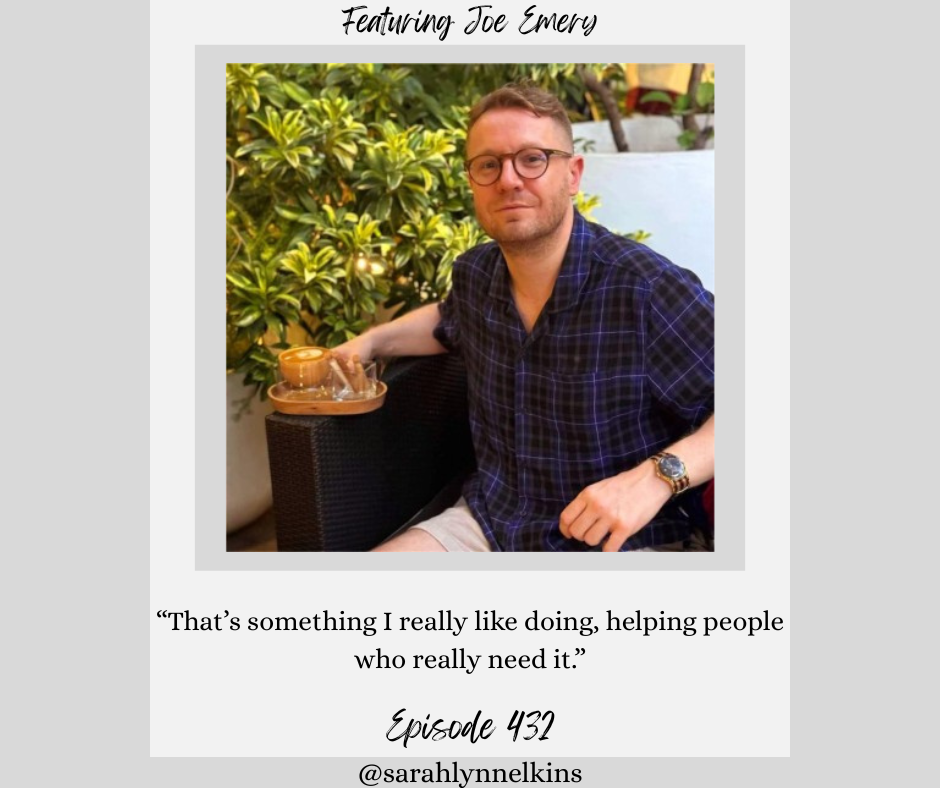
“That’s something I really like doing, helping people who really need it.”
“We all see things everyday that we’re not interested in, and it’s amazing how many people stop to take time out of their day to comment.”
Dear Listeners it is now your turn,
What is it that drove you to be a fan of something? What is your obsession? Have you ever thought about where that could lead you or how it has contributed to where you are now? I think about a lot of the things in my childhood that made me want to meet people or to learn something or to read more and I’m curious what that is for you. And the other thing I want to know is what are you doing when it comes to seeing the one comment that is mean or one boss that treated you badly, are you still holding on to that or are you starting to see it for exactly what it is, that those people who are cruel have their own reason for being that and when you give them the greater voice over the people who are kind you’re giving them this power and you’re taking away and reducing the power of people who are doing good in the world.
And, as always, thank you for listening.
About Joe
About Sarah
Sarah is a Montana based workplace communication trainer, TEDx speaker, DisruptHR speaker, public speaking coach, professional storyteller, musician, and podcast host. Her workshops and coaching packages with teams and their leaders are known to address and reduce miscommunication – the most common cause of tension and stress in the workplace. Using the team’s results from the StrengthsFinder assessment, she guides teams in learning to speak each other’s “language”, learning to value each other’s strengths and connecting with each other through enhanced self-reflection and effective listening.
Sarah’s nearly 20 years working in government agencies inspired her to complete her MBA and to achieve her StrengthsFinder certification to improve work environments for others, guiding teams toward increased satisfaction, productivity, and happiness.
Visit her website to purchase her book, Your Stories Don't Define You in paperback or audiobook.
428 Building Bridges Through Kindness and Compassion
In being human we are able to connect more authentically with people not just in the workplace but in everyday life, by allowing them to see us for who we truly are and what we are capable of.
In today’s episode Sarah Elkins and Neal Foard discuss the importance of compassion and connection.
428 Building Bridges Through Kindness and Compassion
In being human we are able to connect more authentically with people not just in the workplace but in everyday life, by allowing them to see us for who we truly are and what we are capable of.
In today’s episode Sarah Elkins and Neal Foard discuss the importance of compassion and connection.
Highlights
Being present and aware of your actions on others and the world around you.
Building trust and genuine connection that lasts lifetimes as opposed to a quick and easy contract.
The importance of working in a diverse environment.
Quotes
“What I have been taught again and again is to try as much as possible to really wait for their personality to emerge, to wait for the real person to emerge. Don’t hurry it along and don’t make any judgments.”
“Knowing as much as you can about somebody's personhood as opposed to their professional attributes is a marvelous thing to communicate well. Any time you can speak from personal experience and people can get a sense of what your experience was, it will help them react to you in a human way.”
Dear Listeners it is now your turn,
I am really curious about what you will do with what you picked up from this conversation maybe it’ll be from the very beginning of this conversation when you realize that a really good test for the people you want to spend time with is watching how they interact with other people. People that can’t serve them, people that can’t help them, people that can’t do something for them. Maybe it’s somebody on the autism spectrum, maybe it’s someone who acts or behaves differently than you do, maybe it’s a server at a restaurant, or someone in retail. How we treat each other is a really good indication of if you want to spend time with them.
And, as always, thank you for listening.
About Neal
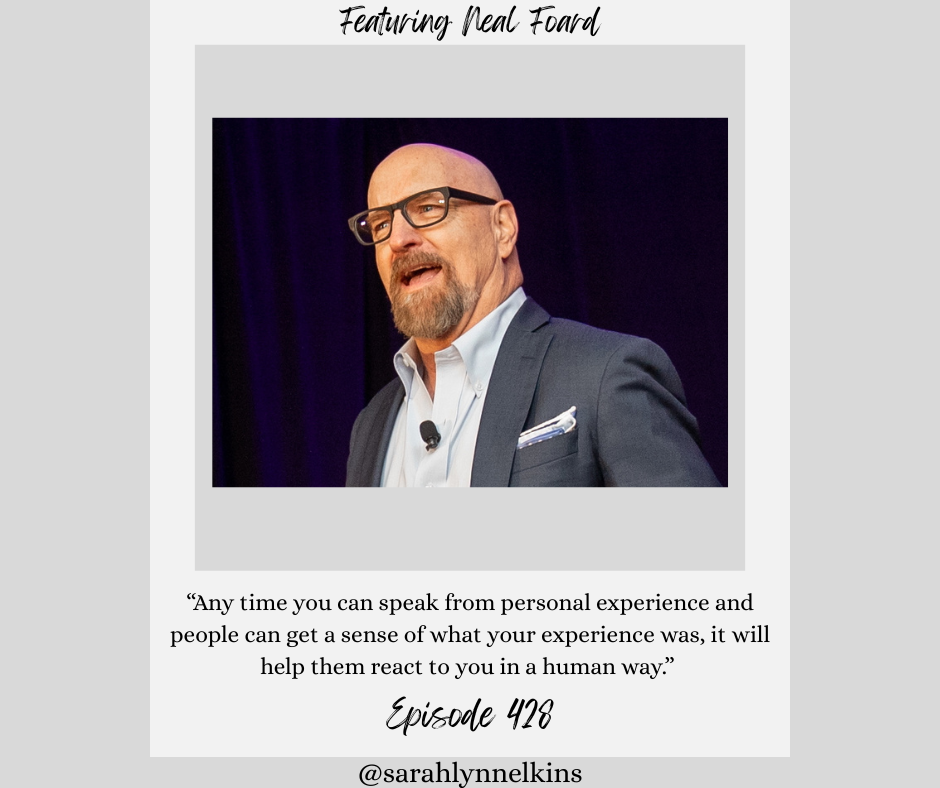
Neal Foard is a master storyteller and branding expert who spent 25 years shaping award-winning ad campaigns for global icons like Budweiser, Lexus, and Sony. For his international work on Toyota, he was listed among the top ten most decorated creative directors in the world. As Worldwide Director of Creative Learning for advertising giant Saatchi & Saatchi, Neal authored a program to teach professionals to sell their work more effectively. Today, he consults with Fortune 500 companies, universities, and governments on the art of persuasive messaging. A sought-after speaker with multiple appearances on the TEDx stage, Neal is known to millions for his viral videos celebrating everyday human kindness.
Be sure to check out Neal’s LinkedIn and Instagram! As well as Supercharge Your Leadership Skillset and The Restaurant of Mistaken Orders!
About Sarah
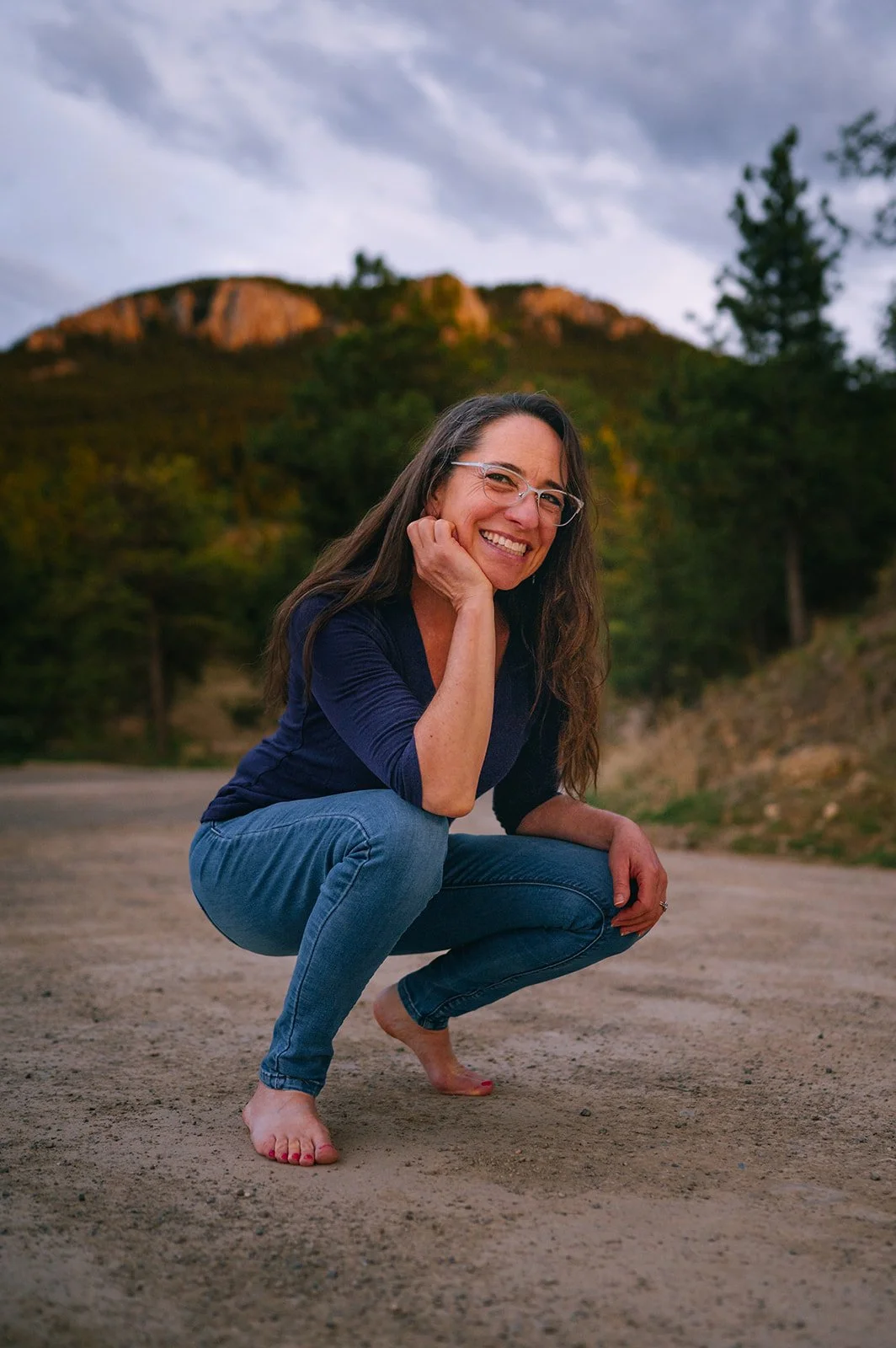
Sarah is a Montana based workplace communication trainer, TEDx speaker, DisruptHR speaker, public speaking coach, professional storyteller, musician, and podcast host. Her workshops and coaching packages with teams and their leaders are known to address and reduce miscommunication – the most common cause of tension and stress in the workplace. Using the team’s results from the StrengthsFinder assessment, she guides teams in learning to speak each other’s “language”, learning to value each other’s strengths and connecting with each other through enhanced self-reflection and effective listening.
Sarah’s nearly 20 years working in government agencies inspired her to complete her MBA and to achieve her StrengthsFinder certification to improve work environments for others, guiding teams toward increased satisfaction, productivity, and happiness.
Visit her website to purchase her book, Your Stories Don't Define You in paperback or audiobook.
404 The Unpredictable Nature of Our Stories
Like the humble ant, we go about our lives caring for those in our home, seeking new horizons, and using our natural talents to build monuments to our success. However, just like the ant, we are subject to things out of our control; be it a rainstorm that floods known pathways or a cruel child with a magnifying glass. These things can break us, they often do, but just like the ant we must settle again, rebuild, and make our home safe again.
In this episode Sarah Elkins and Anne Plaisance discuss the many trials and tribulations they had faced and how they channeled it into something beautiful and powerful.

Like the humble ant, we go about our lives caring for those in our home, seeking new horizons, and using our natural talents to build monuments to our success. However, just like the ant, we are subject to things out of our control; be it a rainstorm that floods known pathways or a cruel child with a magnifying glass. These things can break us, they often do, but just like the ant we must settle again, rebuild, and make our home safe again.
In this episode Sarah Elkins and Anne Plaisance discuss the many trials and tribulations they had faced and how they channeled it into something beautiful and powerful.
Highlights
How have you surprised others? With your choices, strengths, and/or stories?
How have you turned the hard parts of your story into something inspiring? How have you transformed?
When was the moment your relief finally turned to joy?
Quotes
“What you don’t transform, you transmit.”
“I’d say it’s a little bit like kintsugi, the japanese art where you fill all the cracks with gold, but here you fill your soul with love.”
Dear Listeners it is now your turn,
My question isn’t necessarily what you’ll do with this information, my question for you today is will you take five minutes after listening to this podcast to take inventory of where you are right now in your feelings, in how you are taking action in something that you want to do, take five minutes and take inventory. What do you need now? What will put you in a better place now? And what tiny ant sized step can you take in that direction?
And, as always, thank you for listening.
About Anne

Internationally renowned painter Anne Plaisance has established herself as a key figure on the contemporary art scene, with over 100 exhibitions worldwide. She has been awarded numerous times, receiving major distinctions as well as grants from the prestigious Cambridge Arts Council and Massachusetts Cultural Council. Her work, marked by profound artistic and social engagement, has been featured in influential media outlets such as The Boston Globe, Harper’s Bazaar, Elle Decoration, and Artscope, and she has been regularly invited on television and radio programs.
Her creations are part of prestigious private collections in London, Milan, Paris, Warsaw, Dubai, Kyoto, and Boston, establishing her as a widely collected and internationally recognized artist.
Founder of the transformative art exhibition Wonder Women Now, she stands out for her commitment to women’s empowerment and her bold approach to the global issue of domestic violence, making her work a true force for social and cultural change.
Be sure to check out Anne’s Facebook, Instagram, and LinkedIn! As well as her website Anne Plaisance!
About Sarah
"Uncovering the right stories for the right audiences so executives, leaders, public speakers, and job seekers can clearly and actively demonstrate their character, values, and vision."
In my work with coaching clients, I guide people to improve their communication using storytelling as the foundation of our work together. What I’ve realized over years of coaching and podcasting is that the majority of people don’t realize the impact of the stories they share - on their internal messages, and on the people they’re sharing them with.
My work with leaders and people who aspire to be leaders follows a similar path to the interviews on my podcast, uncovering pivotal moments in their lives and learning how to share them to connect more authentically with others, to make their presentations and speaking more engaging, to reveal patterns that have kept them stuck or moved them forward, and to improve their relationships at work and at home.
The audiobook, Your Stories Don’t Define You, How You Tell Them Will is now available!
Included with your purchase are two bonus tracks, songs recorded by Sarah's band, Spare Change, in her living room in Montana.
Be sure to check out the Storytelling For Professionals Course as well to make sure you nail that next interview!
393 Being Direct and Intentional in Conversations
It can be far too easy to let yourself be passive in conversations, whether it be to let another person make a decision or to avoid conflict. However in doing so we rob ourselves and others of deep meaningful connection, which is why it is so important to be direct and intentional with your words.
In today’s episode Sarah Elkins talks about these points while also bringing up times in her life where she was passive and direct in conversation, and why it is so important to her to be direct and intentional.
393 Being Direct and Intentional in Conversations
It can be far too easy to let yourself be passive in conversations, whether it be to let another person make a decision or to avoid conflict. However in doing so we rob ourselves and others of deep meaningful connection, which is why it is so important to be direct and intentional with your words.
In today’s episode Sarah Elkins talks about these points while also bringing up times in her life where she was passive and direct in conversation, and why it is so important to her to be direct and intentional.
Highlights
Be direct and honest with your words, don’t leave room for doubt or miscommunication.
Don’t leave a conversation completely up to one person. Communication goes both ways.
Being intentional in conversation, as well as understanding and compassionate.
Quotes
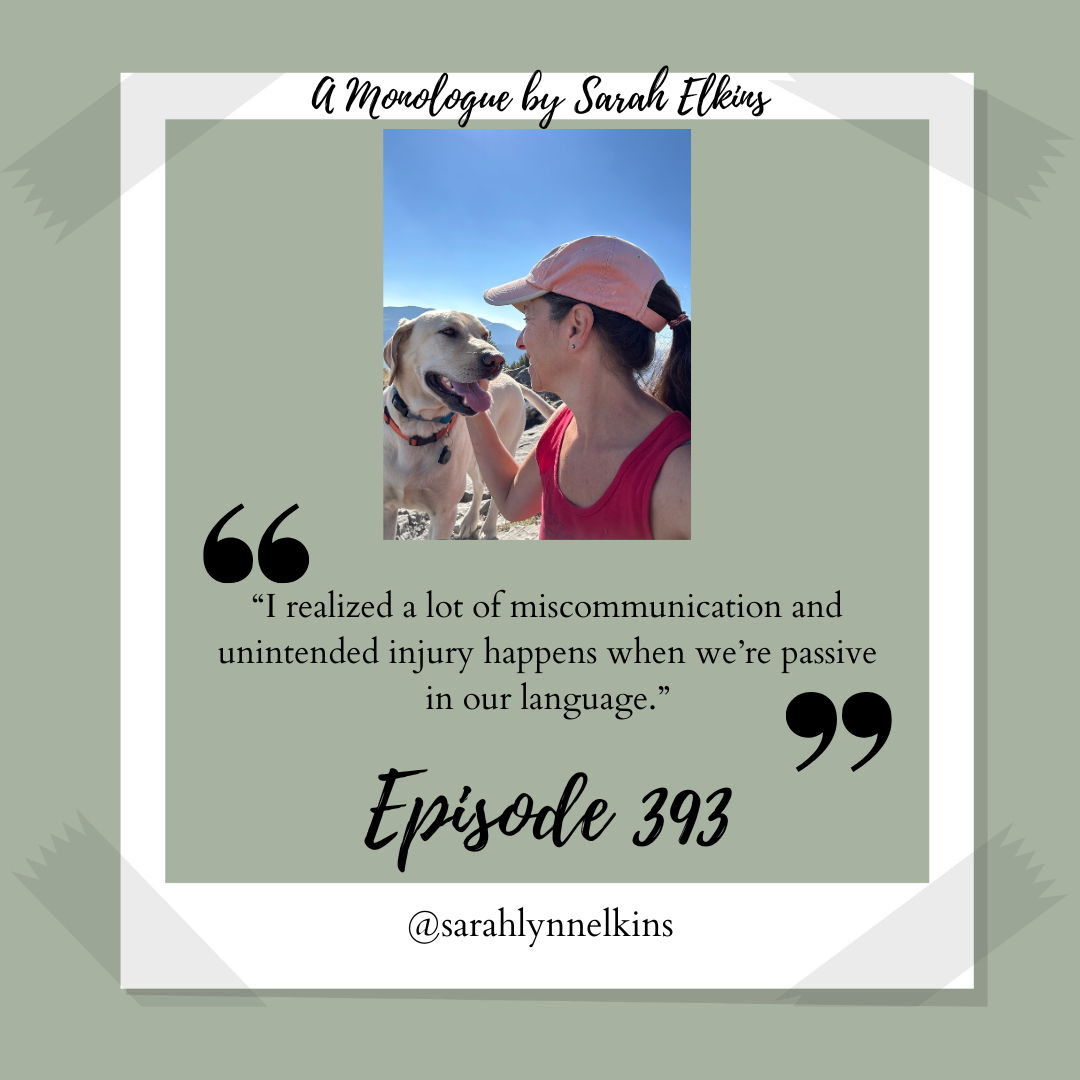
“I realized a lot of miscommunication and unintended injury happens when we’re passive in our language.”
“I also remembered a few people from my past who were especially difficult, insulting, and actually cruel in their communication with me. I thought about how I interacted with them – things I could have handled differently - for the purpose of learning, not regret, and thoughts about”
Dear Listeners it is now your turn,
I encourage you to listen to last week’s short episode and then try using a less passive voice in your communication. What will you do differently so you can move past injury and grow into better, safer, more satisfying relationships?
And, as always, thank you for listening.
About Sarah
"Uncovering the right stories for the right audiences so executives, leaders, public speakers, and job seekers can clearly and actively demonstrate their character, values, and vision."
In my work with coaching clients, I guide people to improve their communication using storytelling as the foundation of our work together. What I’ve realized over years of coaching and podcasting is that the majority of people don’t realize the impact of the stories they share - on their internal messages, and on the people they’re sharing them with.
My work with leaders and people who aspire to be leaders follows a similar path to the interviews on my podcast, uncovering pivotal moments in their lives and learning how to share them to connect more authentically with others, to make their presentations and speaking more engaging, to reveal patterns that have kept them stuck or moved them forward, and to improve their relationships at work and at home.
The audiobook, Your Stories Don’t Define You, How You Tell Them Will is now available!
Included with your purchase are two bonus tracks, songs recorded by Sarah's band, Spare Change, in her living room in Montana.
Be sure to check out the Storytelling For Professionals Course as well to make sure you nail that next interview!
390 Good Service Goes Both Ways
Anyone who has ever worked in customer service has at some point or another dealt with that one customer. You know the type, the huffy, irritable, “My issues are more important than your wellbeing and rules” that insist and demand everything, while demeaning you in the process. Unfortunately, these people will always exist, however what we can change is how we allow these types of interactions to affect us.
In today’s episode Sarah Elkins tells the story of one of her own unruly customer moments, as well as how she chose to learn and grow from the experience in order to teach others.
390 Good Service Goes Both Ways

Anyone who has ever worked in customer service has at some point or another dealt with that one customer. You know the type, the huffy, irritable, “My issues are more important than your wellbeing and rules” that insist and demand everything, while demeaning you in the process. Unfortunately, these people will always exist, however what we can change is how we allow these types of interactions to affect us.
In today’s episode Sarah Elkins tells the story of one of her own unruly customer moments, as well as how she chose to learn and grow from the experience in order to teach others.
Highlights
Respect others. Especially those who are in a position of community service.
Carrying your work home with you is not healthy for you.
When you are rude and nasty to people, no one will be in your corner.
Quotes
“But then it hit me, I should write a book about customer service. The point would be that good service goes both ways. If you want good customer service try being a good customer first.”
“Because it’s easier to provide good customer service when you are looking at it from the perspective of the customer.”
Dear Listeners it is now your turn,
Can you think of a time when you weren’t the best customer? When whatever was going on in your life erupted into a situation and you treated someone badly? Did you apologize? Can you think of a time when you had exceptional service? Did you tell the person or their manager? Did you write a rave review? What made the experience memorable?
We need kindness around us. You know the old saying that people are fighting battles we know nothing about. And when you’re frustrated with a situation it’s rarely the fault of the employee in front of you. And most of the time they can’t fix it without engaging their supervisor. So start with kindness and develop an advocate for yourself. Let’s do our best to bring our best to others.
And, as always, thank you for listening.
About Sarah

"Uncovering the right stories for the right audiences so executives, leaders, public speakers, and job seekers can clearly and actively demonstrate their character, values, and vision."
In my work with coaching clients, I guide people to improve their communication using storytelling as the foundation of our work together. What I’ve realized over years of coaching and podcasting is that the majority of people don’t realize the impact of the stories they share - on their internal messages, and on the people they’re sharing them with.
My work with leaders and people who aspire to be leaders follows a similar path to the interviews on my podcast, uncovering pivotal moments in their lives and learning how to share them to connect more authentically with others, to make their presentations and speaking more engaging, to reveal patterns that have kept them stuck or moved them forward, and to improve their relationships at work and at home.
The audiobook, Your Stories Don’t Define You, How You Tell Them Will is now available!
Included with your purchase are two bonus tracks, songs recorded by Sarah's band, Spare Change, in her living room in Montana.
Be sure to check out the Storytelling For Professionals Course as well to make sure you nail that next interview!
Episode 147: Every Person Has A Story to Tell if You Ask the Right Question
It was one of at least a dozen stories like it that my aunt, my father’s sister, told me when she visited. Each of her stories would start with something like “when we moved and needed to…, we met the nicest person!”
My uncle, who is far less exuberantly friendly, would shake his head, and with a small smile on his face he mumbled: “You always say that.”
How Stories Can Bring Out the Best in the People Around You
Everyone has a story, and I mean everyone.

Fran & Jeff at the Dearborn River, Scapegoat Wilderness Area, Montana, 2020
“When the guy came to deliver our new washer and dryer, he kept looking at me like he wanted to say something, like he knew me. Instead of just letting it go, I asked him if he grew up here, or if he was from somewhere else. Most people around this town aren’t from here. He said he was from northern Virginia, so I asked where he went to school. That’s when his eyes lit up: ‘You were my teacher! I knew you looked familiar but I couldn’t place you!’ I couldn’t believe it, I was so happy as a flood of memories came back to me. He was such a sweet kid, of course I remembered him. I said: 'Yes! Ryan! Now I recognize you, you’re not the little boy I taught anymore. How is your sister?'”
"We had a wonderful conversation and caught up. He told me about his sister, I remembered she was having some reading problems because of an eye condition, and then he told me the story of how he ended up here.”
It was one of at least a dozen stories like it that my aunt, my father’s sister, told me when she visited. Each of her stories would start with something like “when we moved and needed to…, we met the nicest person!”
My uncle, who is far less exuberantly friendly, would shake his head, and with a small smile on his face he mumbled: “You always say that.”

Fran & Jeff & Sarah, at the Dearborn River, Scapegoat Wilderness Area, Montana, 2020
Having my aunt around was a welcome reminder of my father. Until this visit, I never realized how similar they were, and now that my dad is gone, having her around gives me a sense of his presence and keeps his memory closer. It was an awesome visit, we took long hikes together, took time to explore this little town, and ate outside together, constantly sharing stories.
It wasn’t until after they left that I started to think about the way my aunt would tell a story of a contractor, delivery person, or someone else they met when they moved from Virginia to Arizona. My uncle was right, my aunt always had a story to share about the people she met, what they had in common, something interesting the person shared, the kindness they showed toward her and my uncle. Almost every story ended with “they were SO nice.”
It’s months later, and those stories are still with me. I realized that she almost always has these stories of people she meets when we have our marathon phone calls.
It’s not that she is a magnet for interesting, kind people, it’s because she is interested and kind that nearly everyone she meets demonstrates those qualities. People are interesting to her because she demonstrates curiosity and care when she asks questions. People are kind to her because of her kind, open nature. She expresses curiosity instead of judgment when someone does something she wouldn’t do, and when she tells these stories she tells them from a place of observation and thoughtfulness.

Our kitchen under construction. Yes, this is serious.
Our major kitchen remodel began a couple of months ago when I reached out to our local bank to ask about refinancing rates. I went straight to the broker who served us three years ago. I had done a little research to find out typical, current interest rates, but I didn’t bother applying through anyone else. We had a relationship. I knew I could trust her, that she would do her very best to get me the best rate, and that she would have everything in place for the closing, which means less stress for me and my husband. She has great stories to share about her son who is a musician, and the funny things that happened when she and her husband started a similar project.
The company I reached out to for the electrical work is owned by a couple I met while kayaking on the Missouri River. When I called, the woman I met was grateful that I remembered them, and though they’re swamped right now, like all the other good contractors around here, she said she would fit our project into the schedule.
The evening after I met the electrician they sent to do the work, I was telling my husband how kind he is, that he has a degree in something related to wildlife biology from the University of Montana, and that he spent the last many years living on an Indian reservation, where he went to become a certified electrician. I told my husband about his daughters and that he was thrilled to be invited to take a bagful of apples from our trees so he and his youngest could use their new dehydrator as an evening activity – quality time.
That evening as I spoke to my husband about the electrician and mentioned how kind and interesting he was, I saw the same small smile cross my husband’s face as I saw on my uncle’s face. He didn’t have to say anything. The smile said: “You always say that.”

Our kitchen, now with subfloor!
You won’t be surprised to hear that I’ve had many stories since then about the people working with me on this huge project. I’m acting as general contractor, and all of the service providers have had to be patient with me as I figure things out.
From the woman at the city who is handling the permit process, the plumber who showed up at very short notice to disconnect and cap the gas line to the stove so our movers could get it into the truck, the contractor designing and building the cabinets who made a gorgeous turned bowl from one of the 100 year old fir wood beams removed from our ceiling, to the movers and insulation teams who worked with us in those first two days of the project, every story begins or ends with “they were so interesting (or patient, or understanding) and kind!”
Every time I walk away from one of the people providing our services, I think: “I’m so lucky to be having these positive experiences. I know they’re all so busy and fitting us in despite their crazy schedules. We are behind schedule and have found some unexpected issues, and everyone has worked together to do their best to get us back into our kitchen.”
Last night as I finished getting ready for bed, I looked in the mirror and smiled when I saw my father and my aunt looking back at me. Everything suddenly made sense:
People are interesting when you ask the right questions. Every person has a story to tell, and when we listen – when we really listen, the best of who they are is revealed.
---
Thanks for listening to this episode of Your Stories Don’t Define You, How You Tell Them Will. The book of the same title is now available, and the audiobook version will be released in November, 2020.

If you’re ready to uncover your stories, and learn to uncover the stories of the people around you to create stronger connections and healthier communities, visit elkinsconsulting.com.
While you’re visiting the website, you can learn more about the book and the work we do to improve communication among teams and through our one-to-one coaching.
Episode 131: Make Kind Loud - It's the Only Way Out of This Mess
Louisa Garrett used to rely on her sarcastic sense of humor to make people laugh. But when she saw herself through the eyes of her nieces and nephews, as a model for the behavior she wanted to see in them - and in others, she had an epiphany. Being sarcastic was not a kind sense of humor, sarcasm can certainly be funny, but it is rarely kind.
"It's Better to Be Kind than to be Funny" - Louisa Garrett

Louisa Garrett used to rely on her sarcastic sense of humor to make people laugh. But when she saw herself through the eyes of her nieces and nephews, as a model for the behavior she wanted to see in them - and in others, she had an epiphany. Being sarcastic was not a kind sense of humor, sarcasm can certainly be funny, but it is rarely kind.
As the youngest of a gaggle of kids, Louisa loved to be the center of attention. She’d do anything silly to make her siblings laugh, and developed a reputation for lightening difficult situations and conversations with her sense of humor.
Now, as we finally begin to address the issues of racism and bigotry in the most substantial way since the days of MLK Jr., Louisa has her work cut out for her. She knows that all any of us can do is be kind to each other, “stand in the gap” to support the efforts of our communities to address systemic racism and bigotry, and demonstrate the thoughtfulness and compassion we want to see in others.
You can learn more about Louisa by visiting her website, and by following her fantastic activity on Facebook.
Are you ready to find clarity? The next Finding Purpose through Your Natural Strengths course begins July 8, 2020, and runs for 8 weeks, every Wednesday. Schedule a call to find out if this course is right for you.
