

Your Stories Don’t Define You
How You Tell Them Will
A podcast to unlock your stories and uncover meaningful insights.
316 Community In The Age of Social Media
Throughout our careers we will all need to make decisions to benefit ourselves and others by being a good leader and building up our teammates. In the age of social media and technology it is easy to focus on progress and monetization over the health of your community and your team. It is vital to your growth as a person and a business owner to choose community and growth for the betterment of your business, your community, and your team.
In today’s episode Sarah Elkins and the equally accomplished Eric Elkins discuss the importance of community and teamwork in our current age, how taking the time to listen to others and hold yourself and them accountable can lead to growth and change in the world around you. Eric also shares the skill of storytelling and brings awareness, compassion, and mindfulness to the conversation.
316 Community In The Age of Social Media
Want to join this year’s NLV Conference? Register here!

Throughout our careers we will all need to make decisions to benefit ourselves and others by being a good leader and building up our teammates. In the age of social media and technology it is easy to focus on progress and monetization over the health of your community and your team. It is vital to your growth as a person and a business owner to choose community and growth for the betterment of your business, your community, and your team.
In today’s episode Sarah Elkins and the equally accomplished Eric Elkins discuss the importance of community and teamwork in our current age, how taking the time to listen to others and hold yourself and them accountable can lead to growth and change in the world around you. Eric also shares the skill of storytelling and brings awareness, compassion, and mindfulness to the conversation.
Highlights
Sometimes you shouldn’t care what people think, especially if it’s something that makes you happy.
Oftentimes growing means change, don’t be afraid to spread your wings.
Community builds each other up, don’t be afraid to accept help and help others.
Turn conversations that are hard into something positive for you in the long run.
Value your team, without them you and your business can’t grow or make meaningful connections.
Quotes
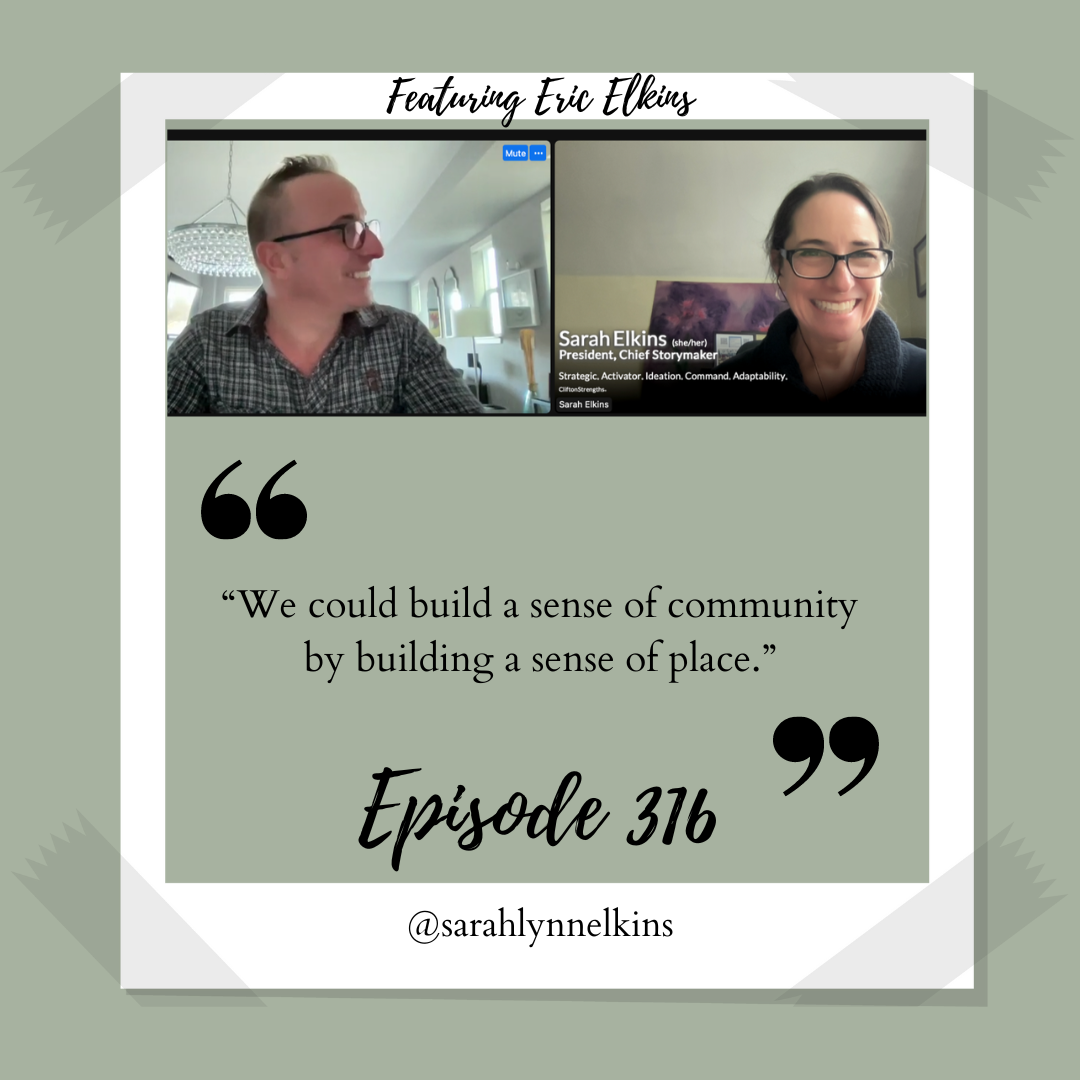
“We could build a sense of community by building a sense of place.”
“For me it’s always about connecting people so that they can be more successful and be happier and do what they need to do.”
“I often say when you get a negative comment or a negative review: Your response has two audiences and two functions, the first audience is the person who wrote the comment, the negative comment or the negative review, and the first thing you need to do there is deescalate and hopefully get that conversation offline or into a private venue so that you can work through the situation and solve the problem. But that second audience is everybody else who’s watching what you’re gonna do, and so that’s why it’s always important to respond, take responsibility, and then to actively in that response move that conversation elsewhere.”
“We all go to work. We all have to deal with the vagaries of the workplace, and the slog that is even a job that we love, and the one thing that keeps us coming back day after day is the connection we have to the people there.”
Dear Listeners it is now your turn,
It’s time to hold up that mirror in front of yourself, what behavior are you continuing in your management or your conversations within your community and the people who care about you that maybe you didn’t like when other people did those behaviors towards you. I know it’s hard to be a manager, especially if you’re new to that, so make sure that you’re paying attention to what you didn’t like in your experience with managers and not continuing those behaviors with your people. Listeners, I would love to hear your thoughts on this episode.
And, as always, thank you for listening.
About Eric

Eric Elkins is a strategist, author, professional speaker, and CEO of WideFoc.us Social Media (http://www.widefoc.us/), a Denver-based agency he founded in 2007. Using organic and paid social strategies along with full-service community management, his team drives tangible results for B2B tech/SaaS companies, B2C brands, the home services industry, nonprofits, and global corporations. For more than 25 years, Eric has helped companies grow their visibility and increase revenue. He writes the occasional novel, hosts Denver food faves at denverlicious.com, and loves to share his eating and travel adventures on Instagram as @ericelkins.
Be sure to check out Eric’s LinkedIn, Instagram, and Facebook! As well as his website Wide Focus and his food blog Denverlicious!
About Sarah
"Uncovering the right stories for the right audiences so executives, leaders, public speakers, and job seekers can clearly and actively demonstrate their character, values, and vision."
In my work with coaching clients, I guide people to improve their communication using storytelling as the foundation of our work together. What I’ve realized over years of coaching and podcasting is that the majority of people don’t realize the impact of the stories they share - on their internal messages, and on the people they’re sharing them with.
My work with leaders and people who aspire to be leaders follows a similar path to the interviews on my podcast, uncovering pivotal moments in their lives and learning how to share them to connect more authentically with others, to make their presentations and speaking more engaging, to reveal patterns that have kept them stuck or moved them forward, and to improve their relationships at work and at home.
The audiobook, Your Stories Don’t Define You, How You Tell Them Will is now available!
Included with your purchase are two bonus tracks, songs recorded by Sarah's band, Spare Change, in her living room in Montana.
Be sure to check out the Storytelling For Professionals Course as well to make sure you nail that next interview!
Episode 65: Our Internal Disconnect and the Damage of a Perception Gap
When I have an opportunity to share my thoughts on this topic as a keynote speaker or workshop facilitator, the first step I take is to describe what I lovingly call the Perception Gap.
That’s the gap between how you THINK you’re being perceived, and how people are ACTUALLY experiencing you.
Stories to Shift Your Internal Messages and External Perceptions

My friend Marietta Gentles Crawford wrote a book on the topic, From Nine to Thrive, and I highly recommend it if you want to dig into this theme more deeply.
I describe personal brand as:
What people say about you and think about you when you’re not around.
When I have an opportunity to share my thoughts on this topic as a keynote speaker or workshop facilitator, the first step I take is to describe what I lovingly call the Perception Gap.
That’s the gap between how you THINK you’re being perceived, and how people are ACTUALLY experiencing you.
Many people believe they know, they consider themselves pretty self-reflective, but they aren’t necessarily intentional about how they want to be perceived by the people around them. That creates a major disconnect when it comes to building strong relationships. Why? Because though I don’t believe you need to care what people think about you, you DO need to care about what CERTAIN people think about you.
For instance, do you care what your partner or spouse or children think of you? Of course you do! What about your clients and potential customers? If you don’t, you are absolutely limiting yourself in creating productive relationships.
The disconnect for people who know themselves, but don’t understand their own perception gap is that many don’t realize how they might be contributing to miscommunication with people they care about, and how they might be contributing to many of their own obstacles and challenges.
Think about an experience at work with a person who could be described as a bully. Do you think they wake up in the morning, look in the mirror and say: “I’m so happy, so satisfied with my life! Today will be a perfect day to terrorize my colleagues at work! It gives me great satisfaction to know people don’t trust me or want to spend time with me.”
Probably not. Most people who can be described as bullies don’t actually KNOW they’re considered to be that way by the people around them. Some do, for sure, but most don’t. And some who do know themselves well enough have come to the conclusion that: “this is just how I am, and if people don’t like it, that’s just too bad.”
And that would be fine if it stopped there. But it doesn’t ever stop there. People in that situation are often lonely, bitter, are self-conscious and lack self-confidence. The disconnect is that they can’t understand WHY they’re lonely, and they blame everyone around them for their problems.
The same goes for the colleagues and friends who complain a lot. We have all had experiences with this person, the one that everything seems to happen to: The car accident, the frozen pipes in their house, the dog puking on the carpet, getting fired or passed up for a promotion or new job, the drama with their friends and boyfriend, etc.
It’s one thing to come to work sad or in a bad mood once in a while, but when the complaining is consistent, an everyday thing, that changes how people see that person. Do you love to hang out with people like this?
Are you that person?
Have you noticed that when two complainers have to work together, they often don’t like each other? Even complainers don’t like hanging out with complainers!
Often the bullies and complainers in your life know, generally, how people feel about them, but they don’t take the next step to understand their role in that perception.
If a bully or complainer decides they are comfortable with the perceptions of others, it would be simpler just to embrace it. If you know you are the complainer or bully, you must also know that being that kind of person is going to impact your relationships. To address the disconnect, you must understand the consequences of owning those traits, and being intentional with your actions and behaviors.
When I worked with a bully a few years ago, I started to fall into the trap of negativity, consistently complaining about her to my colleagues. It took a while to realize I was getting more and more angry and depressed – and that I didn’t really like myself, partly because I was not only behaving in a way that didn’t feel good, but mostly because I was THAT colleague – the one who complains and talks behind someone’s back. At some point I realized that I was contributing to my situation and tension with her through my actions and behavior.
And from the other side, my boss likely knew there were people talking about her like that, and I wasn’t the only one. She also knew her reputation for being a bully and micromanager, and I know it hurt her. But as far as I knew, she never took that next step of considering her role in that perception, understanding that the common denominator in her trouble among colleagues was her.
Here are some strategies to shift those perceptions, once you’ve realized your role in the negative perceptions people have of you:
Watch for target fixation.
My husband, Bob, has been riding motorcycles for decades. He uses an obstacle in the road to describe the impact of target fixation on motorcycle driving. When a driver sees a deer or something else in the road, an inexperienced driver will focus intently and with anxiety on the deer or obstacle, and will most likely hit it. An experienced driver will be aware of the deer or obstacle, but will focus on the area around it so he can find a solution or alternative to avoid the obstacle.
We can use golf as another analogy here. A good golfer is well aware of the sandtraps, water, and trees between her and the hole she’s aiming for, but uses positive target fixation by focusing her attention on the hole she wants to put the ball into, not the obstacles.
The same can be done when you are making changes and shifting the way you speak and think to improve your relationships. Focus on things that are going right, the things you’re grateful for, the things you do really well.
Ever notice that when you’re considering buying a car, and you’ve narrowed down your choices to, say, an orange Subaru… suddenly you start seeing orange Subarus all over the place? That’s because what you focus on is eventually what you start seeing everywhere.
So focus on the positives, the things you’re grateful for in your life (start small, like being glad for the green lights when you’re running late.) You can be aware of the obstacles for sure, but don’t focus on them.
Look for patterns in your relationships:
If you’re struggling with someone at work, consider whether you’ve been there before. Are there other situations from your past that you had a similar issue?
As you begin to identify patterns of struggle with certain people in your life, at work and in personal relationships, think about whether those people all have a certain trait in common. Are they all generally one gender? Do they lack self-confidence? Do they remind you of a parent or sibling you have a difficult relationship with?
Consider how your behavior might either be attracting this kind of person, or contributing to the tension in those relationships. When you see a pattern emerge, think about what actions and behaviors you can consistently adjust – every day, and with every person – to be a person they want to spend time with.
Be self-reflective and intentional:
When I found a great job early in my career, I couldn’t believe my luck. I was sure I didn’t deserve the position I had been offered. I was so excited for the first few months in that position, doing everything I could to impress the people around me. When a known bully in the organization casually mentioned here concern that I wasn’t qualified for my job, and she couldn’t imagine why they hired me, I started to second-guess my work.
Every time I’d complete a task, I’d get intensely self-conscious about my work and it would take me twice as long as it should because I’d be digging into it to find errors. At some point, this became overwhelming, and my inner critic was screaming at me that I didn’t deserve that job. Someone more qualified would be better, and my colleagues would be better off without me on the team. So my work deteriorated. I was self-sabotaging because I didn’t think I deserved my job and the encouragement I had received from my boss and other colleagues.
But here’s where self-reflection becomes so powerful.
I noticed that as my work deteriorated, my relationships with my colleagues also deteriorated. I knew I was letting them down.
It took a few weeks to see this situation from that perspective, and I had a very close friend to talk through it and process the dynamic out loud. My “ah ha” moment was when I realized it was my choice to be the person who deserved that job and the support and encouragement of my colleagues.
It was my choice, every day, and with every task, to earn the life, reputation, and relationships I wanted. The best part is that no matter what happened prior to my decision to shift things, I could start right away, with something as simple as showing up for work on time. It would take time to repair the damage I had done, but with every single interaction, I would be intentional about being the person who deserved the life I was living.
It’s your turn now.
What patterns emerge when you consider the relationships in your life that cause you grief and struggle? What might have been your role in those relationships?
What patterns emerge when you consider the most healthy, productive relationships in your life? What did you do that helped build those relationships?
How do you want to be perceived by the people around you? And what consistent actions and behaviors can you use to demonstrate to others that you are someone who deserves – and who earns every day – the life you want to live?