
Your Stories Don’t Define You
How You Tell Them Will
A podcast to unlock your stories and uncover meaningful insights.
Why It Works with Joe Kwon - Storytelling
5.0 Why It Works: Sarah Elkins on Storytelling
in Podcast
Have you ever wondered why some storytellers mesmerize you and others give Ambien a run for its money? How come some stories you tell have people on the edge of their seat and others induce yawns? Did you know that there is a lot more than words that goes into telling a good story?
In today's episode of "Why It Works," Sarah Elkins, a leadership and storytelling coach, reveals some of the hidden mechanisms behind storytelling. Listen in to find out the connection between vulnerability and storytelling, how lessons from music can improve your storytelling and the one thing that drives Sarah crazy about bad storytellers.
Your "What" Defines Your "Why", and Your "How" Follows
I walked away from the workshop with that Rock Star Feeling (RSF). It's that feeling when you walk away from an encounter, project, or situation knowing you nailed it. I call it RSF because I've experienced it as a musician; walking away from a performance with that euphoric high feeling, and knowing you will do almost anything to feel that way again... soon.
It was a valuable couple of hours for me, and not because I was paid for them. I walked away from the workshop with that Rock Star Feeling (RSF). It's that feeling when you walk away from an encounter, project, or situation knowing you nailed it. I call it RSF because I've experienced it as a musician; walking away from a performance with that euphoric high feeling, and knowing you will do almost anything to feel that way again... soon. It's that sense that you're really good at something; you've contributed, and that you're providing value to the people around you.
1.) Storytelling to Improve Sales
I had completed a two-hour workshop focused on the topic of storytelling to improve sales, as part of a two-day retreat for a regional group of sales leaders, when I walked away with that feeling. When the workshop ended, almost everyone in the room took a moment to ask me a question, share a story, or hug me before I walked out the door.
As a group, we created space for everyone in that room to feel safe, comfortable, and curious. We shared stories that connected us, and we discussed what makes a specific personal story the right story to share, when, and how to share it. We talked about reading our audience, and we came to the conclusion that in sales, we have to be in it for the long haul if we want to sustain our business and the relationships we create. It was clear that sharing a personal story is one great strategy to draw out the stories of others. We also talked about the fact that business is about people, and that when someone buys from us, they're not just buying a product; they're creating a relationship with us.
It took me a few hours to decompress and process everything that happened in those two hours, but I couldn't shake the feeling that I had discovered - or uncovered - something about myself that I had been searching for.

2.) No Longer Virtual
That was two weeks before I hosted the second annual No Longer Virtual conference, or #NLVDenver. Not quite a rock star feeling, as I decompressed in the days following #NLV, I found myself a little conflicted. I knew it was a success, and by the accounts of almost every participant, people got far more out of attending than they could have imagined. But I couldn't put my finger on what, exactly, was giving me this feeling of dissatisfaction. That is - until I was sharing this vulnerability with my dear friend Aaron Skogen, and he asked me this question:
How did you plan to define success with #NLV?
I was more than a little embarrassed. With all of my education, experience and my incredible support network, I hadn't considered this important question at all. Well, that's not exactly true. I had considered what I wanted out of #NLV, but I hadn't written it down anywhere. I hadn't told anyone, and I hadn't found ways to quantify success, other than breaking even financially in the first few years.
When I considered the question, I realized that success for NLV was simply creating an environment for people to connect authentically, and to learn and grow together. And it was certainly a success if I measured it that way.
A few years ago, I realized I'm a slow processor. It takes time for me to fully process an event, an incident, an intense conversation. By process, I mean to fully reflect on what it meant to me, the lessons I could learn from it, and how I'll apply whatever it was to future scenarios. And now, more than a year after the first #NLV, I'm finally feeling like I've fully processed the experience.
Good things come in threes, I'm told, and it was the third event that finally helped me put things together in my head.
3.) Women's Leadership Network, Helena, Membership Social
Our local Women's Leadership Network hosted a social event and invited women from all over the community to network, ride the carousel, drink champagne, and eat ice cream. The goal was to create buzz and recognition for our growing, thriving organization, and to encourage more women to join. It was a success in many ways, but the key for me was the environment we created as a board. We created space in our little community for women to be together in a casual, fun place, to share food and drinks, and to be comfortable being themselves.
For a while, I focused on my "why" as my ability to encourage people to step out of their comfort zones and take risks they wouldn't otherwise take. Now I know that ability is a component of something more dynamic. It took me figuring out my "what" to truly define my "why". Sounds backward, right? Does it matter how you get there, as long as you get there? I don't think so.
Here it is, my "what"... drum roll, please...

As I work to process this new idea, I can see that everything I've done successfully in my past has been part of this "why", from hosting guests in our home, to facilitating groups for the Montana University System, to creating a safe place in an office for people to share their frustrations and successes.
Where ever I sit, I am compelled to create an environment where people feel safe and confident to share their biggest dreams, fears, joys, and challenges. Whatever I am doing, I find my joy, my satisfaction, in creating space for people to take risks for personal and professional growth, and support and motivate them to take specific steps to achieve their goals.
And my "why" followed:

This isn't an overnight lightning bolt; it has taken years of self reflection to come to my "why", and many pivotal conversations with people who know me, and for whom I have so much respect, admiration, and gratitude. What's a little disconcerting is that one person has been telling me this for almost 20 years; I'm not sure I was ready to believe it, and I definitely didn't have a clue how to apply it to providing income for me and my family.
And now? Now I'm ready to put my "why" into my "what", so the "how" will present itself. (Thanks, Arminda Lindsay.)
I'm asking for your help in putting my "what" into action:
When you're planning a retreat or conference, and you want a session that's truly unique, engaging, and effective in creating space for your team to explore storytelling as a tool for communication and sales, call me. Let's explore how my "why" can help you fully realize your "how".

Mid-Life Crisis? Dazed & Confused? You're Not Alone.
Are you going through a time of uncertainty? Are you feeling off-balance and lost? No one can solve your problems for you, but reaching out to encouraging, supportive, engaged friends will definitely help.
I recently read a sad article about a ridiculous number of women my age who are going through a sort of mid-life crisis. The part that caught my attention first was this:
"Hey," I said, happy to have caught her on a break from her job, "do you know anyone having a midlife crisis I could talk to?"
The phone was silent for a second.
Finally, she said, "I'm trying to think of any woman I know who's not."
When I read that exchange, I realized that women in my age range are having very similar experiences to current young adults just leaving high school and college.
Our world is so different from what I experienced as I left high school. Career paths were pretty traditional then, though there were some who took different journeys. Most of my friends didn’t think about the next step after high school because the next step was college; most of us never thought about NOT going on for a four year degree. I was surrounded by my middle class friends in suburban Colorado neighborhoods, but even my friends outside of that community knew the traditional path and generally followed it.
Those traditional paths still exist, but they’re an awful lot like where Kodak was about 30 years ago; they’re not real anymore.
Some people are seeing this as an exciting opportunity, a chance to do whatever seems right at any given moment. Others are experiencing a kind of agoraphobia, a sense of overwhelming loss and confusion. For them, it’s like being really hungry and going to a restaurant with too many menu options. They get so overwhelmed that they can’t make a decision and walk away starving.
Women who are going through this crisis are facing similarly overwhelming options, but instead of seeing this time as full of opportunity, they’re seeing it as failure, or worse, their lives completely shattered.
I have to keep reminding myself that not everyone likes to be in that “in-between” space, where I live most of the time. People who fit the equation comfort = happiness are overwhelmed by this time in their lives, while others who have consistently shifted gears to find the next adventure see this time as exciting and full of opportunity.
It’s hard to know what to do to help friends going through this phase of self-discovery and change; after all, their world is unbalanced and full of uncertainty. I’ve written about strategies for helping a person who is grieving, and they apply here, too. Remember that your friends are grieving. They’re grieving the loss of what they thought they wanted in life, the loss of their certainty, and potentially the loss of the foundation of their marriage and parents as their health deteriorates.
A good coach can help define the questions that need to be addressed, and will help clarify what the answers mean in terms of action steps and opportunities. Coaching is well worth the investment, and in combination with a counselor, can turn things around significantly. Not every counselor or coach is the same, so if you find one you don’t work well with, keep looking. Don’t stick with one you don’t feel excited to share with, but don’t give up on coaching or counseling if you have one negative or ineffective experience!
Listening is a huge part of allowing a person to grieve. If you are a good listener, that may be your primary role in helping your friends.
Being a positive force of encouragement and support is absolutely the best thing you can do for people. Make sure you have a small group that meets regularly to talk about the challenges and questions you’re all facing. More importantly, make sure the energy in that group remains positive. Each person in your group must have the ability and comfort level to intervene when a meeting turns into a rant session. A complaint-filled hour will only drag you down; when anyone in the group senses that things are going south in a conversation, they must know how to carefully switch gears and talk about actions people can take to move forward.
Are you going through a time of uncertainty? Are you feeling off-balance and lost? No one can solve your problems for you, but reaching out to encouraging, supportive, engaged friends will definitely help. I have what I call my N.A.G. group, Nudge – Advise – Guide, and we meet once each month to help us stay accountable to ourselves with our goals, to encourage and advise us when we have crazy ideas, and to guide us to make the best choices.
“If you regret any part of your past, think about your future, and make changes and efforts now, so you don’t look back again with regret.”
How you perceive this time in your life is YOUR CHOICE. You can wallow in sadness over the loss of what you thought you had, what you thought you wanted, or you can step up and live out the dreams you’ve dismissed while you were developing yourself to be who you are right now.
Dream big, take action, and be a good N.A.G. for others.

Nervous? If you're not, you're not doing it right.
I was more nervous than I think I have ever been. My legs were shaking so hard, I thought they might actually collapse beneath me.
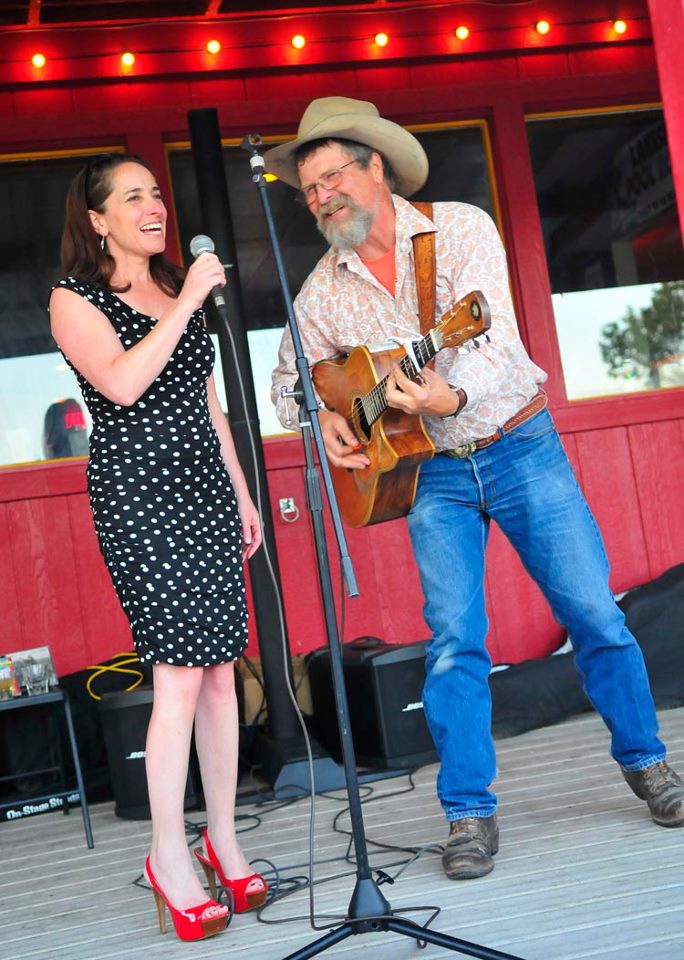
Being nervous means what you're doing matters to you.
This post was inspired by a post by my friend Zach Messler, called "Overcome your fear of public speaking. Here's what I do." If you aren't a bit nervous about a speech or performance, you're probably not engaged or excited about what you're about to do.
It was 9:45 am and the ceremony was scheduled to begin at 10. I knew they would be running late because they were bringing in WWII veterans, most of them disabled, all of them 88+ years old, plus their families from all over the US and Canada. The First Special Service Force, sometimes referred to as the Devil's Brigade, had received the Congressional Medal of Honor, finally, earlier that year. The metal was being presented to Fort Harrison for display, as the home of the First Special Service Force in the beginning of WWII.
As the public affairs person for the city, I had been involved from the beginning of the plan for the weekend of activities, to include this ceremony at Fort Harrison on Friday morning, as well as a re-enactment of the parade on Saturday, of soldiers that marched down our main street just before they left Montana to head to Europe. When asked if I would sing the US and Canadian Nation Anthems for the parade, I was honored and accepted. My friend agreed to come to Helena to sing with me, so we could perform the songs in harmony.
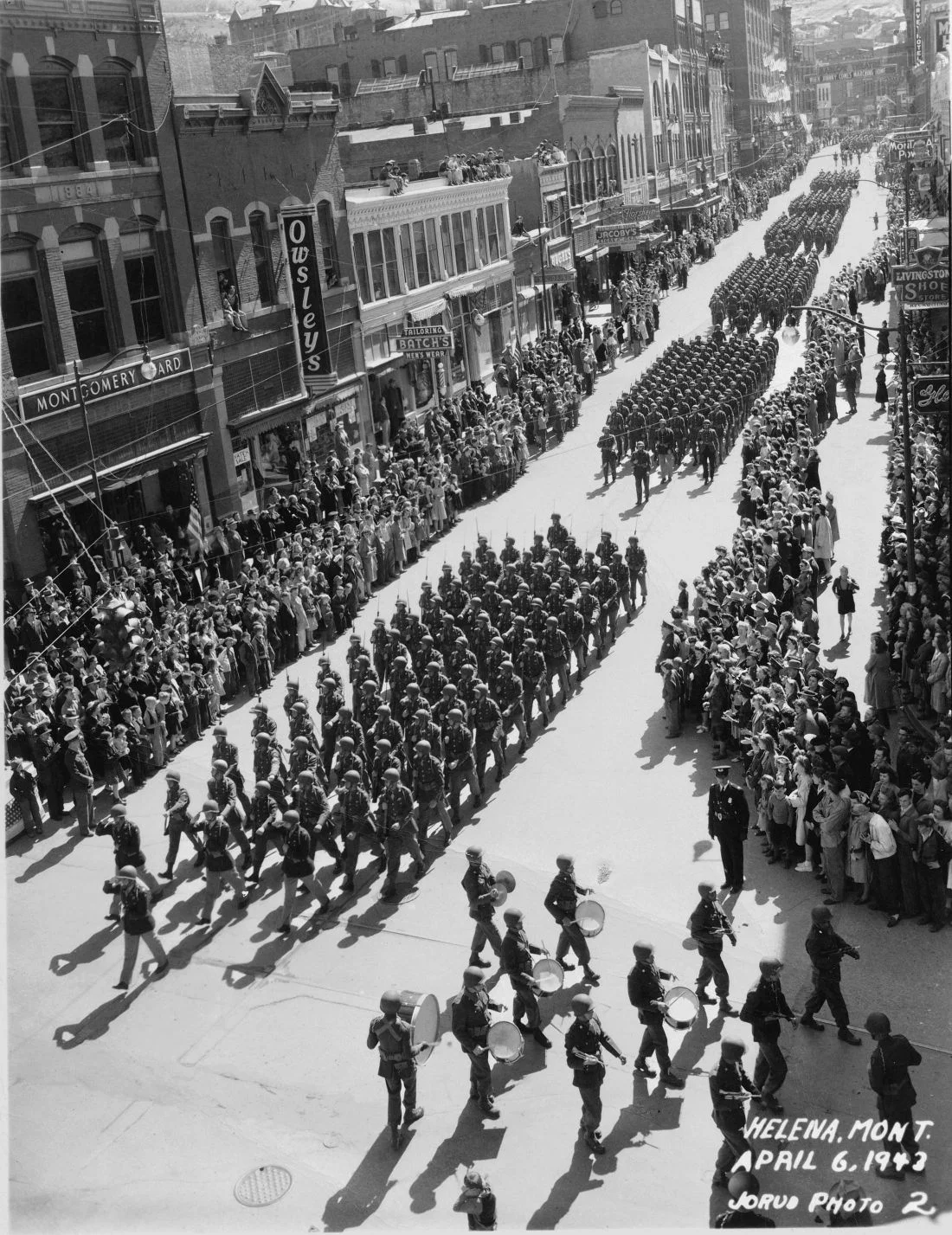
I assumed they had found someone to perform the two anthems for the ceremony the day before the parade, so when I arrived that morning, I was surprised to hear they were planning to... use a recording.
It seemed insulting to me, so I impulsively offered to sing both anthems. Solo. Unaccompanied.
When I began the Star Spangled Banner, standing at the podium in front of more than 200 guests and a handful of WWII heroes, I was more nervous than I think I have ever been. My legs were shaking so hard, I thought they might actually collapse beneath me. I gripped the side of the podium with my left hand, hit the high note at the end, paused, and sang the Canadian National Anthem for the first time in my life. When I left the stage after the ceremony, a Canadian woman asked me: "Are you sure you're not Canadian?"
I've often been asked:
How do you get over the nerves during a performance?
- Change your internal message: "I'm so excited about this!" Instead of "I'm so nervous!"
- Breathe with intention. In other words, don't start speaking or singing until you have taken a few deep breaths to calm yourself. When you feel yourself getting shaky again, pause. When you're planning your presentation - mark your script at places where a pause would be natural.
- Insist on a microphone stand or a lapel mic. Holding a microphone will exacerbate your nerves, trust me. If you must hold a microphone, start by holding it with both hands. If you know ahead of time you'll be holding the mic, wear something heavy on your mic-holding wrist, like a large watch or bracelet. The weight will help with the shaking.
- Breathe into your diaphragm, relax your knees slightly, and tighten the muscles in your lower abdomen. Feel your knees wobbling and your heart racing? Don't try to stop the shaking, that just makes it worse. Make sure your feet are planted, your knees just slightly bent, and squeeze those muscles in your rear end - hard. This provides structure and a more solid foundation for your voice. That squeeze will help make the vibrato in your voice less noticeable.
- As part of your preparation, choose your shoes first, then build your outfit. Make sure you select shoes that make you feel confident and attractive. When you feel yourself start to shake, glance at your feet, solid in position, then look back up and continue. Again, plan your pauses so you have opportunities to collect yourself.
Zach Messler is a master of keeping an audience engaged, and he makes it look so easy! Give yourself credit for putting yourself out there - it's scary, and it's not something everyone has the courage to do. Practice these techniques while practicing Zach's and you'll improve every time you speak.
*cover photo courtesy of @elizawileyphotographer, parade photo courtesy of the Helena Independent Record

Make Every Encounter an Opportunity
Her face brightened. Our boys have that effect on people; there is something about a kind, polite, genuine kid that makes people feel good.
As I finished my purchase at our local grocery store, the clerk smiled at me and we wished each other a good day. Our younger son, now taller than I am, chimed in. He looked straight at her (sometimes grumpy) face and said with genuine kindness: "Have a good afternoon!"
Her face brightened. Our boys have that effect on people; there is something about a kind, polite, genuine kid that makes people feel good.
When I was a brand new mother, a friend told me about an interaction with her four year old son. When she disciplined him with a time-out, he told her "you're mean, mommy." Her response has stayed with me for many years:
I'm mean sometimes because I never want you to be the kid no one wants to be around.
That statement is part of why our boys are polite and people enjoy them. As parents, we encouraged kindness and respectful behavior, and also set boundaries with them that made sense -- and followed through with consequences.
I'd like to take the credit for that, but I think it has more to do with their nature and many role models. Because of their observations of the behavior of their father, their grandparents, aunt & uncles, close neighbors and adult friends, and yes, me, they understand that each person must be valued. Even people who are mean, who behave badly, must be treated respectfully. That doesn't mean they are respected; those are two different things.
When our younger son and I walked out of the grocery store, the expression on the clerk's face stayed with me for a while. I was smiling, off in my head, when our son asked me: "Why are you smiling like that?"
It took me a moment to realize I was smiling "like that" and to put my thoughts into words. He knows me -- so he waited. I asked him:
is it fake to act pleasant when you don't feel pleasant?
And then I said:
My friend and I recently had a conversation about the difference between being fake, acting like you're happy when you're really not, and being kind to people despite not being happy at every moment.
Did you see how that woman lit up when you smiled and told her to have a good afternoon? She glowed. What you said, and the way you said it with genuine kindness, changed the flow of her day. If you were having a bad day but still made an effort to do what you did with her, is that being fake? Or is it being kind? For her, that momentary interaction was the difference between slogging through the afternoon, and feeling a small burst of warmth and satisfaction.
You often have that effect on people, Max. They can't help but smile when you're around. I hope you understand that, and that you continue to choose -- that you are intentional -- to be kind toward others. There is something about you that makes people want to be their best selves when you're around. You're magical!
Our conversation turned to something else, and for the moment I was distracted from that introspection.
In the shower the next morning, our conversation came back to me.
We have many opportunities in our days to make that tiny bit of difference in each interaction. We have a choice to say "thank you" to the person in front of us, to wave and smile at the driver who lets us merge into traffic. We have a choice when we hold the door for someone coming in behind us to smile with genuine kindness and care. Why wouldn't we make that effort with every single person in our day? It takes less energy to smile at someone than it does to be angry, or to actively ignore a person.
Being kind doesn't mean letting people treat you like a doormat, sometimes you have to choose confrontation. Being unkind won't change things, so keeping in mind the result you want from the confrontation really helps in keeping emotion out of a conflict. I recently told someone "you're not nice to me." I didn't add any emotion to the comment, just a matter-of-fact observation to explain why I avoided interaction with her. I often use a strategy I wrote about, imagining that if I was recording it, how I would want to see myself years after the confrontation.
Think for a moment about the people you want to be around, the people you enjoy spending time with. I'm a lot pickier these days about where I choose to spend my energy and time, and I choose people who are positive, the ones who are curious, and who choose to learn, grow, and be kind. This doesn't mean we are always happy, real life is often not happy.
We all have choices to make, every day, and I choose kindness. What will you choose?
Send me a message, I love to hear from readers.

Perception Is Weird
Since then I've been observing the gap between how we are perceived, even by those we believe are closest to us, versus how we perceive ourselves.
I was awkward in high school. I had friends in all of the different cliques but never felt like I belonged anywhere. Totally self-conscious, low self-esteem, the only place I felt real was in my choir classes. That's why I'm often surprised when I hear how my peers perceived me back then -- because it's completely different from how I perceived myself.
In my second year of college, a friend's apartment neighbor was a guy who went to the same high school I attended. One evening my friend asked her neighbor what I was like in high school.
She was one of those girls that could have been popular but just didn't care.
When my friend repeated this back to me, I was stunned. And really disappointed. Of course I wanted to be popular! That's not at all how I knew myself just a few years earlier. I couldn't imagine how he came to that conclusion.
Since then I've been observing the gap between how we are perceived, even by those we believe are closest to us, versus how we perceive ourselves. At this point in my life, I'm very intentional in how I put myself out to the world, so I think that gap is smaller, but there is still a wide gap.
When I hear it said that people don't change, I cringe. I'm so different from who I was in my teens, early twenties, and even 5 years ago! The obstacles, challenges, joys and successes we experience can change us dramatically. A few years ago I was honored to be a guest blogger on Whitney Johnsons's blog; I wrote about how I found my voice when I was 40. People definitely change.
My mother and I were standing in my kitchen a few years ago, making beef jerky. She said:
If you had told me 15 years ago that I'd be standing here in your kitchen, in Montana, helping you make beef jerky, I never would have believed it.
I responded: "If I told myself 10 years ago that I'd be singing in a rock band in gogo boots and vintage mini dresses, I would never have believed it!"
"I'd believe it." Was her answer. That's a big gap in perception.
In a recently published post I described myself in college as being barefoot most of the time. People who knew me then weren't surprised at all, but those who have only known me in the past 20 years were very surprised to read that article. Here's one comment:
Thank you for the belly laugh as I visualized you traipsing around Colorado sans shoes.
And another:
I used the HaHa icon because I never pictured you barefoot . . . not that I've known you long enough for that anyway. Barefoot? Wow.
And one more:
Great article, Sarah. A barefoot past? You have always been a strong, unique individual.
This set of comments had me considering perception again, and why that gap exists. When we think we know someone, we are often surprised when they step out of the context in which we think we know them. Why do we sometimes underestimate people we know, while we put those we don't have a personal connection with on a pedestal?
It has been about 8 years that I've been singing professionally in this small town; there are still people who have known me for nearly the 17 years we've lived here who have not seen me perform.
One of those people heard me sing at a big event with more than 700 guests. She came over to me afterward, gushing. It was wonderful! A few days later, I ran into her at a shop downtown and as she introduced me to the woman next to her, she said:
This is my friend Sarah, she sings with a band and she's actually really good!
Actually? Why did she say "actually?" I knew she didn't mean to be insulting, so I smiled and thanked her. But the word stuck with me. Why "actually?" Is it because she never knew me to be a singer and her expectations of my singing were low? She knew I sang but had never heard me, so maybe that was it? But why would her expectations be low? What did she know of me that would color her perception that way? What was I putting out there that might give her a different impression?
Yes, all of these are sort of silly questions to consider, but they help me think more deeply about the whole idea of perception and the impact it has on us. Do I see myself differently from how my friend sees me? Definitely. Living in a small town, this gap in perception can impact a career; because so many people here know me in the context of my job history, my music, and my children, it can be tricky -- and impossible -- to earn support when I want to do something significantly different.
When I finished reading an incredible novel, The 13th Clock, I was blown away. I leaned back in my reading chair and thought: "Wow! My BROTHER wrote that book!" It's not that it was surprising that my brother would write a fantastic book, but it definitely caught me in unfamiliar territory in seeing him in a different context.
Why is it that when we know (or think we know) someone well, we are often surprised when they are successful, or when they do something extraordinary? Do you find that people who think they know you underestimate you in some contexts? I'm intensely curious about this gap, and though I'm sure we can't come to any conclusions, I'd love to hear your thoughts on the topic.
Make History Accessible - Share Stories

Our son is taking theatre this year in school and is loving the experience. We've been telling him for years that he should get involved in performing arts because he can be SO dramatic...
A few weeks ago his class was asked to participate in the State Historical Society's Thursday night live reading event. The students, with great direction from their teacher, selected letters and diaries written by everyday Montanans between 1880 and 1990 to read to the audience. They were invited to select letters and diaries from the Historical Society's robust collection, and to research the characters with help from teachers and professionals in the agency. They also did research on their own to find images, photographs and maps, to create a visual accompaniment for the performance. The letters and diaries were from everyday Montanans, soldiers, families of soldiers, adventurers, and families separated during the civil war.
As a group, they defined the genre they wished to focus on, selected which letters and diaries to read, and created brief narratives to explain to the audience what they were about to hear.
Students took turns that evening between reading the narratives and reading the letters and diary entries as if they were those characters. It was an outstanding performance. What was extraordinary about the evening were the students' responses to questions from the audience following the live readings.
"When you were researching these characters, what struck you most about them?"
The people were real people, not famous historical figures. They were real people with real feelings, fears, and concerns for their families back home. We've read history with major characters, but these people were THERE, in the foxholes, writing letters to people and not knowing if they would ever see them again. They were real people who were experiencing historic moments with different perspectives, hopes, and dreams for the future.
"When you were reading through the letters in class, deciding which ones to include, did you have any emotional responses?"
Oh yes. Sometimes as we read a letter out loud to our classmates we'd get choked up, having trouble finishing reading without crying. I can't speak for my classmates, but for me it was about seeing myself in these words. My brother is serving in the military now and I couldn't help imagining what he would say in a letter if he wrote one.
"Did this exercise make you think differently about letter writing, and technology's impact on our lives and stories?"
Absolutely. It made me want to start writing a diary. So my words might offer a glimpse into real life in this era, way into the future.
Definitely. Reading these letters made me think I should start hand writing letters - on paper, with a pen - so my family could have them in the future.
Yes, for sure. I realized how much we could lose in terms of historical perspective from individuals - not famous people - if we don't find ways to collect the digital records being created now. But not just collecting them, there is plenty of data out there. We need to find ways to make sure the stories don't get lost in the sea of digital records, that we can categorize them and keep them long into the future.
I realized that those letters I have from my grandparents are even more valuable, bigger treasures, than I had given them credit for. Now I want to keep them safe, scan them in case of damage, and make sure I have them for my children some day.
I realize that handwriting really is important because it's part of what made these stories so real to us. Handwriting can give you a glimpse into the personality of the writer.
Are you as impressed as I am by these students? They are telling their own stories simply by expressing their feelings and thoughts about the characters they are researching! How much more can we do for ourselves in sharing our stories in such an engaging environment?
They were asked to perform like this again at another Thursday night reading. The organizers and audience were gushing about the power of this experience and were energized to do more with this concept.
Stories have impact on us emotionally, intellectually and physically. Many of us in the audience were sitting up and leaning forward for the entire hour-long production. What does that say about the performers and their material?
Do you have stories like this to share? Tell me more in the comments below!
Thank you for reading, commenting on, and sharing my posts!
I am a BlogPoet at BlogPoets.com!
About me:
A skilled teacher and entertaining speaker, I offer storytelling and customer service trainings and workshops and one-to-one coaching. I teach people how to find their stories, organize them, and share them across platforms. Learning to tell your story is the key to your success. Visit this page to learn more.