Your Stories Don’t Define You
How You Tell Them Will
A podcast to unlock your stories and uncover meaningful insights.
Episode 170: Focus on the Client, Not the Reward: Stories of Service and Gratitude
Your goal in any situation cannot be about you, about making money, about getting the job, about closing the deal. The goal has to be service to others. It must reflect your humanity and align with your values, your goal is most valuable to you when it is about helping the person in front of you reach their goals or solve a problem.
The money, the contract, the job offer - those are the results of meeting the goal, not the goal itself.
Bob Burg Reminds Us That We Cannot Inhale without Exhaling - We Cannot Give without Receiving
This conversation with Bob was full of inspiration and what I call *zingers*, those one sentence quotes that packs a huge motivational punch. The piece that seems to be most sticky to me is this idea:
Your goal in any situation cannot be about you, about making money, about getting the job, about closing the deal. The goal has to be service to others. It must reflect your humanity and align with your values, your goal is most valuable to you when it is about helping the person in front of you reach their goals or solve a problem.
The money, the contract, the job offer, those are the results - the reward - for meeting the goal, not the goal itself.
Read those last two paragraphs again, friends, and then give yourself some time to process them. And then try to apply this guidance in your next conversation. That's what I've been doing since we recorded this episode.
The final lesson in the book The Go Giver is one that I have to continually remind myself: The Law of Receptivity.
It's the final lesson in the book because the first four lessons involve learning to shift your mindset toward giving, toward understanding how to give in a way that is practical and truly helpful to others. You must learn those lessons before you can learn to open yourself up to receiving.
If you're ready to receive, dive into this conversation and enjoy!
---
The Go Giver series is a collection of books full of inspiration. If you're curious about Bob and his work, be sure to follow him on LinkedIn, visit his website, join his Facebook community, and interact with him on Twitter.
---
ABOUT SARAH:
"Uncovering the right stories for the right audiences so executives, leaders, public speakers, and job seekers can clearly and actively demonstrate their character, values, and vision."

Elkins Consulting logo with image of Sarah with her dog, Toblerone
In my work with coaching clients, I guide people to improve their communication using storytelling as the foundation of our work together. What I’ve realized over years of coaching and podcasting is that the majority of people don’t realize the impact of the stories they share - on their internal messages, and on the people they’re sharing them with.
My work with leaders and people who aspire to be leaders follows a similar path to the interviews on my podcast, uncovering pivotal moments in their lives and learning how to share them to connect more authentically with others, to make their presentations and speaking more engaging, to reveal patterns that have kept them stuck or moved them forward, and to improve their relationships at work and at home.
The audiobook, Your Stories Don’t Define You, How You Tell Them Will is now available!
Included with your purchase are two bonus tracks, songs recorded by Sarah's band, Spare Change, in her living room in Montana.
Episode 169: Do You Have a Diverse Personal Board of Directors?
Humans are biased. We're designed to identify people who are different from us, people we have things in common with, and people who pose a threat to our safety - emotional & physical.
It's easier for our brain to make a decision about a person when we allow our bias to control it. But how many times have you misjudged someone you met, for better or for worse? When we rely on our bias to make decisions about a person's potential as a friend, foe, or neutral, we seriously limit the potential of the relationship.
Personal Growth is Dependent on Your Direct Circle of Influence
Adrienne Kimball and Karen Cohen met when Karen was interviewing for a job where Adrienne worked. At first glance, Adrienne assumed the two would have little in common, but midway through the conversation, her opinion shifted.

Adrienne Kimball podcast cover art
Humans are biased. We're designed to identify people who are different from us, people we have things in common with, and people who pose a threat to our safety - emotional & physical.
It's easier for our brain to make a decision about a person when we allow our bias to control it. But how many times have you misjudged someone you met, for better or for worse? When we rely on our bias to make decisions about a person's potential as a friend, foe, or neutral, we seriously limit the potential of the relationship.
In this episode, Adrienne and Karen talk about what it's like to work together, a black woman and a white woman, and the expectations they have for each other and their relationship.
You might be surprised that this is even a thing, that people are talking about something that should be so basic, so common, so - not something we need to talk about. But you're wrong. We have to have these conversations in order to grow, and to address the issues of our time: racism, white supremacy, hate.
What I love about this conversation and these two women is their commitment to having a solid relationship based on respect and love. They offer gentle corrections when needed simply because the health of their relationship depends on it.
Our conversation describes why it's critical for personal and professional growth - and for our community health - to look closely and honestly at our networks, at our closest relationships. Are they diverse? Are there people who think differently from you? Are there people who come from completely different backgrounds, different socio-economic and educational upbringing? Do they look significantly different from you and your family, maybe even speak a different native language?
Take a hard look, friends, be real about this. And then take the slow road toward diversifying your network and circle of friends. Ask people you trust about others you should follow and connect with.
There are plenty of resources out there to find the voices of BIPOC (black, Indigenous and people of color) and of LGBTQ professionals, writers, and artists. Find people whose messages resonate with you and simply following them on your favorite platforms to learn more.
Open your eyes and heart to a world of possibilities, build a diverse personal board of directors.
---
Adrienne Kimball is the Chief Talent Officer at Rubicon Programs in northern California. She's a keynotes speaker, culture champion, equity evangelist and mentor.
Karen Elkins Cohen is the Director of Human Resources at Rubicon Programs.
These two women are fantastic facilitators of discussions on the topics of diversity, inclusion, equity, and building a culture of equity and inclusion. They hosted a session at the No Longer Virtual Summit in Atlanta in 2019 that was engaging and thought-provoking, a session people continue to talk about, two years later.
---
ABOUT SARAH:
"Uncovering the right stories for the right audiences so executives, leaders, public speakers, and job seekers can clearly and actively demonstrate their character, values, and vision."
In my work with coaching clients, I guide people to improve their communication using storytelling as the foundation of our work together. What I’ve realized over years of coaching and podcasting is that the majority of people don’t realize the impact of the stories they share - on their internal messages, and on the people they’re sharing them with.
My work with leaders and people who aspire to be leaders follows a similar path to the interviews on my podcast, uncovering pivotal moments in their lives and learning how to share them to connect more authentically with others, to make their presentations and speaking more engaging, to reveal patterns that have kept them stuck or moved them forward, and to improve their relationships at work and at home.
The audiobook, Your Stories Don’t Define You, How You Tell Them Will is now available!
Included with your purchase are two bonus tracks, songs recorded by Sarah's band, Spare Change, in her living room in Montana.
Episode 168: No Longer Virtual and the Worldwide Shutdown
On this episode of the Your Stories Don't Define You podcast, I'm joined by three #NLVChicago2020 guests. Shelley Brown, Mike "Fritz" (the Fritziest) Fritzius, and Kevin Strauss shared their stories about those two days in our little #NLV bubble.
It was magical, truly, and you'll see I'm not the only one who feels that way.
When Transformation is Imminent, Know Your Resources
One year ago today (for this recording), March 12, 2020, we were at the top of the world at the Mid-America Club in Chicago on the 80th floor of the AON Center.
The No Longer Virtual Summit, limited to 50 guests, had shrunk to 20 in the room. When my husband and I left Montana at 6am on the Tuesday before, the airport was pretty quiet. I remember thinking the airplane was particularly clean that morning. We arrived at O'Hare and took the train into the city.
I had already received 5 or 6 cancelations from people who didn't feel safe to travel, or their employers were highly discouraging them from leaving the county or country (Canada).
I also received a dozen messages and calls asking me not to cancel. Since we were already there, and others were on their way, we went forward.

A moment of stress relief, wandering with Robert Downs (Photo courtesy of Robert Downs Photography)
Wednesday was brutal. It seemed the hotel was going to hold me to my contract, which meant my room attrition might cost me nearly $10,000, and that didn't include the catering bill.
The Mid-America Club was far more accommodating. With less than 24 hours notice, they allowed me to shift the final catering number in half, reducing the potential for a dramatic amount of food waste, something I couldn't tolerate on top of the rest of the stress filling my days.
Brainstorm session for NLV2021 Notes
On this episode of the Your Stories Don't Define You podcast, I'm joined by three #NLVChicago2020 guests. Shelley Brown, Mike "Fritz" (the Fritziest) Fritzius, and Kevin Strauss shared their stories about those two days in our little #NLV bubble.
It was magical, truly, and you'll see I'm not the only one who feels that way.
My intention is to have a few more of these episodes to highlight the experiences of others in the room those two days. It was different for everyone, and yet, we knew we were surrounded by the people who would help us adjust as the world around us transformed before our eyes.
If you're interested in learning more about this year's No Longer Virtual Summit in Montana on June 10, 11, 2021, click here.
ABOUT SARAH:
"Uncovering the right stories for the right audiences so executives, leaders, public speakers, and job seekers can clearly and actively demonstrate their character, values, and vision."
In my work with coaching clients, I guide people to improve their communication using storytelling as the foundation of our work together. What I’ve realized over years of coaching and podcasting is that the majority of people don’t realize the impact of the stories they share - on their internal messages, and on the people they’re sharing them with.

Audiobook cover art
My work with leaders and people who aspire to be leaders follows a similar path to the interviews on my podcast, uncovering pivotal moments in their lives and learning how to share them to connect more authentically with others, to make their presentations and speaking more engaging, to reveal patterns that have kept them stuck or moved them forward, and to improve their relationships at work and at home.
The audiobook, Your Stories Don’t Define You, How You Tell Them Will is now available!
Included with your purchase are two bonus tracks, songs recorded by Sarah's band, Spare Change, in her living room in Montana.
Episode 167: Keen Observation is the Key to Finding Humor Almost Anywhere
Kat’s mom was a therapist and her dad a writer. They self-analyzed themselves into a mess, and she struggled to find ways to address her inner emotions. She craved something completely different, and worked hard to avoid a career in any field related to her mom’s.
What's the perfect contradiction & complement to therapy? Comedy, of course!
After finishing her degree, she moved to Chicago to try her skills at improvisation, and landed a career with Second City.
A Skeptic and a Believer: There Are So Many Things We Experience That Cannot Be Explained
Another great introduction from Shelley Brown, Kat Barker was a fabulous guest on this episode of Your Stories Don't Define You.

Kat Barker Quote, podcast cover art
Kat’s mom was a therapist and her dad a writer. They self-analyzed themselves into a mess, and she struggled to find ways to address her inner emotions. She craved something completely different, and worked hard to avoid a career in any field related to her mom’s.
What's the perfect contradiction & complement to therapy? Comedy, of course!
After finishing her degree, she moved to Chicago to try her skills at improvisation, and landed a career with Second City.
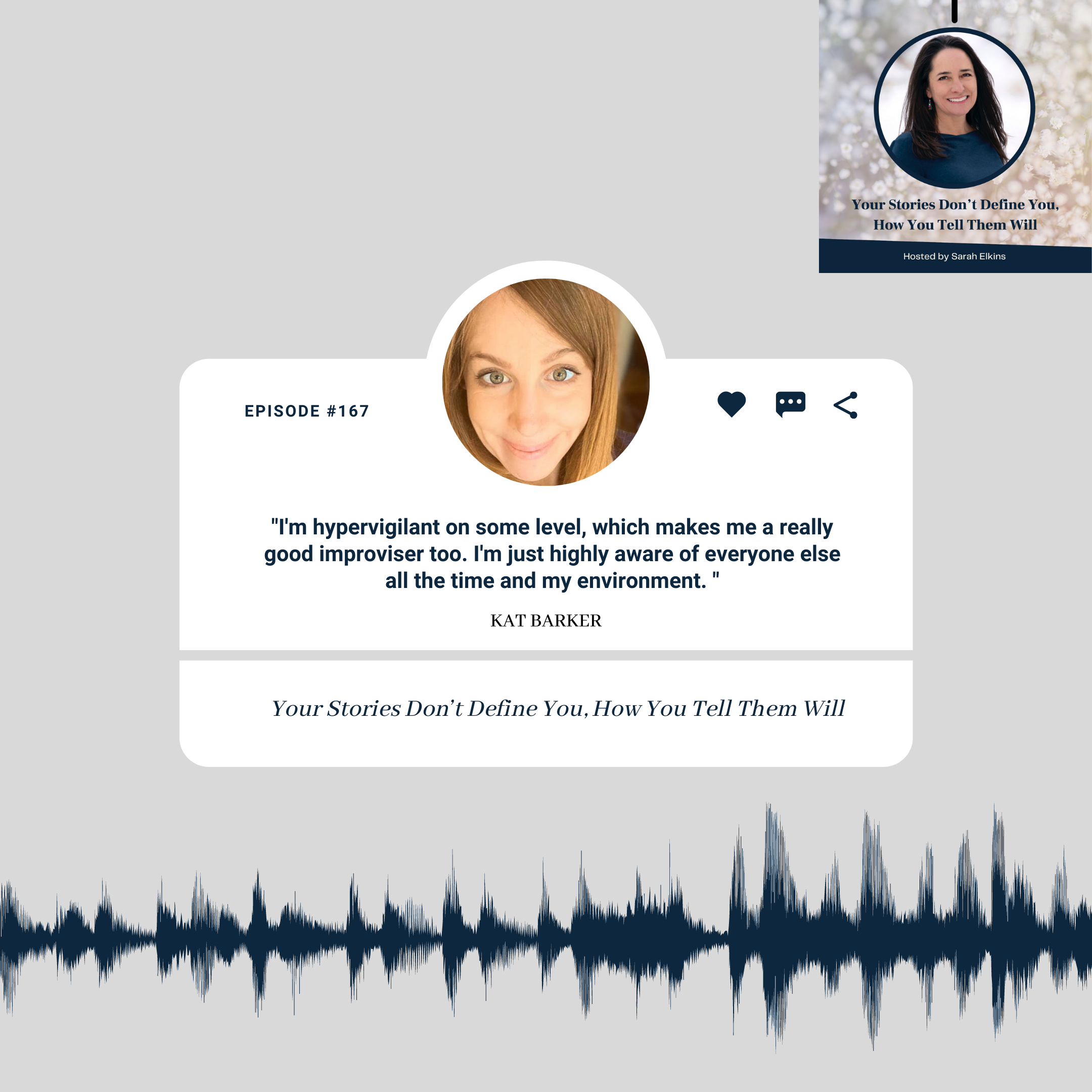
It was her exploration into her own healing that changed her path. As much as she loves the work of improvisation as a business tool and strategy, she found herself continually drawn toward not only the observation of humanity necessary to be great at improvisation, but the part of humanity that needs serious attention - our internal dialogs, the way we hold trauma and stress in our bodies and neural pathways, our thoughts about who we are and how we show up.
Her first foray into something that wasn't traditional therapy, but did lean in that direction, was cranialsacral therapy. It appealed to the comedian part of her, which might seem strange. It's a process of using light touch and attention to address trauma and unexpressed emotion caught in the body, to stabilize the central nervous system. It's what people call "energy work." Her first story in the episode explains why humor plays a big role in her work.
If you loved this episode, please give it 5 stars and maybe write a review? And be sure to get in touch with Kat to learn more about her, visiting her website: Sheholdsthelight.com
Here are references for topics from our conversation:
Somatic Therapy: https://www.goodtherapy.org/learn-about-therapy/types/somatic-psychotherapy
Akashic Records: https://www.edgarcayce.org/the-readings/akashic-records/

Sarah walking on Mt. Helena, Helena, Montana, Fall 2020
ABOUT SARAH:
In my work with coaching clients, I guide people to improve their communication using storytelling as the foundation of our work together. What I’ve realized over years of coaching and podcasting is that the majority of people don’t realize the impact of the stories they share - on their internal messages, and on the people they’re sharing them with.
My work with leaders and people who aspire to be leaders follows a similar path to the interviews on my podcast, uncovering pivotal moments in their lives and learning how to share them to connect more authentically with others, to make their presentations and speaking more engaging, to reveal patterns that have kept them stuck or moved them forward, and to improve their relationships at work and at home.
The audiobook, Your Stories Don’t Define You, How You Tell Them Will is now available!
Included with your purchase are two bonus tracks, songs recorded by Sarah's band, Spare Change, in her living room in Montana.
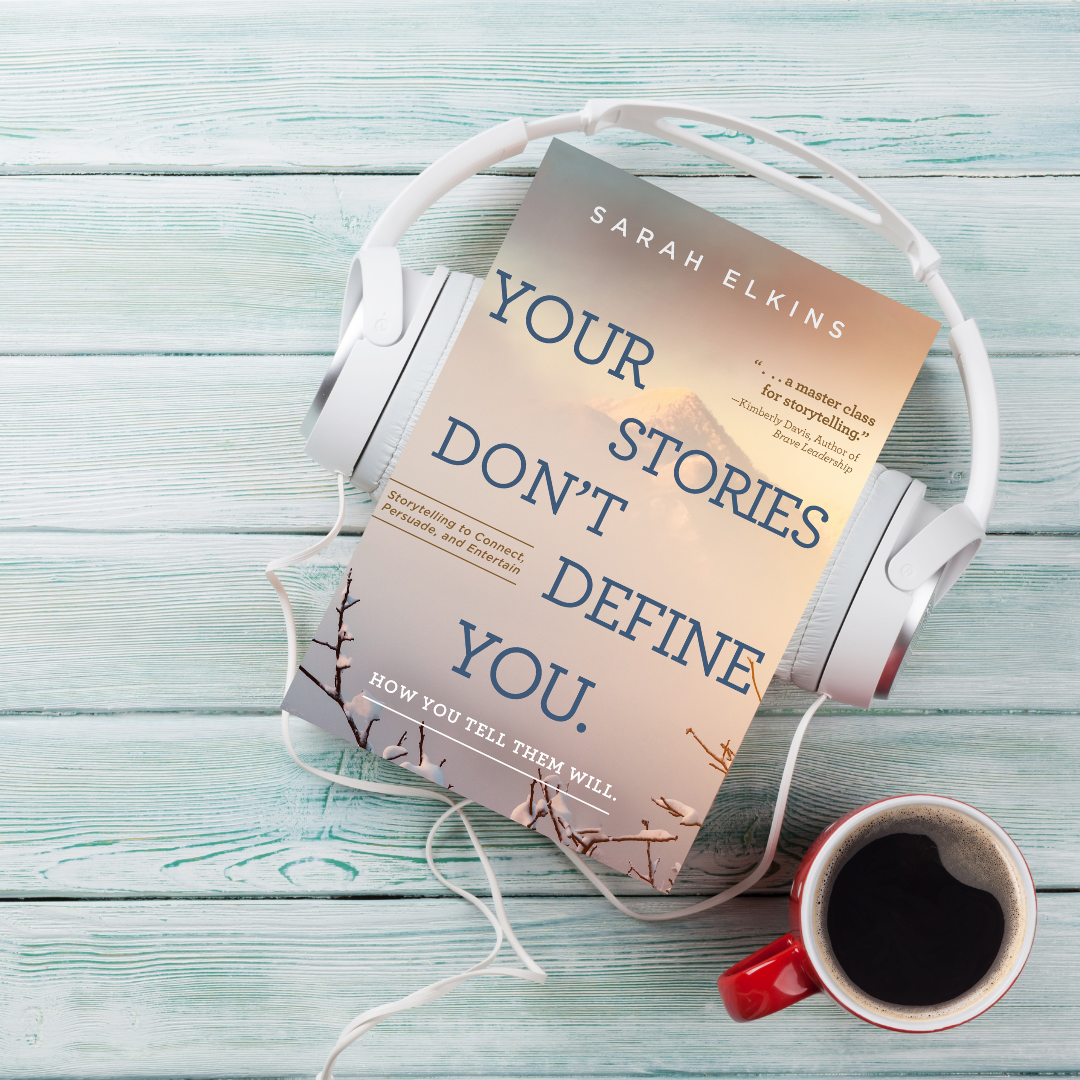
Audiobook cover art
Episode 166: Compare and Contrast Doesn't Always Mean Compete
How many times have you listened to a story and wanted to jump in, interrupt, to share a story of your own? Is it because you think your story is better, more meaningful or entertaining? Is it because you want to connect with the person and you know finding something in common is a good way to do that?
When I read a recent article by my friend Tom Dietzler, and he posed those questions in the context of a story he listened to, I was intrigued and reached out to ask him to chat about that on a podcast episode.
Your Story Matters, But Not More Than Someone Else's
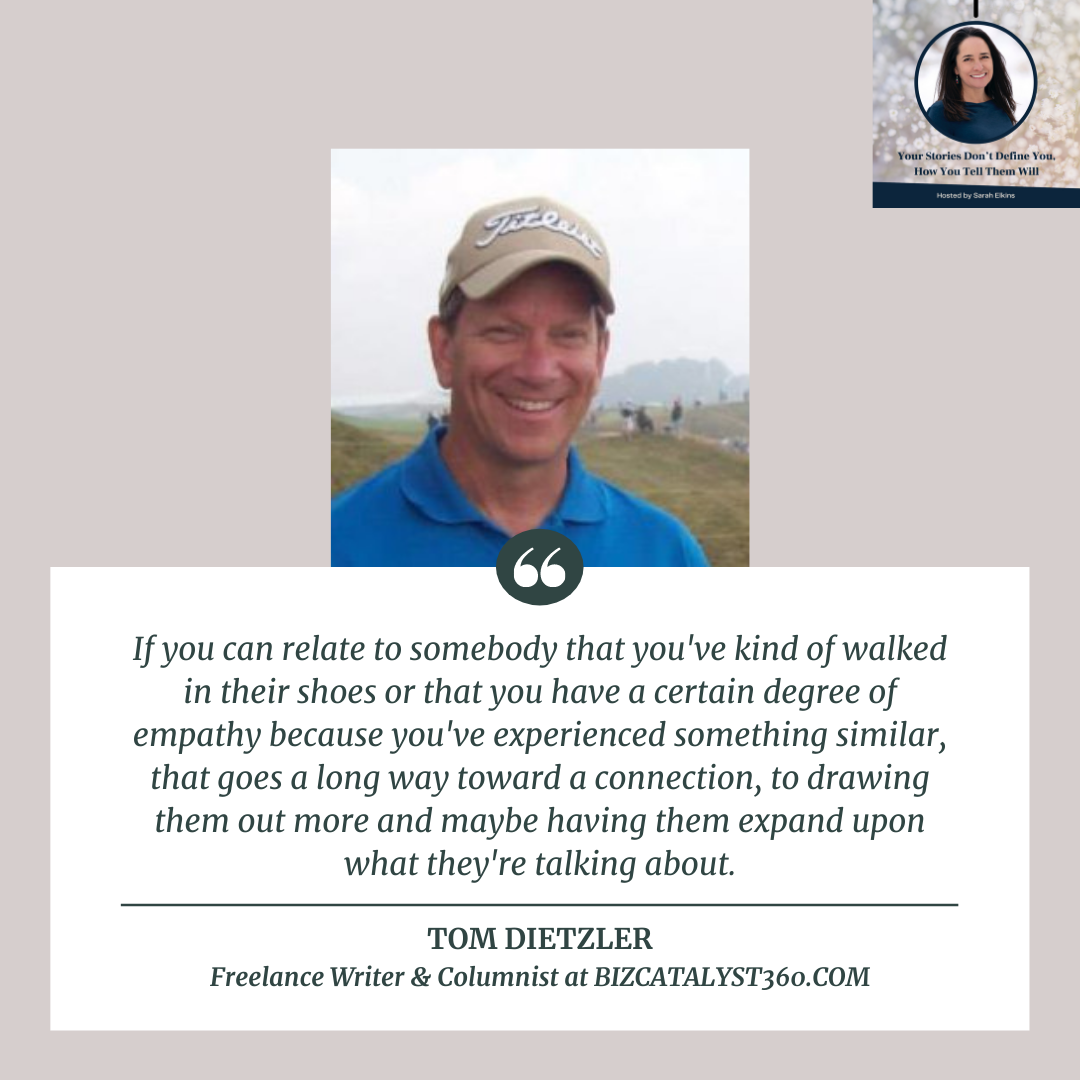
Tom Dietzler quote and image.
How many times have you listened to a story and wanted to jump in, interrupt, to share a story of your own? Is it because you think your story is better, more meaningful or entertaining? Is it because you want to connect with the person and you know finding something in common is a good way to do that?
When I read a recent article by my friend Tom Dietzler, and he posed those questions in the context of a story he listened to, I was intrigued and reached out to ask him to chat about that on a podcast episode.
ON FIRES, HISTORY, AND JUST LISTENING … told the story about Tom's deep dive into a 4 part series hosted by Lindsay Graham (not the Senator) on the The Great Chicago Fire of 1871.
As he listened to the details of the beginning of the fire, and even into the second part of the series, Tom desperately wanted to interject, to remind the narrator that there was another fire with even more fatalities and larger footprint at the same time, just 250 miles north of Chicago, in Peshtigo, Wisconsin.
It took him a while to even realize he was doing this, but when he did, he had to take a step back to figure out why. And that's the reason I wanted to chat with him.
When we listen to a story, it's easy for our own similar or related stories to pop into our heads. But what do we miss when we are too busy thinking of what we'll say next to contribute to the conversation?
---
Tom Dietzler is a contributing writer for the award winning platform BizCatalyst 360. Connect with him on LinkedIn to receive notifications of his new posts!
---

Sarah & her dog, Toblerone on Mt. Helena, Helena, Montana
ABOUT SARAH:
In my work with coaching clients, I guide people to improve their communication using storytelling as the foundation of our work together. What I’ve realized over years of coaching and podcasting is that the majority of people don’t realize the impact of the stories they share - on their internal messages, and on the people they’re sharing them with.

My work with leaders and people who aspire to be leaders follows a similar path to the interviews on my podcast, uncovering pivotal moments in their lives and learning how to share them to connect more authentically with others, to make their presentations and speaking more engaging, to reveal patterns that have kept them stuck or moved them forward, and to improve their relationships at work and at home.
The audiobook, Your Stories Don’t Define You, How You Tell Them Will is now available!
Included with your purchase are two bonus tracks, songs recorded by Sarah's band, Spare Change, in her living room in Montana.
Episode 165: Don't Fight the Current. Embrace it. Use it to Propel You Forward
Analogies are a powerful way to shift a mindset, taking all the emotion and knowledge of something familiar, and applying it to something completely different.
In our conversation, Joe demonstrated the analogy of taking small steps in business, testing them, and shifting them when necessary to adjust to external forces, and compared that to how a whitewater canoe athlete can roll with the force of the current, testing different positions of the paddle, their body weight, and the position of their legs. Each small adjustment, taken with thought and intention, can make the difference between fighting the current and embracing its power.
Whitewater Canoeing Makes For Ideal Life & Business Analogies
I spend a lot of time on rivers here in Montana, and never thought of that time and all the lessons I've learned in my experiences as analogies for business and life until I read Sarah Johnston's interview with Joe Jacobi.
Analogies are a powerful way to shift a mindset, taking all the emotion and knowledge of something familiar, and applying it to something completely different.
In our conversation, Joe demonstrated the analogy of taking small steps in business, testing them, and shifting them when necessary to adjust to external forces, and compared that to how a whitewater canoe athlete can roll with the force of the current, testing different positions of the paddle, their body weight, and the position of their legs. Each small adjustment, taken with thought and intention, can make the difference between fighting the current and embracing its power.
You don't have to be someone who spends a lot of time on, in, or near rivers to understand this analogy and apply it to whatever problem you're trying to solve.
The highlight of this conversation for me was when Joe described how being mindful makes the difference between getting frustrated and fearful as the river takes control of the boat, and the thoughtful, intentional, subtle movements he makes to get "unstuck" from whatever obstacle he was facing.
As I make my way as a self-employed professional, building my business, trying out small ideas and shifts in my services and focus, I'll continue to consider this analogy, not fighting the current, but embracing its power to propel me forward.
Episode 164: Why I Added #Pronouns to My LinkedIn Profile Name
I added the pronouns (she, her) to my profile name on LinkedIn a couple of weeks ago, and left a comment on a friend's post shortly afterward.
That was the first time my name came up with the pronouns, and someone I love promptly responded with "lose the pronouns" in his response to my comment.
I was annoyed, why would he care what my title says? It felt insulting, critical, like a condescending comment you'd expect from your older brother when you were teenagers. I was being judged.
A Story of Being Intentional About Signals

Quote from podcast episode 164
I added the pronouns (she, her) to my profile name on LinkedIn a couple of weeks ago, and left a comment on a friend's post shortly afterward.
That was the first time my name came up with the pronouns, and someone I love promptly responded with "lose the pronouns" in his response to my comment.
I was annoyed, why would he care what my title says? It felt insulting, critical, like a condescending comment you'd expect from your older brother when you were teenagers. I was being judged.
Sometimes those things that trigger us are important cues for room for self-reflection and personal growth, right? This was one of those triggers.
Now I have nothing but appreciation for that snide remark.
Mt Helena, Helena, Montana February 2021
As I took my walk on the mountain behind my house later that day, I thought more about his comment. It was really bothering me and I couldn’t pinpoint why I was feeling triggered and defensive.
Then it dawned on me, it was the same feeling I had as a teenager and young adult when my brother or sister would give me a hard time about something I said or did. It was the feeling of self-consciousness about not actually thinking through what I said or did, though they could have presented it more gently, there was merit to the criticism. That never feels good.
In this case, I was feeling self-conscious because I hadn't truly considered why I added the pronouns. So there was some merit to my friend’s critical comment. I realized how important it was for me to have clarity around the action of adding pronouns. Otherwise, it’s meaningless. My friends and connections know how much the word intention fills my world… I had done something without fully considering the intention behind it.
The evening before I added pronouns I participated in a webinar "The 5 Languages of Appreciation at Work" hosted by my dear friend Amy Ashworth (who nailed it, by the way.)
In the beginning of the webinar, one participant said that in other small, interactive webinars he attended, guests introduced themselves and added their pronouns to their name. That made sense to me, so I changed my name in Zoom to include my pronouns. I added them in LinkedIn at the same time, to be consistent.
The lightbulb went on in my brain as my heart rate went up, climbing a steep part of the mountain. (That's generally where I find my most meaningful ideas and inspirations.)
I had a vivid memory from just over five years ago: I was looking through my LinkedIn connections and realized the majority of them looked like me. Then I took a hard look at my connections on Facebook and locally, right here in my close community. Again, I was struck by the homogeny of what I was seeing.
Startled and disappointed, I began the work of intentionally broadening my network across political, ethnic, religious, gender identity, sexual preference, and all other communities that have significantly different life experiences from mine. Through a combination of curiosity and intention, I started to build a community that was far more diverse, not for the sake of diversity, but for the sake of inclusion, personal growth, and yes, love. I love people, even the ones I don’t like very much. And when I became aware of my limited circle of friends and acquaintances, I felt like a fraud. It seemed hypocritical for me to share my thoughts about love, justice, community, and communication, given my limited exposure to people who think and look and have experiences that are significantly different from mine.
In these past 5 years, my world has expanded and my feelings of connection have deepened. It hasn't always been easy, especially given the polarization of communities over the past 4 years. I've had to listen carefully, consider how my world view and experiences have created my biases and filters, and have experienced gentle and not-so-gentle correction for stepping in it with people I care deeply about.
Our micro-aggressions run deep, that's why they can be so hard for us to see, and why it hurts when someone points it out.
I’ve continued to practice my own gentle corrections when I’ve experienced bias, whether as a woman, a Jew, a mother, an American, and one time – as a Jewish woman living in Montana.
(My go-to demonstration of a micro-aggression is when a bartender said to me a few years ago: "You look really good for 40!" after asking to see my ID. I gently corrected him. "No need to qualify that compliment. Just tell me I look good.")
So why did I suddenly add pronouns?
I hadn't added pronouns before because I have a feminine name, and believe it's obvious that I identify as a woman. It didn’t seem necessary.
When our older son was the only Jewish kid in his class in kindergarten, and the teacher offered to let him put a birds nest on the top of his Christmas Tree calendar instead of a star. That way he could call it a Winter Tree instead.

When I added pronouns it wasn't for me. It isn't about me.
It’s about normalizing something for those who feel marginalized by having to point it out.
That was it. My "ah ha" moment on the mountain.
Adding pronouns was a simple and effective indication to my network that my world is broadening. Because what we share about ourselves, images, words, stories, and yes, pronouns, are all signals for the people around us.
I’m indicating that my love and care for people isn't despite their differences, but because of them.
Our differences aren't something to be tolerated, they're something to explore, to value, and to celebrate.

Sarah and chocolate lab, Toby, snow, Mt Helena, Helena, Montana
ABOUT SARAH:
In my work with coaching clients, I guide people to improve their communication using storytelling as the foundation of our work together. What I’ve realized over years of coaching and podcasting is that the majority of people don’t realize the impact of the stories they share - on their internal messages, and on the people they’re sharing them with.
My work with leaders and people who aspire to be leaders follows a similar path to the interviews on my podcast, uncovering pivotal moments in their lives and learning how to share them to connect more authentically with others, to make their presentations and speaking more engaging, to reveal patterns that have kept them stuck or moved them forward, and to improve their relationships at work and at home.
The audiobook, Your Stories Don’t Define You, How You Tell Them Will is now available!
Included with your purchase are two bonus tracks, songs recorded by Sarah's band, Spare Change, in her living room in Montana.