Your Stories Don’t Define You
How You Tell Them Will
A podcast to unlock your stories and uncover meaningful insights.
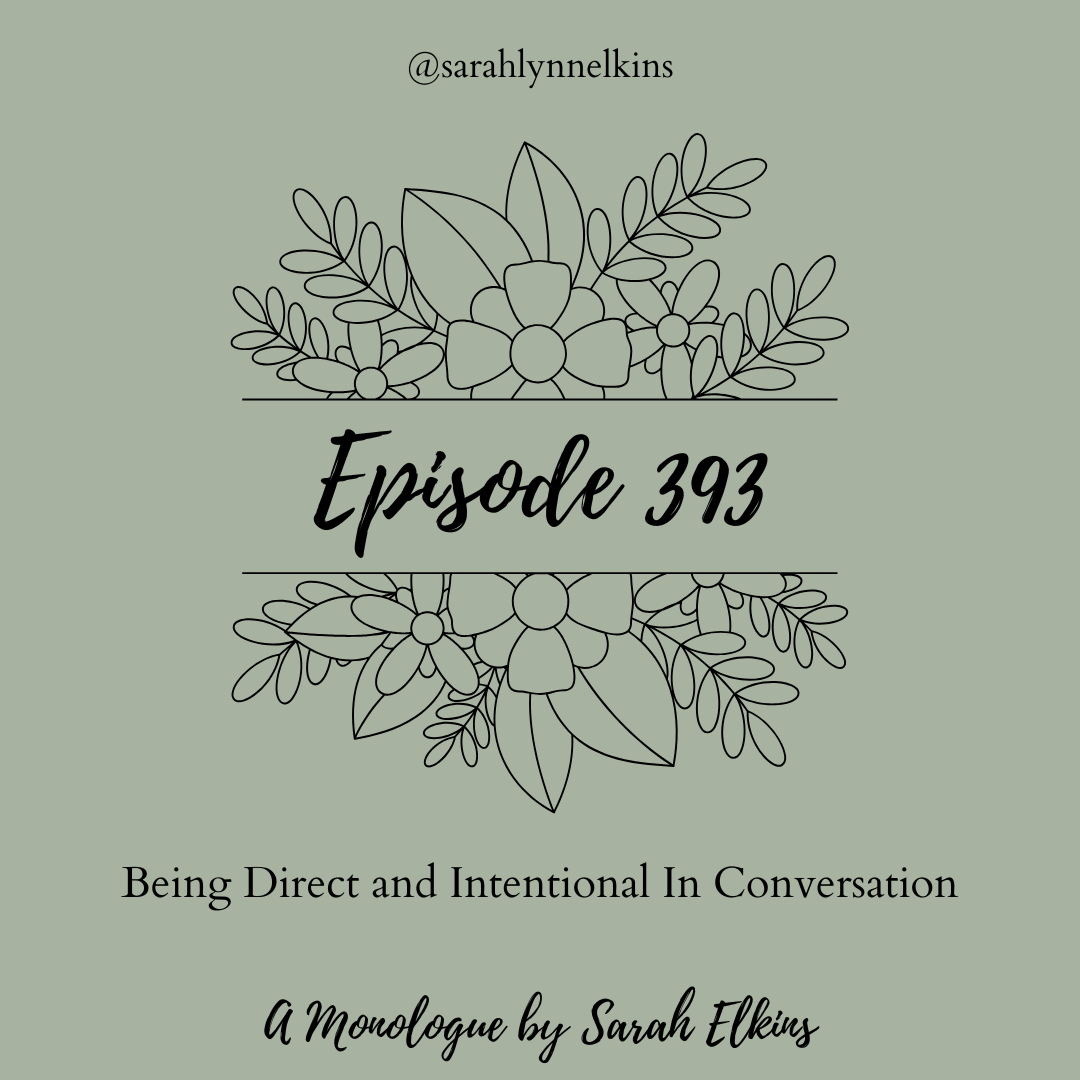
393 Being Direct and Intentional in Conversations
It can be far too easy to let yourself be passive in conversations, whether it be to let another person make a decision or to avoid conflict. However in doing so we rob ourselves and others of deep meaningful connection, which is why it is so important to be direct and intentional with your words.
In today’s episode Sarah Elkins talks about these points while also bringing up times in her life where she was passive and direct in conversation, and why it is so important to her to be direct and intentional.
393 Being Direct and Intentional in Conversations
It can be far too easy to let yourself be passive in conversations, whether it be to let another person make a decision or to avoid conflict. However in doing so we rob ourselves and others of deep meaningful connection, which is why it is so important to be direct and intentional with your words.
In today’s episode Sarah Elkins talks about these points while also bringing up times in her life where she was passive and direct in conversation, and why it is so important to her to be direct and intentional.
Highlights
Be direct and honest with your words, don’t leave room for doubt or miscommunication.
Don’t leave a conversation completely up to one person. Communication goes both ways.
Being intentional in conversation, as well as understanding and compassionate.
Quotes
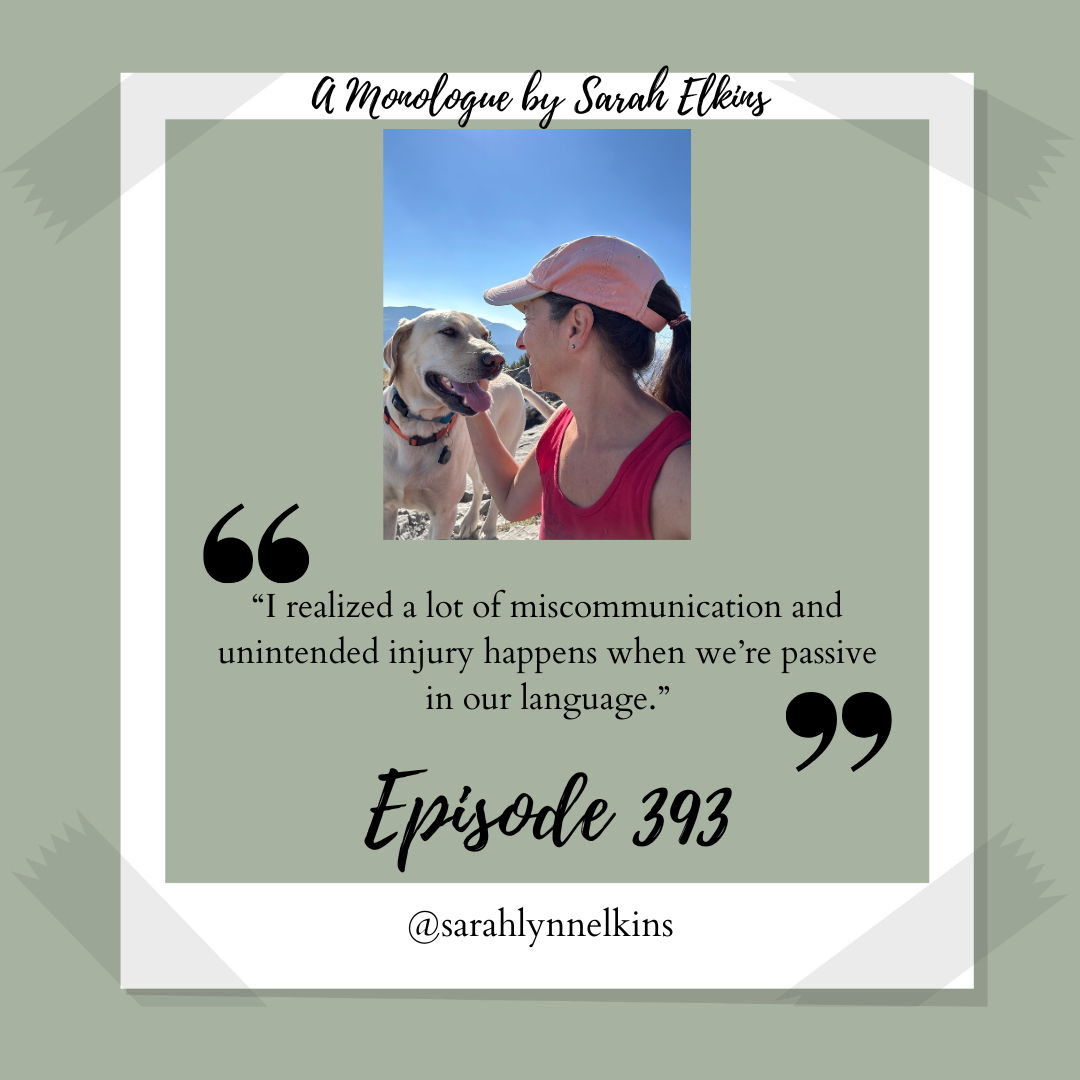
“I realized a lot of miscommunication and unintended injury happens when we’re passive in our language.”
“I also remembered a few people from my past who were especially difficult, insulting, and actually cruel in their communication with me. I thought about how I interacted with them – things I could have handled differently - for the purpose of learning, not regret, and thoughts about”
Dear Listeners it is now your turn,
I encourage you to listen to last week’s short episode and then try using a less passive voice in your communication. What will you do differently so you can move past injury and grow into better, safer, more satisfying relationships?
And, as always, thank you for listening.
About Sarah
"Uncovering the right stories for the right audiences so executives, leaders, public speakers, and job seekers can clearly and actively demonstrate their character, values, and vision."
In my work with coaching clients, I guide people to improve their communication using storytelling as the foundation of our work together. What I’ve realized over years of coaching and podcasting is that the majority of people don’t realize the impact of the stories they share - on their internal messages, and on the people they’re sharing them with.
My work with leaders and people who aspire to be leaders follows a similar path to the interviews on my podcast, uncovering pivotal moments in their lives and learning how to share them to connect more authentically with others, to make their presentations and speaking more engaging, to reveal patterns that have kept them stuck or moved them forward, and to improve their relationships at work and at home.
The audiobook, Your Stories Don’t Define You, How You Tell Them Will is now available!
Included with your purchase are two bonus tracks, songs recorded by Sarah's band, Spare Change, in her living room in Montana.
Be sure to check out the Storytelling For Professionals Course as well to make sure you nail that next interview!
392 Intention and Mindfulness In Conversation
Inevitably we will have to confront the reality of how certain comments, remarks, and individuals make us feel, especially when it is in a negative way. Unspoken expectations lead to resentment, and if we do not have the hard conversations and practice curiosity and active listening we not only do a disservice to them but to ourselves as well.
In this episode Sarah Elkins takes us on a hike with her dog Jocko, while teaching us the importance of mindfulness and intention in conversations, and how important it is we talk to and listen to people we want to maintain relationships with.
392 Intention and Mindfulness In Conversation

Inevitably we will have to confront the reality of how certain comments, remarks, and individuals make us feel, especially when it is in a negative way. Unspoken expectations lead to resentment, and if we do not have the hard conversations and practice curiosity and active listening we not only do a disservice to them but to ourselves as well.
In this episode Sarah Elkins takes us on a hike with her dog Jocko, while teaching us the importance of mindfulness and intention in conversations, and how important it is we talk to and listen to people we want to maintain relationships with.
Highlights
Sharing things we enjoy with others.
How do you approach conversations that involve or may lead to conflict?
Knowing when, where, and how to start the hard conversations. Be mindful of your audience.
Stay curious about someone’s intentions and remember to actively listen.
Quotes
“Passive versus more direct approaches in having conversations, particularly in times when we feel like there is going to be conflict or we’re addressing something that could create conflict.”
“Anyone who has ever been in a long term relationship knows that timing is everything.”
“It’s all about Practice.”
About Sarah

"Uncovering the right stories for the right audiences so executives, leaders, public speakers, and job seekers can clearly and actively demonstrate their character, values, and vision."
In my work with coaching clients, I guide people to improve their communication using storytelling as the foundation of our work together. What I’ve realized over years of coaching and podcasting is that the majority of people don’t realize the impact of the stories they share - on their internal messages, and on the people they’re sharing them with.
My work with leaders and people who aspire to be leaders follows a similar path to the interviews on my podcast, uncovering pivotal moments in their lives and learning how to share them to connect more authentically with others, to make their presentations and speaking more engaging, to reveal patterns that have kept them stuck or moved them forward, and to improve their relationships at work and at home.
The audiobook, Your Stories Don’t Define You, How You Tell Them Will is now available!
Included with your purchase are two bonus tracks, songs recorded by Sarah's band, Spare Change, in her living room in Montana.
Be sure to check out the Storytelling For Professionals Course as well to make sure you nail that next interview!
Episode 197: Stories of Those Things We Don't Talk About
How do we respond and connect with others when discussing difficult topics such as miscarriages?
Join Sarah Elkins and coach, writer, and speaker, Sandra Winterbach, as they delve into a human response to infertility and the related reactions and interactions with the people in our lives.
Sandra shares her experience with learning about who she is and the importance of self-reflection for her health, and the way self-reflection contributes to gratification in her life.
Communication Starts with Me
*Note from Sarah: We're just a few weeks away from publishing our 200th episode! If you're a fan of the podcast, we'd love to hear from you and include your words in the beginning of that episode. Simply email your thoughts to sarahelkins@elkinsconsulting.com, or record a short voice memo on your phone and email it to me. Thank you in advance for helping us celebrate this milestone!*

How do we respond and connect with others when discussing difficult topics such as miscarriages?
Join Sarah Elkins and coach, writer, and speaker, Sandra Winterbach, as they delve into a human response to infertility and the related reactions and interactions with the people in our lives.
Sandra shares her experience with learning about who she is and the importance of self-reflection for her health, and the way self-reflection contributes to gratification in her life.

Image of Sandra Winterbach with quote for podcast cover art
“I’m doing my work right now, mostly for myself...to find my way through this and to realize how my own health is intricately related to what I can do for myself.”
*Show notes contributed by Tracy Ackeret
ABOUT SARAH:
"Uncovering the right stories for the right audiences so executives, leaders, public speakers, and job seekers can clearly and actively demonstrate their character, values, and vision."
In my work with coaching clients, I guide people to improve their communication using storytelling as the foundation of our work together. What I’ve realized over years of coaching and podcasting is that the majority of people don’t realize the impact of the stories they share - on their internal messages, and on the people they’re sharing them with.
My work with leaders and people who aspire to be leaders follows a similar path to the interviews on my podcast, uncovering pivotal moments in their lives and learning how to share them to connect more authentically with others, to make their presentations and speaking more engaging, to reveal patterns that have kept them stuck or moved them forward, and to improve their relationships at work and at home.
The audiobook, Your Stories Don’t Define You, How You Tell Them Will is now available!
Included with your purchase are two bonus tracks, songs recorded by Sarah's band, Spare Change, in her living room in Montana.
Episode 169: Do You Have a Diverse Personal Board of Directors?
Humans are biased. We're designed to identify people who are different from us, people we have things in common with, and people who pose a threat to our safety - emotional & physical.
It's easier for our brain to make a decision about a person when we allow our bias to control it. But how many times have you misjudged someone you met, for better or for worse? When we rely on our bias to make decisions about a person's potential as a friend, foe, or neutral, we seriously limit the potential of the relationship.
Personal Growth is Dependent on Your Direct Circle of Influence
Adrienne Kimball and Karen Cohen met when Karen was interviewing for a job where Adrienne worked. At first glance, Adrienne assumed the two would have little in common, but midway through the conversation, her opinion shifted.

Adrienne Kimball podcast cover art
Humans are biased. We're designed to identify people who are different from us, people we have things in common with, and people who pose a threat to our safety - emotional & physical.
It's easier for our brain to make a decision about a person when we allow our bias to control it. But how many times have you misjudged someone you met, for better or for worse? When we rely on our bias to make decisions about a person's potential as a friend, foe, or neutral, we seriously limit the potential of the relationship.
In this episode, Adrienne and Karen talk about what it's like to work together, a black woman and a white woman, and the expectations they have for each other and their relationship.
You might be surprised that this is even a thing, that people are talking about something that should be so basic, so common, so - not something we need to talk about. But you're wrong. We have to have these conversations in order to grow, and to address the issues of our time: racism, white supremacy, hate.
What I love about this conversation and these two women is their commitment to having a solid relationship based on respect and love. They offer gentle corrections when needed simply because the health of their relationship depends on it.
Our conversation describes why it's critical for personal and professional growth - and for our community health - to look closely and honestly at our networks, at our closest relationships. Are they diverse? Are there people who think differently from you? Are there people who come from completely different backgrounds, different socio-economic and educational upbringing? Do they look significantly different from you and your family, maybe even speak a different native language?
Take a hard look, friends, be real about this. And then take the slow road toward diversifying your network and circle of friends. Ask people you trust about others you should follow and connect with.
There are plenty of resources out there to find the voices of BIPOC (black, Indigenous and people of color) and of LGBTQ professionals, writers, and artists. Find people whose messages resonate with you and simply following them on your favorite platforms to learn more.
Open your eyes and heart to a world of possibilities, build a diverse personal board of directors.
---
Adrienne Kimball is the Chief Talent Officer at Rubicon Programs in northern California. She's a keynotes speaker, culture champion, equity evangelist and mentor.
Karen Elkins Cohen is the Director of Human Resources at Rubicon Programs.
These two women are fantastic facilitators of discussions on the topics of diversity, inclusion, equity, and building a culture of equity and inclusion. They hosted a session at the No Longer Virtual Summit in Atlanta in 2019 that was engaging and thought-provoking, a session people continue to talk about, two years later.
---
ABOUT SARAH:
"Uncovering the right stories for the right audiences so executives, leaders, public speakers, and job seekers can clearly and actively demonstrate their character, values, and vision."
In my work with coaching clients, I guide people to improve their communication using storytelling as the foundation of our work together. What I’ve realized over years of coaching and podcasting is that the majority of people don’t realize the impact of the stories they share - on their internal messages, and on the people they’re sharing them with.
My work with leaders and people who aspire to be leaders follows a similar path to the interviews on my podcast, uncovering pivotal moments in their lives and learning how to share them to connect more authentically with others, to make their presentations and speaking more engaging, to reveal patterns that have kept them stuck or moved them forward, and to improve their relationships at work and at home.
The audiobook, Your Stories Don’t Define You, How You Tell Them Will is now available!
Included with your purchase are two bonus tracks, songs recorded by Sarah's band, Spare Change, in her living room in Montana.
Episode 160: When You Feel Honored to Do the Work You Do
This woman is absolutely compelled to improve life for people she encounters. She sees the best in people, and has a beautiful way of bringing out the most endearing qualities. At the same time, she doesn't hesitate to let them know when they're getting in their own way.
Her number one talent in the StrengthsFinder assessment is Includer, which means that she is compelled to include others, and to be included herself. Sarah is the kind of woman who walks into a roomful of people and has a sixth sense in finding the most uncomfortable person, knowing exactly what to say to make them more comfortable, and nurturing that comfort to the point of that person actually enjoying themselves.
Life Just Makes More Sense When Your Work Lights You Up

Image of Sarah Johnston for podcast cover art.
Have you ever interviewed or been interviewed by someone with your name? Boy can that feel strange and awkward.
This conversation with Sarah Johnston was anything but awkward. She dropped some insights here that kept my brain in gear and spinning for days afterward.
This woman is absolutely compelled to improve life for people she encounters. She sees the best in people, and has a beautiful way of bringing out the most endearing qualities. At the same time, she doesn't hesitate to let them know when they're getting in their own way.
Her number one talent in the StrengthsFinder assessment is Includer, which means that she is compelled to include others, and to be included herself. Sarah is the kind of woman who walks into a roomful of people and has a sixth sense in finding the most uncomfortable person, knowing exactly what to say to make them more comfortable, and nurturing that comfort to the point of that person actually enjoying themselves.
When Sarah works with a client, she listens with an intensity to hear what is not being said. Her story about the medical student who had given up on applying for a residency, and instead decided to focus on applying to be a medical technician or physician's assistant provides a crystal clear image of what she hears and how she compassionately presents her thoughts to others.
Sarah's work most definitely has huge impact on individual job seekers, but the true gift in her work is the ripple effect it has. For a person who has been out of work or under employed for a significant length of time, simply getting an interview can create a positive shift in mindset. Getting a job means a huge impact on that person's family and friends, and can shift the lives of others through the decisions to pay it forward.
The way that Sarah transitioned between jobs, and then into her own business is inspiring.
*Correction at approximately 20 minutes, I referred to Heather Younger's book, The Art of Caring Leadership, which will be released in Spring, 2021, but her first book is, The 7 Intuitive Laws of Employee Loyalty, and was published in 2017. Listen to her podcast here.
Episode 154: What Can We Say, What Questions Can We Ask to Help Us Understand Each Other?
Desiree Adaway is no stranger to being the only black person in a room, or even in an entire community.
At 16, while skipping class, she saw an ad in the back of a magazine about exchange student programs and applied, signing her mother’s name on the application, the passport application, and all other necessary documents.
Stories of Racism, and the Importance of Acknowledging Each Other’s Experiences
Desiree Adaway is no stranger to being the only black person in a room, or even in an entire community.

At 16, while skipping class, she saw an ad in the back of a magazine about exchange student programs and applied, signing her mother’s name on the application, the passport application, and all other necessary documents.
She was accepted into the program, but had to decline the invitation because she knew her mother couldn’t afford it. The program administrator found a sponsor, and Desiree started packing - before ever talking to her mother.
Desiree didn’t want to go to Germany. She felt a deep need to go, like she would suffocate if she didn’t go.
Arriving in Germany, she was placed with a host family in a tiny town where she was the only person with dark brown skin within more than a 500 mile radius. Her peers touched her skin and hair, stared at her, she felt like an animal at the zoo. And that was only the beginning.
Throughout school and career, she had many of these experiences, including being the only black person at board meetings, management team events. She lost track of the number of times strangers have reached out without hesitation, much less asking to touch her hair, her skin, one woman at a market hugged her as if she had no ownership of her own body. People have had an outrageous sense of entitlement to touch her. This may not seem like a big deal, but when you put this entitlement into the context of the history of the enslavement of dark skinned people, you might begin to understand.
This part of her story particularly resonated with me because of my experiences as a pregnant woman. Strangers would randomly reach out to touch my belly - and I know this is a common experience during pregnancy. It’s absurd.
Our conversation here is rich with experiences, stories to open eyes to the many different ways racism is experienced in a variety of environments.
The highlight for me was when I asked Desiree about a positive experience when a white person acknowledged racism, acknowledged the beauty of diversity as opposed to pretending to be “color blind.”
She said that her business partner, early in their relationship, pulled her aside and said these words:
One day my whiteness will betray me and I’m going to make a mistake. What will we do to move through that?
The extraordinary thing about how Desiree told me this is that she turned it around and applied that sentiment to herself. She acknowledged that at some point she will fall into that trap as well, potentially with gender identity issues and other parts of humanity that she’s unfamiliar.
If we want to address inequity and racism, we must acknowledge it as it exists for those who experience it.
If you’re ready to take action as a human, you don’t have to make huge gestures. You must notice when micro-aggressions happen, and if you miss it and someone points it out to you, do not dismiss the concern. Ask about it, find out why it’s so insulting, demeaning, why the action or words are symbols of racism and bigotry.
—-
Desiree Adaway is a consultant, trainer, coach and speaker building resilient, equitable, and inclusive organizations. She holds a vision for people’s lives, workplaces and communities until they can hold it for themselves. Learn more by visiting her website, connect with her on LinkedIn, and be sure to follow her on your favorite social media platforms: Twitter, Instagram, and Facebook.
Episode 153: Humans are Complicated! Stories of Life, Discovery, and Ambition
"People's lives are largely a product of the decisions they make."
The theme throughout this conversation is self-reflection. When we understand ourselves, and can reflect on how we're showing up to the people and environment around us, we can make decisions in alignment with our ideals, our ideal vision of who we want to be and how we want to be.
When You Are Driven to Know More, You Make it Happen
Curiosity. Intelligence. Compassion. Ambition.

These are the words that popped into my head the first time I met Kristin Sherry. We spoke about how she started with the development of her hugely successful YouMap book and program, and I knew I was in the company of someone incredibly thoughtful, who was inspired to truly guide people to find their best fit in life and career.
"People's lives are largely a product of the decisions they make."
The theme throughout this conversation is self-reflection. When we understand ourselves, and can reflect on how we're showing up to the people and environment around us, we can make decisions in alignment with our ideals, our ideal vision of who we want to be and how we want to be.
We spoke about assessment tools like CliftonStrengths (StrengthsFinder), DiSC, Enneagram, and Kristin's tool, YouMap, and how the results can help us identify the most natural, instinctive ways our brains work. Which, surprisingly enough, is complicated.
There isn't one all-inclusive, perfect tool to describe who we are, how we think, what motivates us, and what choices we make every day. Not only are we complicated beings with far too many neural connections made in our incredible brains, add to that complexity the fact that we are constantly changing, adjusting our views through experiences and stimulants.
I love the way Kristin thinks about these things, the way she sees people in a multi-dimensional way, not flat, and she uses her vision to guide people to make choices that will eventually bring them to their best environments and roles so they can contribute beauty and competence to their communities, no matter where they sit.
---

Learn more about Kristin by visiting her website, order her recently published children's book, You've Got Gifts! and be sure to preorder her new self-development book, Maximize 365: A year of actionable tips to transform your life.
---
About Sarah:
In my work with coaching clients, I guide people to improve their communication using storytelling as the foundation of our work together. What I’ve realized over years of coaching and podcasting is that the majority of people don’t realize the impact of the stories they share - on their internal messages, and on the people they’re sharing them with.
My work with leaders and people who aspire to be leaders follows a similar path to the interviews on my podcast, uncovering pivotal moments in their lives and learning how to share them to connect more authentically with others, to make their presentations and speaking more engaging, to reveal patterns that have kept them stuck or moved them forward, and to improve their relationships at work and at home.
The audiobook, Your Stories Don’t Define You, How You Tell Them Will is now available!
Included with your purchase are two bonus tracks, songs recorded by Sarah's band, Spare Change, in her living room in Montana.